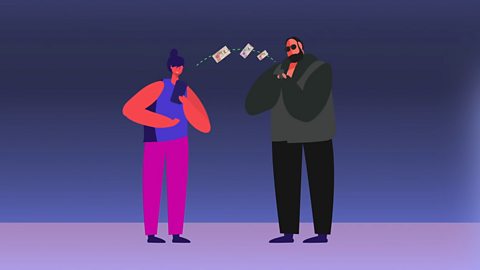
EMMA-LOUISE: If you saw someone take something from a shop without paying, would you call that theft?
What if you saw someone streaming a film without paying? They’re not actually taking anything, they're just watching a film, so you might argue that's alright.
But if someone copied your homework without permission, you’d probably be annoyed. It's your work, it belongs to you so that's only fair, right?
Theft is about more than what you can see in a shop. The phrase ‘intellectual property’, or IP, refers to the non-physical property that people have created, so music, or writing, or films. And while the internet enables creators access to a global audience, it also makes it easier for their work to get ripped off.
I’ve invited Sanah Ahsan to talk to me about these issues because she faces these concerns in her work every day.
So Sanah, what kind of work do you do?
SANAH: I'm a psychologist and I work in activism. I'm a reporter and a spoken word poet.
EMMA-LOUISE: Wow. So, with your spoken word stuff, does that cause any issues?
SANAH: Yeah. I think when you're sharing anything personal or creative material online, it's important to consider the ways that it makes you vulnerable. And the idea of someone taking something so emotionally bound up in my life and passing it off as their own, is quite heart-breaking really.
EMMA-LOUISE: But ideally, don't you want people to share your work? Why do you feel the need to protect it online?
SANAH: I definitely do want people to share my work. I think social media offers a platform that's amazing to reach lots of people. But because of that potential of people lifting that material, it's really important that I take certain actions to keep it safe. It's really important that people understand that creativity and creative expression can be a way of earning a living and be a full time career for people, where that might be their only source of income. And actually, taking their creative property, their intellectual property and passing it off as your own is actually detracting from that person's wellbeing, their career, something that may be a really key source of support for them. That's really important for us all to have an awareness of and think about for each other.
EMMA-LOUISE: It can be difficult though can't it, for people to know what they can and can't share.
SANAH: Yeah, it can be really difficult. With current social media culture, you can witness lots of people sharing and recycling each other's work, and you might think that that's okay if you're seeing other people do that, but it's really important to have an awareness that that isn't okay and you're potentially breaking intellectual property laws by doing that.
EMMA-LOUISE: And what about torrenting and streaming sites? Are these okay?
SANAH: No, they're not okay. There's a risk of downloading a virus but also, you're breaking the law, breaking intellectual property laws, which puts yourself and your parents at risk for having to pay massive fines, potentially.
EMMA-LOUISE: So, what steps do you take to protect your ideas and content from being stolen?
SANAH: I tend to share my poetry through the medium of video. So that's videos of me performing or videos of me reading poetry that I've filmed and that way, it's associated to my face and my voice.
EMMA-LOUISE: Do you have any advice for anyone else trying to protect their content online?
SANAH: Yeah, I mean, doing the same thing. If it's appropriate to share your work through the medium of video so it's associated to your face and voice, then doing that. But again, if you're sharing creative writing then just be mindful, can it be through an image that can't be lifted or copied and attaching any tags to it or names to it?
EMMA-LOUISE: That's really good advice. Thank you, Sanah.
Sharing other people's content online or referencing it in schoolwork is common and acceptable, as long as you give credit to the original creator. This is called 'fair use' or 'citation'. But, copying someone else's work and passing it off as your own is a type of theft, it's called 'plagiarism'.
You have to learn to give credit to the original creator to avoid real world consequences. If you need help, ask a teacher for advice.
You can also use CreativeCommons.org. They collect content that creators have explicitly allowed to be shared, and give you clear guidelines on how you're allowed to use it.
But the general rule is treat other people’s work with the same respect you’d like your work treated.
Do that, and you won’t go far wrong.
Video summary
Sanah Ahsan, a spoken word poet who frequently shares her work online, talks about the dos and don'ts of sharing content, as well as what is meant by intellectual property.
Legal issues around intellectual property are discussed alongside moral issues of copying other people’s work and safety issues involving the accidental downloading of viruses.
The top tips section at the end should provide useful take-away points for students.
Teacher Notes
Students could use this short film to compare the differences between physical theft and intellectual theft.
Students could watch the film and complete a piece of creative writing which takes the point of view of someone who has had their work ‘stolen’ from the internet by another person.
This allows students to understand the real-world consequences of plagiarism.
Students could identify the positives and negatives of sharing work online.
They could then debate the morality of downloading content from the internet such as movies, books or music with each half of the class taking a different side.
Students could also create a quiz based on the content in the film.
Links to new statutory RSE and HE curriculum (secondary)
Online and media: pupils should know their rights, responsibilities and opportunities online, including that the same expectations of behaviour apply in all contexts, including online.
Other subject areas
This short film could be used across other subject areas such as citizenship or business studies.
Through citizenship lessons a legal focus can be taken. Students could research intellectual property law, what it is and the consequences for breaking the law.
In business studies students can use the film as a stimulus for talking about the impact of copyright infringement on markets and businesses.
This series touches on elements of PSHE, citizenship and computing at GCSE in England, Wales and Northern Ireland and National 4 and 5 in Scotland.
More Digital Literacy / Online Security:
Fake News. video
This short film explores the phenomenon of fake news and outlines why it is important to be able to distinguish it from real news.
Live Streaming. video
This short film explores live streaming and provides some useful pointers for young people.
Pornography. video
This short film explores some real-life experiences around pornography.
Self Image and Mental Wellbeing. video
Using a real life story, this short film looks at the negative effects that social media can have on our mental wellbeing.
Sensitive Pictures. video
This short film uses a real life story to explore the legal and emotional consequences of sharing sensitive photos.
Online Gaming. video
Online gamer Pixlriffs talks about some potential dangers to look out for when gaming online, as well as the things you can do to protect yourself.
Trolling and Cyber-Bullying. video
This short film explores the consequences of online bullying, using a real life case study.
Digital Footprint. video
This short film demonstrates that what you post online can follow you in real life, via two real life cast studies.
Online Security. video
This short film offers advice on how to spot an online scam as well as tips on what you can do to protect yourself online.