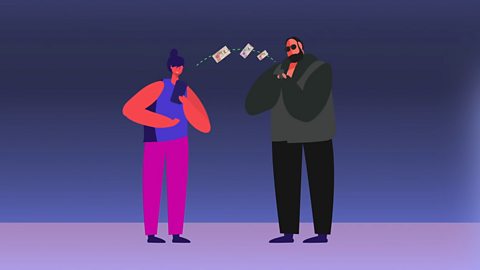
FRANKIE: Have you ever seen someone online doing something deliberately offensive or controversial? That’s called trolling.
Social media sites and apps are run by algorithms, kind of like computer programs. These algorithms treat posts with more comments as more popular. Trolls try to take advantage of this by posting things intended to cause outrage. When people comment the post gets promoted by the algorithm, then more people see it, more people engage, and it just gets more and more popular.
The best advice in this situation is ‘don’t feed the troll.’ In other words, even if you have something brilliant to say, best just to leave them alone.
And if you ever find yourself thinking about saying something mean to someone, you can probably follow the same advice: leave them alone.
Things can seem so impersonal on a messaging app or comment section and it can feel like no big deal to tease someone or leave a nasty comment. But even if you think no one cares, you can be sure someone is seeing your words.
Carney’s story is a real-world example of this. This is him, telling his story in his words.
CARNEY: In secondary school when I was 14, I started being bullied via online messaging platforms, a space where previously I felt safe and happy and could connect with my friends.
At first, I thought it wasn’t bullying, just silly messages I could ignore. Then I started to get them daily, messages that told me “I was nothing” and “nobody cared about me” and that “I should die because no one would know I was gone”.
Before I knew it, I stopped going online at all.
I was in my black pit. I felt I had no one, no one to open up to, no one who would understand. I felt alone.
I thought it was my fault, that something must be wrong with me. I felt I needed to fix this problem and I started doing things to hurt myself. I said to myself, if I do this then they will stop sending these messages. But it wasn’t making it stop. I felt embarrassed to talk to anyone, I didn’t want to go out, or to school, I just wanted to stay locked away.
Then one day I tried to end my life. I never thought I could do anything like that, but there I was doing it.
The next thing I remember was waking up and seeing my parents and my brothers around me, crying.
After coming out of hospital and getting back on my feet. I started seeing someone to talk about what had happened and how to make sure it didn’t happen again. This part of my life felt like learning how to walk again. I had to learn how to be a teenager, how to laugh and enjoy being alive.
I’m older now and over the years I have been able to do so many things I am proud of.
FRANKIE: The bullying stopped and Carney’s mental health improved. In fact, he is now a mental health advocate and app developer.
The most upsetting part about his story, though, is that it was actually his friends who were sending the messages. Somehow, they thought it was all a joke.
Now, Carney’s case may be extreme, but the mindset behind it is surprisingly common. A lot of the time, the perpetrators don’t see their actions as bullying. They think It’s just a bit of banter, or light-hearted fun. But if you’re not sure that everyone is having fun, it’s better to be safe than sorry. My advice is don’t post or message anything that you wouldn't be happy to say in person.
And if you or a friend are ever being bullied, it’s a good idea to speak to an adult you trust. Almost all social media and messaging apps allow you to report harassment so you should do that too. It’s also fine to take a break from your digital life anytime you want. And if you need support, you can reach out to one of the many resources available to help. We’ve included some links below.
Never suffer alone. Remember, a problem shared is a problem halved.
Video summary
This short film explores the consequences of online bullying, using a real life case study.
It identifies the role that algorithms have to play in creating the content that you see online.
The focal point of the film is the true story of Carney, who suffered with his mental health as a result of online bullying.
The story highlights the real-life impact that online words can have and the importance of getting help and talking to people.
The top tips section at the end should provide useful take-away points for students.
Due to the sensitive nature of the subject matter, we strongly advise teacher viewing before watching with your pupils.
No matter what issue you're concerned about, there are services to help you get the advice you need, be it online or over the phone. If you need help, advice or somebody to talk to, please visit BBC Advice
Teacher Notes
Due to the sensitive nature of the content of this film, it is important to have a class contract that outlines the expected behaviour when discussing sensitive issues, to know your class and have information available for any students who may be affected by the story.
Students could start by discussing and defining some of the terms that come up in this film, such as banter, trolling and algorithms.
After watching the film students could rewrite their definitions.
Students could also start the lesson responding to the question “does it matter what we say online?”
Alternatively, students could hot seat Carney and his friends to find out more about their feelings and motivations.
This film could also be a good starting point for discussing mental health and how to identity problems and get help.
Links to new statutory RSE and HE curriculum (secondary)
Respectful relationships, including friendships: Pupils should know about different types of bullying (including cyberbullying), the impact of bullying and how and where to get help.
Online and media: Pupils should know what to do and where to get support to report material or manage issues online.
Mental wellbeing: Pupils should know how to critically evaluate when something they do or are involved in has a positive or negative effect on their own or others’ mental health.
Internet safety and harms: Pupils should know how to identify harmful behaviours online (including bullying, abuse or harassment) and how to report, or find support, if they have been affected by these behaviours.
Other subject areas
This short film could be used across other subject areas such as citizenship, English or computing.
In citizenship this film could form a stimulus to discuss the law about bullying and trolling, where students might consider what laws there should be to deal with this kind of issue and what the punishment should be.
In English students could consider the value of autobiography and telling stories to make sense of events.
Whilst in computing the focus could be on algorithms and how they work to create what you see online.
This series touches on elements of PSHE, citizenship and computing at GCSE in England, Wales and Northern Ireland and National 4 and 5 in Scotland.
More Digital Literacy / Online Security:
Fake News. video
This short film explores the phenomenon of fake news and outlines why it is important to be able to distinguish it from real news.

Live Streaming. video
This short film explores live streaming and provides some useful pointers for young people.

Pornography. video
This short film explores some real-life experiences around pornography.
Self Image and Mental Wellbeing. video
Using a real life story, this short film looks at the negative effects that social media can have on our mental wellbeing.

Copyright and Ownership. video
Sanah Ahsan, a spoken word poet who frequently shares her work online, talks about the dos and don'ts of sharing content, as well as what is meant by intellectual property.

Sensitive Pictures. video
This short film uses a real life story to explore the legal and emotional consequences of sharing sensitive photos.
Online Gaming. video
Online gamer Pixlriffs talks about some potential dangers to look out for when gaming online, as well as the things you can do to protect yourself.
Digital Footprint. video
This short film demonstrates that what you post online can follow you in real life, via two real life cast studies.

Online Security. video
This short film offers advice on how to spot an online scam as well as tips on what you can do to protect yourself online.