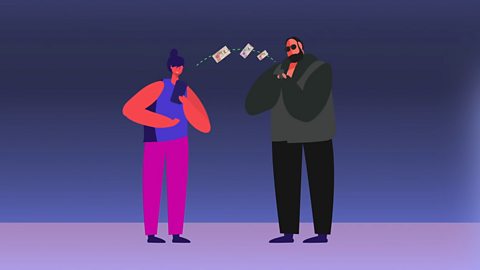
EMMA-LOUISE: Pornography is just videos of real people having real sex, right?
FRANKIE: Sure, just like this video is you and I having a real conversation. Except…
EMMA-LOUISE: There’s a camera operator…
FRANKIE: And a director, and costume and lights, rehearsals, make-up. We don’t look this good in real life!
EMMA-LOUISE: And we don’t always get it right the fifth time. I mean first time!
FRANKIE: It’s not real life.
EMMA-LOUISE: And porn is the same.
FRANKIE: Forgetting that can have real consequences.
EMMA-LOUISE: And while it’s illegal to sell porn to people under 18, you may well encounter it before you reach that age.
FRANKIE: So let’s hear from two people who have dealt with this issue.
EMMA-LOUISE: To protect their identities, we have changed their names and voices, but their stories are true.
SUZIE: When I first started having sex, it was painful. I thought it was normal to hurt the first time. But it wasn’t getting any better. When I finally confided in someone about my experience, I realised what was going on. My partner had been choking me and pulling my hair. We thought that was the right way to do it. I thought that because that’s what my partner believed. My partner believed it, because it was what he had seen in porn.
EMMA-LOUISE: Rough or violent sexual acts can be common place in porn, which can lead people to think that everyone enjoys this.
FRANKIE: But in reality, many people don’t.
EMMA-LOUISE: Both Suzie and her partner assumed she would like it because they were treating porn as a how-to guide.
FRANKIE: Remember, porn is a fiction. It doesn’t reflect reality.
EMMA-LOUISE: And porn performers are cast with specific body types in mind. That doesn’t mean those are the are the best types of bodies or that other body types are worse. And 30 minutes of 'perfect sex' in porn can take hours or even days to create.
FRANKIE: Christian's story reflects this. He ends up disappointed because he bases expectations on what he sees in porn.
CHRISTIAN: The first time I had sex wasn’t amazing, but I thought that was probably normal. No matter how many times I had sex though, it never lived up to my expectations. In porn, it was always smoother and more natural. More glamorous and impressive. After a while, I started to lose confidence in myself because I was comparing my sex life to the porn I had seen.
EMMA-LOUISE: Comparing your sex life to porn is like comparing your driving to a Hollywood car chase.
FRANKIE: It’s dangerous. And it’s never as 'perfect' as a carefully staged and manipulated video.
EMMA-LOUISE: But that’s okay. In fact, it’s quite nice that sex in real life isn’t scripted or rehearsed.
FRANKIE: And porn usually skips over the most important part of sex - consent.
EMMA-LOUISE: Before people have sex, it’s really important they agree on what they want to do together. That’s called consent.
FRANKIE: In porn, people usually just jump straight into it.
EMMA-LOUISE: But in real life, sex should only ever happen with consent.
FRANKIE: In short, porn has very little to do with real life. Real life comes with laughter, tenderness, confusion, breaks and yes, even the odd, accidental fart.
EMMA-LOUISE: It’s true.
FRANKIE: Plenty of people do enjoy watching porn. That’s fine, just like enjoying cinema is fine. Nothing to be ashamed of. Just remember, that it is a film and not real life.
EMMA-LOUISE: And, if you do come across porn by mistake or any images that confuse or concern you, it’s okay to talk about it with a trusted adult.
FRANKIE: Talking about it can help us process what we’ve seen. So, it’s kind of like a film in that way too.
Video summary
This short film explores some real-life experiences around pornography.
It highlights some of the negative impacts porn can have on relationships if viewed as a ‘how-to’ guide to sex.
The top tips section at the end should provide useful take-away points for students.
Use of this short film should be within a broader programme of relationships and sex education and should only be used after establishing class guidelines for discussion of sensitive and controversial issues.
Due to the sensitive nature of the subject matter, we strongly advise teacher viewing before watching with your students.
Teacher Notes
This short film could be useful for addressing consent and could be used as part of a whole lesson on this theme.
Students could discuss what consent is and then watch the film and revisit their initial discussion.
One of the key features of this film is the two true stories from two different young people. Students could watch the first section to ensure that all students have the same understanding of what pornography is.
They could then think of ways it might have negative or unintended consequences.
Teachers could then show the first story and ask students to identify the negative consequences for that relationship.
The same could then be done for the second story.
After watching the stories and the rest of the film students could take on the role of agony aunt and give advice to the different people presented in the film about using pornography.
Whilst the subject matter is treated sensitively and is presented in a way that is suitable for students, it may be more appropriate for older age groups and supporting discussion and activities should be carefully considered.
Links to new statutory RSE and HE curriculum (secondary)
Pupils should be taught the rules and principles for keeping safe online. This will include how to recognise risks, harmful content and contact, and how and to whom to report issues.
Online and media: pupils should be taught that sexually explicit material presents a distorted picture of sexual behaviours, can damage the way people see themselves in relation to others and negatively affect the way they behave towards sexual partners.Being safe: laws relating to sexual consent … and how these can affect current and future relationships
Intimate sexual relationships: how to recognise the characteristics and positive aspects of healthy one-to-one intimate relationships, which include mutual respect, consent, loyalty, trust, shared interests and outlook, sex and friendship.
Other subject areas
This short film could be used across other subject areas such as media studies, computing, English or citizenship.
Within media studies the film could be used in lessons about age ratings and choosing what to watch.
Within English or citizenship there is scope to use the film as a stimulus to debating the availability of pornography or the responsibility of internet providers to block inappropriate content.
This film also provides a way of discussing aspects of internet safety and how to notify providers of inappropriate online content, including where to go for help or advice about any content that causes upset or concern.
This series touches on elements of PSHE, citizenship and computing at GCSE in England, Wales and Northern Ireland and National 4 and 5 in Scotland.
More Digital Literacy / Online Security:
Fake News. video
This short film explores the phenomenon of fake news and outlines why it is important to be able to distinguish it from real news.

Live Streaming. video
This short film explores live streaming and provides some useful pointers for young people.
Self Image and Mental Wellbeing. video
Using a real life story, this short film looks at the negative effects that social media can have on our mental wellbeing.
Copyright and Ownership. video
Sanah Ahsan, a spoken word poet who frequently shares her work online, talks about the dos and don'ts of sharing content, as well as what is meant by intellectual property.
Sensitive Pictures. video
This short film uses a real life story to explore the legal and emotional consequences of sharing sensitive photos.
Online Gaming. video
Online gamer Pixlriffs talks about some potential dangers to look out for when gaming online, as well as the things you can do to protect yourself.
Trolling and Cyber-Bullying. video
This short film explores the consequences of online bullying, using a real life case study.
Digital Footprint. video
This short film demonstrates that what you post online can follow you in real life, via two real life cast studies.
Online Security. video
This short film offers advice on how to spot an online scam as well as tips on what you can do to protect yourself online.