Israel chop accuse of possible war crime sake of killing West Bank boy
- Author, Isobel Yeung, Josh Baker and Sara Obeidat
- Role, BBC News
- Published
For di early afternoon of 29 November last year, several Palestinian boys bin descend on to dia street for di occupied West Bank, wia dem dey often play togeda.
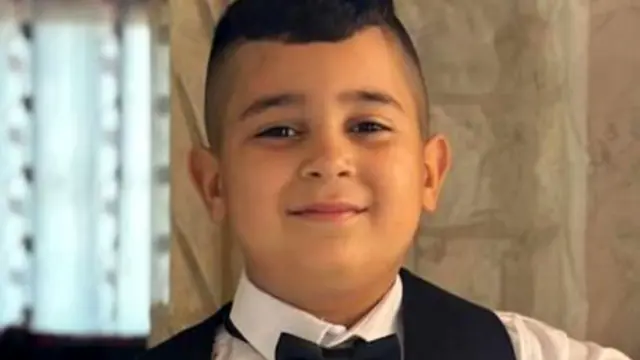
Minutes later, two of dem bin lay dead from gunshots wey Israeli soldiers bin fire - Basil, 15, and eight-year-old Adam.
As part of one investigation into di conduct of Israel security forces for di West Bank, wey dey under military occupation for more dan half a century, di BBC bin put togeda wetin happun on di day wey dem kill di two boys.
Mobile phone and CCTV footage, information about di movements of Israel military, witness testimony and detailed investigation of di scene, including taking measurements, combine to reveal evidence wey suggest serious human rights violations.
Di evidence wey we find don prompt Ben Saul, UN special rapporteur on human rights and counter-terrorism, to say di death of Adam bin appear to be a "war crime".
Anoda ogbonge legal expert, Dr Lawrence Hill-Cawthorne, bin describe di use of lethal force as “indiscriminate”.
Di Israel Defense Forces (IDF) tok say di circumstances of di deaths dey “under review” but say dat “live fire dey used only in order to remove immediate threats or for arrest purposes, following arrest protocols afta dem don finish oda options”.
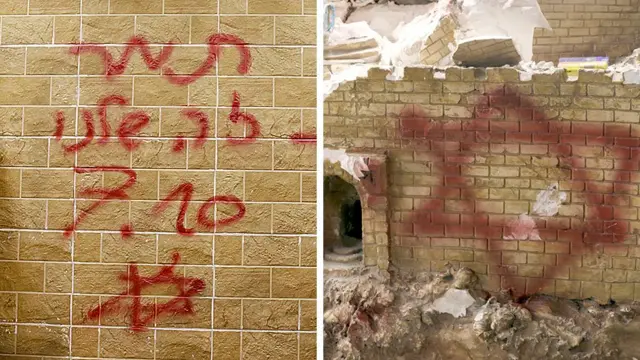
Wit violence wey dey increase for di West Bank for di months since wey Hamas attack Israel from Gaza on 7 October, di BBC don also find evidence of Palestinian homes wey dem vandalise with graffiti, Palestinian civilians threaten wit weapons and tell dem to comot di territory go neighbouring Jordan, and di possibility say dem don scata di bodi of a Palestinian gunman.



End of Di one wey oda users dey read well well
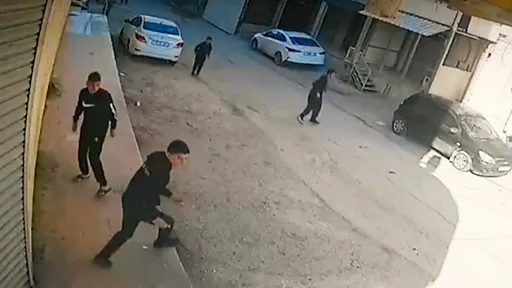
Video footage from 29 November show Basil standing next to a hardware store wey di shutter dey firmly locked down. Wen Israel military arrive, shops quickly close for Jenin, city wey dey West Bank - Palestinian territory wey no dey under Hamas, unlike Gaza.
Witnesses say gunfire bin dey sound from a nearby operation by Israel army for di Jenin refugee camp.
Adam, wey be football fanatic and massive fan of Lionel Messi, bin stand wit im older brother Baha, 14. Na about nine oda boys dey di street in total, all captured on CCTV cameras wey provide nearly 360-degree view of wetin happun next.
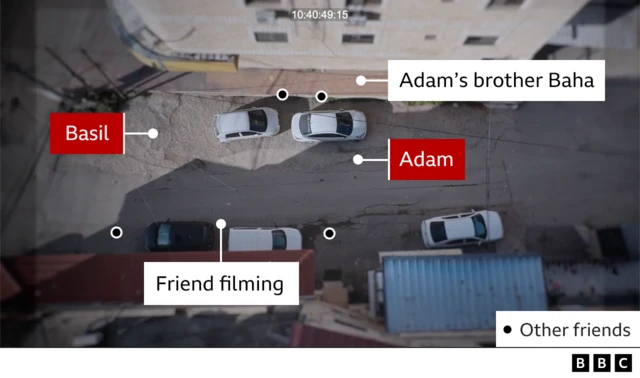
A few hundred metres away, a convoy of at least six armoured Israeli military vehicles turn to a corner and begin dey head towards di boys, wey become uneasy. Several of di boys start to dey move away.
At dis precise moment, mobile phone footage show say di front door of one armoured vehicle open.
Di soldier wey dey inside di vehicle bin get a direct view of di boys. Basil move into di middle of di road, while Adam dey 12m further from di soldiers, running away.
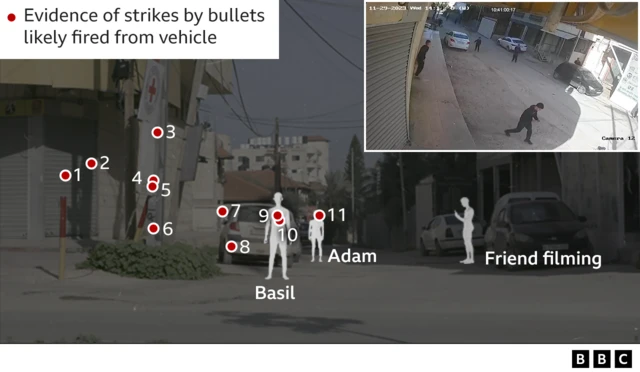
Den at least 11 gunshots bin go out.
Examining di scene, di BBC find di bullets wey strike a wide area. Four bullets hit one metal pole, two hit di shutter of di hardware store, one enta through di bumper of one parked car, and anoda pierce one handrail.
Medical reports wey di BBC obtain show say two shots hit Basil for im chest.
Anoda bullet strike eight-year-old Adam for di back of im head as im dey run away.
Di older brother Baha desperately try to drag im to cova, wey come leave a trail of blood as im scream for ambulance.
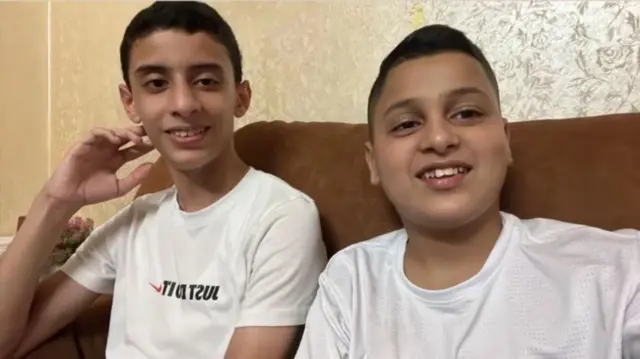
But e dey too late. Baha say Adam and im friend Basil die for im front.
“I dey in shock; I no dey even tink about mysef. I try to speak to am. I start to say, ‘Adam, Adam!’ But im soul don dey comot im bodi becos im no ansa,” Baha tell di BBC tearfully.
Bifor dem shot am, Basil bin dey squeeze somtin for im hand. E no dey clear wetin e be. Di IDF later share one picture wey dem take at di scene, wey dem tok say e dey show one explosive device.
We bin share evidence from our investigation of di scene wit a number of independent experts, including human rights lawyers, a war crimes investigator and a counter-terrorism expert, as well as members of di UN and oda neutral bodies. Some give dia analysis anonymously.
Di experts agree say dem suppose investigate di incident and some go further to say dat e be like say e show violations of international law.
Ben Saul, di UN special rapporteur on human rights and counter-terrorism, tok say questions fit dey about weda lethal force fit dey used legally in Basil's case, if im dey hold explosive.
"For Adam, dis dey appear to be a violation of di International Humanitarian Law prohibitions on deliberately, indiscriminately or disproportionately attacking civilians, a war crime, and a violation of di human right to life," Mr Saul tok.
Dr Lawrence Hill-Cawthorne, co-director of di Centre for International Law for di University of Bristol, say: "Di soldiers dey for armoured vehicles. Even if threat bin dey, dem suppose just drive away and plan arrest, rather dan to use apparently indiscriminate, lethal force, wey dey in violation of international law.”
Di IDF say di suspects bin wan throw explosives towards dia forces, putting dem in immediate danger. "Di troops bin respond wit fire and hits dey identified," Israel military say.
But according to di video evidence wey we don examine and witness testimony, Adam no appear to dey armed and bin dey run away wen dem shoot am for back of di head.
Di IDF say di circumstances of Basil and Adam deaths dey "under review", wey e dey do for evri death of a child for di West Bank due to IDF activity.
But several former Israeli soldiers wey view di BBC evidence say dem believe say Israel legal system go protect soldiers wey use lethal force, regardless of weda e dey justified.
One former sergeant wey serve for di West Bank from 2018-2020, say e go take "Israeli soldier murdering a Palestinian at zero range for dis to dey taken as murder for Israel" and "na basically a 0% chance of criminal proceedings" against soldier wey dey involved for di kain case of Adam.
Data from di Israeli human rights group Yesh Din suggest say fewer dan 1% of all complaints against Israeli soldiers dey result in prosecutions.
Footage of di Hamas attack on 7 October, wey about 1,200 pipo dey killed and 253 taken hostage, bin vex di Israeli public and shock di world. Since den, di world attention don dey focused on di war and humanitarian crisis for Gaza, wia more dan 34,000 pipo don dey killed, according to di Hamas-run health ministry.
At di same time, military operations by Israel don also increase for di occupied West Bank, making last year di deadliest year on record for children wey dia.
A total of 124 children dey killed for 2023, according to Unicef - 85 dey reportedly killed afta 7 October.
So far for 2024, 36 Palestinian children don dey killed for di territory by Israeli settlers or di military.
Since di West Bank no dey classed as a war zone, di use of force suppose dey more constrained, according to international law.
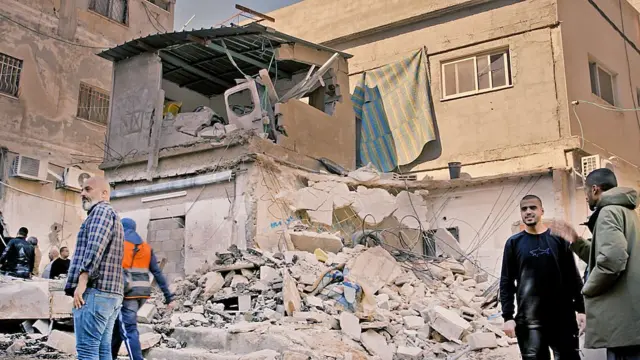
While di IDF keep di exact rules of engagement secret, former and serving Israeli soldiers tell us di use of lethal force suppose be last resort wia a real and imminent danger to life dey. A staged approach gatz dey taken.
Dem say dis dey begin wit a verbal warning for Arabic and Hebrew, bifor e go escalate to di use of non-lethal weapons such as tear gas, den shooting at di legs, all bifor shooting to kill.
Di BBC get access from di Palestinian Authority-run health ministry for di West Bank to medical reports of 112 children, aged between two and 17, wey Israeli fire kill between January 2023 and January 2024.
We no fit know di exact circumstances of all of dis shootings, and e dey possible say some genuinely pose threat to di lives of Israeli soldiers.
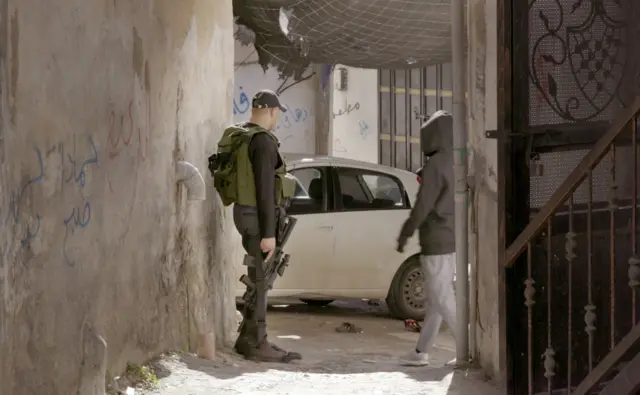
We show our evidence again to independent experts. Prof Marco Sassoli, wey be international law expert from di University of Geneva, say: “Remains of di deceased, even if dem dey lawfully killed, gatz dey respected. Wat you report violate international humanitarian law and fit even constitute a war crime.”
Di IDF say afta examining di dead fighter, explosives don dey found and Red Crescent personnel refuse to touch di bodi. "For dis reason, IDF troops gatz restrain im hands and feet to ensure dia safety and to check if dia weaponry dey under di bodi."
"To assume say pipo fit interact wit di army di way Palestinians do on a daily basis and still go about dia lives as if notin happun - say pipo wey dey live for dis reality no go take up arms - dey naive and dehumanising," one pesin tok.
"Tins dey get worse."