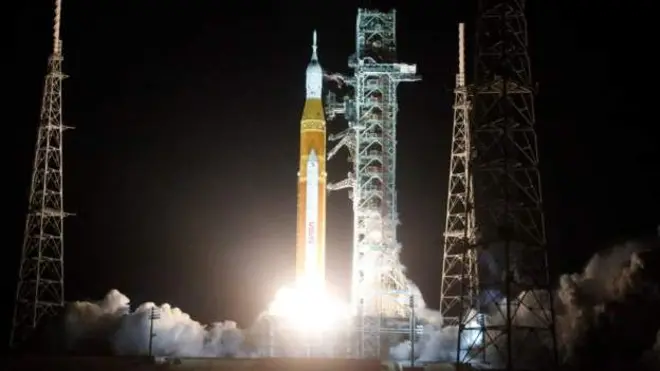
Why India dey launch mission to study di Sun?
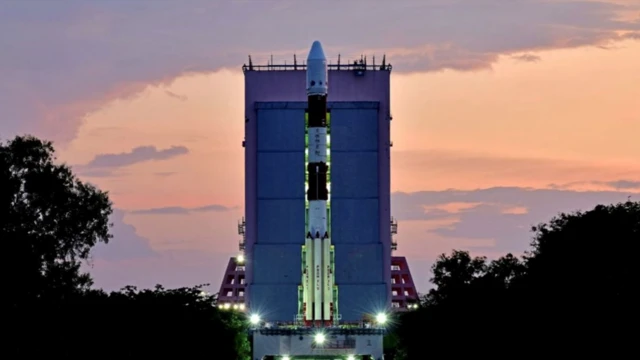
Wia dis foto come from, Isro
One week afta dem become di first nation to successfully land a probe near di south pole of di Moon, India don ready to visit di Sun.
Di plan na to launch a space-based observatory - wey be India's first - to monitor our nearest star and to study features of space weather like solar winds.
Dis no be di first mission to study di Sun - Nasa and di European Space Agency (ESA) bin don place orbiters for dis purpose - but e get some unique features.
So wetin be Aditya-L1? Here is everything you need to know about the mission.
Wetin be Aditya-L1's launch date and time?
Aditya means Sun for Sanskrit and Hindi, and if evritin go according to plan, di spacecraft go lift-off at 06.20 GMT on Saturday 2 September from di kontri main spaceport at Sriharikota, 100km north of Chennai.
Pictures released by the Indian space agency show the rocket carrying the probe now fully integrated on the launch pad.
How much time e go take to reach di Sun?
Di spacecraft no go actually visit our nearest star at all.
Di destination na a distance of 1.5 million kilometres from Earth - almost four times di distance between Earth and di Moon, but only a tiny fraction (1%) of di distance to di Sun itself, wey dey 151 million kilometres away.




End of Di one wey oda users dey read well well
If dem compare am, Nasa's Parker spacecraft, weywaka pass Venus last week, go ultimately fly as close as 6.1 million kilometres from di surface of di Sun.
E go still take a while for Aditya-L1 to reach e destination though.
"Di total travel time from launch to L-1 (Lagrange point) fit take about four months for Aditya-L1," di Indian Space Research Organisation (Isro) tok for one post on X (formerly Twitter).
So why dem put so much effort if di Sun go still dey far away?
Wetin be Lagrange point?
Di L1 in di name of di mission refer to a Lagrange point - a location for space wia di gravitational forces of two large bodies, like di Sun and di Earth, balance out, creating a region of equilibrium wey spacecraft fit use to reduce fuel consumption.
Dem name dem afta Joseph-Louis Lagrange, one French mathematician wey first study dem in di18th Century.
Wetin be di objectives of di Aditya-L1 mission?
Di Indian spacecraft go carry seven payloads in total and e go observe di layers of di Sun wey dey outside - wey dem call di photosphere and chromosphere - e go use instruments like electromagnetic and particle field detectors.
E go also study wetin dey ginger di weather for space, and also ask, for example, to get better understanding of di dynamics of solar wind, wey dey cause di beautiful northern and southern lights on Earth, but also electromagnetic disturbances.
Once dem place am for im orbit, di observatory go benefit from "a continuous, clear view of di Sun".
"Dis go give us a greater advantage of observing di solar activities and its effect on space weather in real time," Isro tok.
E go also observe radiation wey dem no go fit study from Earth because di atmosphere dey filter am out.