Wetin be di electoral college wey go elect US president?
Wia dis foto come from, Getty Images
US presidential election go happun on November 5. But e dey possible say di candidate wey get di higher votes no go be di winner.
Dis na sake of say no be voters dey choose directly who go be president, na wetin dem dey call electoral college dey choose am.
How e dey work.
So who Americans dey vote?
When Americans do di presidential election, most of dem go vote for either Democrat Kamala Harris or Republican Donald Trump.
But dat vote go only go up to make-up one group of officials wey go represent Miss Harris or Mr Trump for electoral college.
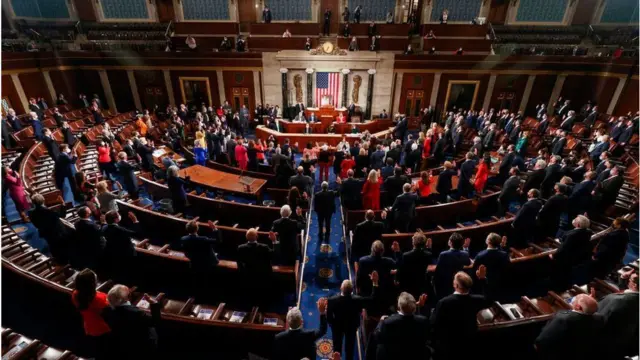
Di word “college” hia simply mean group of pipo wey get shared task. Dis pipo na electors and dia job na to choose who go be president and vice president.
Di electoral college dey meet evri four years, few weeks after election day, to do dia task.
How di electoral college dey work?
Na number of electors from each state dey roughly make up di population. Each state get as many electors as dem get lawmakers for di US Congress (di House and di Senate).




End of Di one wey oda users dey read well well
California get di highest electors - 54 - while some states with small population like Wyoming, Alaska and North Dakota (and Washington DC) get as low as three.
Di total number of electors na 538.
Each elector dey represent one electoral vote and candidate need to get - 270 or more - votes to win di presidency.
Generally, states dey award all dia electoral college votes to di candidate wey win votes of ordinary voters for di state.
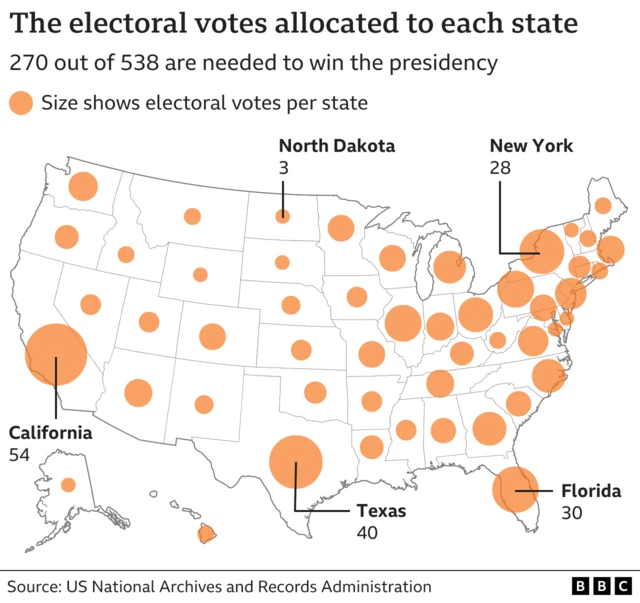
For example, if candidate win 50.1% of di votes for Texas, dem go award am all di 40 electoral votes from di state. Candidate fit still use landslide win and still e go get same number of electoral votes.
So e dey possible for candidate to become president by winning number of tight races for some states, even doh e get fewer votes across di kontri.
Wetin be di pros and cons of di electoral college?
Advantages:
Smaller states dey important to candidates
Candidate no need travel di whole kontri
recounts dey easier unto say di officials fit isolate di issue for one state
Disadvantages:
Plenty voters feel dia votes no go count
Too much power dey di hands of di swing states (see below)
Di popular vote winner fit loose di election (more on dis later)
Risk of fake electors (more on dis later too)

Wia dis foto come from, Getty Images
Wetin be swing states?
Most states dey consistently vote for di same party for each election.
Dis na why most presidential candidates dey target specific “swing states” wia di vote fit go either way rather than trying to win over voters across di kontri.
For 2024, di top battleground states na Arizona, Georgia, Michigan, Nevada, Pennsylvania and Wisconsin.
Weda candidate don loose public votes still become president?
Yes. In fact, two out of di last six elections, candidates wey get fewer votes from di general public later win.
For 2016, Donald Trump bin dey almost three million votes behind Hilary Clinton. For 2000, George W. Bush defeat Democrat candidate Al Gore wey win popular votes by more than half a million votes.
Only three oda presidents don dey elected without winning di popular votes, all of dem na for di 19th century.
Why dem choose dis system?
When dem draw di US constitution for 1787, national popular votes to elect a president dey practically impossible (kontri size and tricky communications).
So, some of di pipo wey do di constitution create di electoral college, wia each state go choose electors.
Di system favor smaller states as e give dem more voice dan for national popular votes to decide who go be president.
Electoral college also favor di southern states wia slaves plenty for di population. Even though slaves no vote, dem count dem for di US Census (as three-fifths of a person).
Since di number of electoral votes dey determined by di size of population of a state, southern states get more influence to elect who go be president dan wetin direct public vote go give dem.
Must electors vote for candidate wey win?
For some states, electors fit vote for who dem prefer, regardless of who voters dey back. But in practice, electors dey almost always vote for di candidate wey win di most votes for dia states.
If electors vote against di candidate wey dia state pick, dem dey term dem ‘faithless’. For 2016, dem cast seven electoral college votes dis way, but faithless electors never ever change di results.
For some states, ‘faithless’ electors fit face fine or even dey prosecuted for dia votes or for abstaining.
Who be fake elector?
For 2020, US voters come dey familiar with di concept of “fake electors” after Trump supporters among di Republicans for seven US states create dia own electors as dem use am overturn di election results.
In some cases, dem create and sign official looking documents or arrive for state capitals on 14 December - wen electors across di kontri dey meet to officially cast dia votes.
Some of di pipo wey dey involved don face prosecution and investigation still dey go on.
Wetin fit happen if di candidates tie for di election?
If no majority winner emerge, di House of Representatives di lower house of US lawmakers go den vote to elect di president.
Dis don hapun only once for 1824. Four candidates split di electoral votes wey deny any of dem di win.
As na two parties dey dominate di US system, e dey unlikely for dat to hapun.