How India launch dia first mission to di Sun
- Author, Geeta Pandey
- Role, BBC News, Delhi
- Published
Wia dis foto come from, ISRO
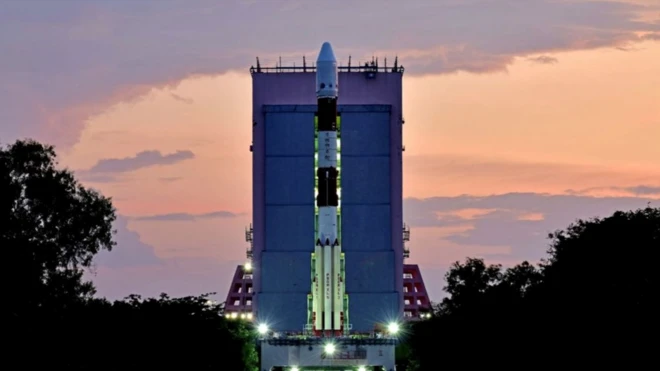
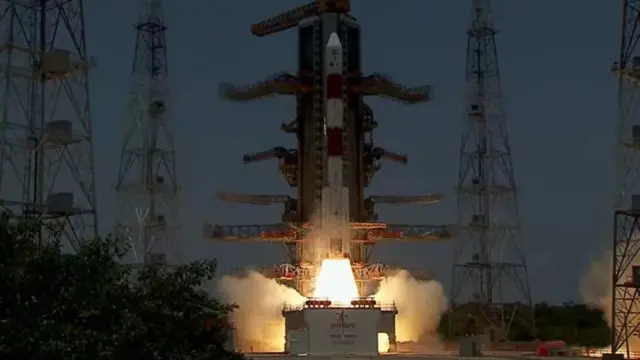
India don launch dia first observation mission to di Sun, just days afta di kontri make history by becoming di first to land near di Moon south pole.
Aditya-L1 lift off from di launch pad for Sriharikota on Saturday at 11:50 India time (06:20 GMT).
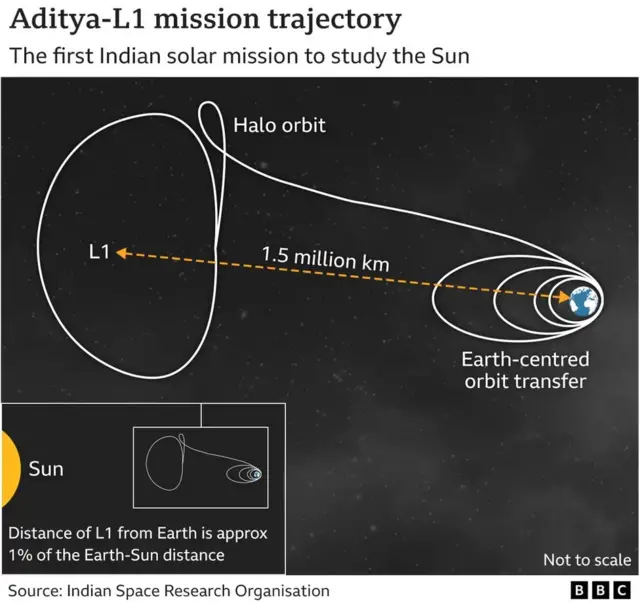
E go travel 1.5 million km (932,000 miles) from di Earth - 1% of di Earth-Sun distance.
Di space agency for India say e go take four months to travel dat far.
India first space-based mission to study di solar system biggest object dey named after Surya - di Hindu god of Sun wey dem also sabi as Aditya.
And L1 stand for Lagrange point 1 - di exact place between Sun and Earth wia di Indian spacecraft dey head to.
According to di European Space Agency, a Lagrange point na a spot wia di gravitational forces of two large objects - like di Sun and di Earth - cancel each oda out, allowing a spacecraft to "move around".
Once Aditya-L1 reach dis "parking spot", e go fit go round di Sun at di same rate as di Earth. Dis also mean say di satellite go need very little fuel to operate.




End of Di one wey oda users dey read well well
On Saturday morning, a few thousand pipo gada for di viewing gallery wey di Indian Space Research Agency (Isro) set up near di launch site to watch di blast off.
Dem also broadcast am live on national TV wia commentators describe am as"magnificent" launch. Isro scientists say di launch dey successful and di "performance dey normal".
Di spacecraft go now travel plenti times around di Earth before e go launch towards L1.
From dis good position, Aditya-L1 go fit watch di Sun constantly - even wen e dey hide during an eclipse - and carry out scientific studies.
Isro neva tok how much di mission go cost, but reports for di Indian press say e fit cost 3.78bn rupees ($46m; £36m).
Wia dis foto come from, ISRO
Isro say di orbiter dey carry seven scientific instruments wey go observe and study di solar corona (di outermost layer); di photosphere (di Sun's surface or di part we see from di Earth) and di chromosphere (a thin layer of plasma wey dey between di photosphere and di corona).
Di studies go help scientists understand solar activity, like solar wind and solar flares, and dia effect on Earth and near-space weather in real time.
Former Isro scientist Mylswamy Annadurai say di Sun dey influence di weather for Earth evritime thru radiation, heat and flow of particles and magnetic fields. At di same time, im say, e dey also affect di space weather.
"Space weather dey play a role in how effectively di satellites function. Solar winds or storms fit affect di electronics on satellites, even knock down power grids. But gaps dey for our knowledge of space weather," Mr Annadurai tell di BBC.
India get more dan 50 satellites for space and dem dey provide many crucial services to di kontri, including communication links, data on weather, and help predict pest infestations, droughts and impending disasters.
According to di United Nations Office for Outer Space Affairs (UNOOSA), approximately 10,290 satellites remain for di Earth's orbit, wit nearly 7,800 of dem currently operational.
Aditya go help us understand beta, and even warn us ahead, about di star on which our lives depend, Mr Annadurai tok.
"Knowing di activities of di Sun like solar wind or a solar eruption a couple of days ahead go help us move our satellites out of harm's way. Dis go help increase di longevity of our satellites wey dey space."

Wia dis foto come from, Getty Images
Di mission, go above all help improve our scientific understanding of di Sun - di 4.5 billion-year-old star wey dey hold our solar system togeda.
India solar mission come just days afta do kontri successfully land for di world's first-ever probe near di lunar south pole.
Wit dat, India also become only di fourth kontri in di world to achieve a soft landing on di Moon, afta di US, di former Soviet Union and China.
If Aditya-L1 dey successful, India go join di select group of kontris wey dey already study di Sun.
Japan na di first to launch a mission in 1981 to study solar flares and di US space agency Nasa and European Space Agency (ESA) don dey watch di Sun since di 1990s.
For February 2020, Nasa and ESA do collabo to launch one Solar Orbiter wey dey study di Sun from close quarters.
E dey also gada data wey scientists say, go help understand wetin dey ginger di dynamic behaviour of di Sun.
And for 2021, Nasa newest spacecraft Parker Solar Probe make history by becoming di first to fly thru corona, di outer atmosphere of di Sun.