Surprising colour combinations, topiary, and a yearning for the simple life were just a few of the trendsetting planting highlights. | 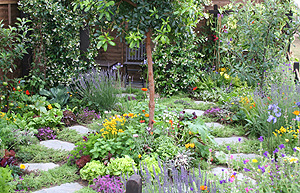 |
Hot and smokyOrange and purple might be an unlikely pairing in the garden - but designers at Hampton Court showed us that when they're together, they hit it off beautifully. It's a surprisingly sophisticated colour combination that contrasts the hottest, brightest shades with the smokiest, darkest, most sumptuous plants around for the ultimate wow-factor. 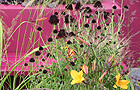 In the Centrepoint Garden, Clare Whitehouse used near-black Scabious 'Chile Black' under planted with ochre-orange daylilies, including Hemerocallis 'Golden Chimes' whose petals are backed with dusky purple, picking up the colour scheme beautifully. "I'm not usually very fond of daylilies," says Claire, "but this one is fantastic. I've noticed it's turned up in several other show gardens, too." Plants which were born for this colour scheme include Dahlia 'David Howard', with brilliant orange flowers and deep purple leaves, and Phormium 'Rainbow Queen' which has orange-tinged purple sword-shaped leaves. Both feature in Fiona Stephenson's extraordinary, rich planting in Growing Together, in which vibrant, hot colours in the foreground, signifying the sun, shade back to near-black around the startling, modern stainless steel moongate. This was a great garden for unusual planting combinations: drifts of Helenium 'Moerheim Beauty' shone bronze against vibrant orange Achillea 'Walter Funcke', while blackest Heuchera 'Obsidian' brooded below the wine-coloured foliage of Cercis canadensis 'Forest Pansy'. Another tip to take away is Fiona's decision to include touches of paler colours in the purple scheme - such as the fabulous Cimicifuga racemosa 'Brunette', carrying white flowers over purple foliage - to prevent the dark colour scheme from becoming gloomy. Where the wild things are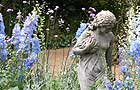 There was a certain nostalgia in the air for a simpler way of life at the show this year. Cottage gardens were everywhere, from Rosie Hardy's mixed planting of flowers and vegetables in the Daily Mail Pavilion, to the blowsy, romantic planting of A Midsummer Night's Dream, in which delphiniums and roses mingled in a dreamy, quintessentially English scene. Wildflowers, too, popped up all over the place. The simple, poignant conceptual garden, The Fallen, used lines of wildflowers to mark out a 'graveyard' commemorating extinct species, while in The Miller's Garden, cornflowers and field poppies were scattered through the barley. Ferns were also used to great effect. Mike Harvey, in the The Unwind Garden, combined them with Hydrangea 'Annabelle' and papery white astrantias, and they also lurked under a metal grid pathway in an innovative planting by Hadlow College in their small garden, Full Frontal. Prickly heatIt' wasn't all quintessential Englishness and natural planting, though. The exotic was also there, but with a nod to environmental concerns: several gardens demonstrated how plants from other countries can be used to minimise water consumption. Mediterranean plants like olives, citrus and grapevines looked as if they're here to stay: Anthea Guthrie, in her Spanish-inspired Torres Tapas garden, has used all three to create a look that reminded you of hot climates even when your umbrella is up. She put it in a firmly English setting, though, with a bed of riotous roses in the middle, creating an interesting fusion that may be the shape of things to come. 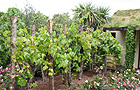 The Banrock Station and Eden Project garden, 'I'll Drink to That', went even further afield. As well as Mediterranean plants like figs, grapes and olives, there were exotic desert plants from South Africa. A Protea nestled among prehistoric restios and cycads, the whole thing was lightened by an underplanting of Osteospermum 'Orange'. It was more desert than downpour, which might seem ironic given the weather forecast: but just wait till the next drought and it'll seem right at home.

| | |





