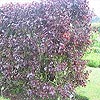
The purple plum comes highly recommended by Anne Swithinbank. Like other gardeners who grow this beautiful tree, she loves the pink spring blossom which is one of the first of the season. Bronze-coloured new growth follows this display, gradually darkening to rich purple. The foliage is especially valuable in the garden as a contrast to the greens which dominate in summer. The leaves also cast dappled shade which makes this tree a good place to retreat on a hot, summer's day. Like all deciduous prunus, it enjoys a moist but well-drained soil and thrives in full sun. The Royal Horticultural Society has also recognised its outstanding qualities and have given it their prestigious Award of Garden Merit (AGM).
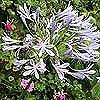
Agapanthus africanus African blue lily
A clump-forming, evergreen perennial with strap-like leaves. In late summer, trumpet-shaped, deep blue flowers are produced in rounded umbels. Plants work well when planted en masse in the border or in a large container on the patio. They enjoy a sunny position in moist but well-drained soil.
Helenium 'Moerheim Beauty' Helen's flower
Heleniums have very characteristic flower shapes quite unlike those of other daisy flowers. The crimson red of 'Moerheim Beauty' is a very versatile colour, useful for both hot, orange-red planting schemes and with coppery pink. Try them with orange or yellow flowers of red-hot poker, solidago or other late daisy flowers, such as rudbeckias and heliopsis. Or in a pastel scheme with pink Japanese anemones, schizostylis and Michaelmas daisies. The flowers are good for cutting. Plants will not reach their final height until their second year. To restrict their size, cut back to about 30cm (1ft) tall in May. This not only reduces their final height but will also delay flowering by a week or two. To propagate, divide plants in spring. Dividing in autumn often fails as the small plants produced die during the winter.
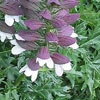
Acanthus spinosus Bear's breeches
A statuesque architectural plant, with handsome dark green leaves whose stylised shapes form the decorative detail on Corinthian columns, bringing a strong hint of classical elegance to the garden. The plants make large, mound-shaped rosettes of glossy leathery leaves, finely cut and each tipped with a ferocious spine. The flower spikes resemble tall foxgloves from a distance, with hooded two-tone flowers. Once established it is virtually impossible to move plants so correct positioning is vital. A dramatic plant for growing in gravel or grass, or at the back of a large border. The Royal Horticultural Society has given it its prestigious Award of Garden Merit (AGM).
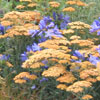
Achillea 'Terracotta' Yarrow
Achilleas are traditional border flowers valued for their feathery foliage and striking flat, circular heads of flowers throughout the main summer season. They team well with other perennial flowers and are a vital ingredient of a traditional herbaceous border they are also at home in island beds, cottage gardens and other perennial planting schemes. The variety 'Terracotta' has beautiful blooms which open orange fading to yellow with age.
To view the panoramic image, click on the garden with your mouse and drag it around the picture. To find out about the planting hotspots in the garden, click on the leaf icon above. To start and stop the audio commentary click on the speaker icon.
If you're having problems viewing the panoramic images read our help page. Alternatively, take a look at our still photography of all of the show gardens.
"The theme of my garden is one world in harmony - opposites growing together. It is inspired by an ancient symbol called the Vesica Piscis in which two circles merge. Historically the vesica (overlapping area) signifies the mediation of opposites. The aim of the garden is to communicate this idea and measure its therapeutic properties.
"The theme of opposites is portrayed with a sun and moon garden merging in the vesica. The moon garden elements are darkness, cool colours, moonlight effects and water. The sun garden is at the front and its elements are light, warm colours, sunlight and heat.
"This self-funded garden launches a study led by Dr. Murray Griffin, Chartered Psychologist at the University of Essex, where a limited number of people will be let into the garden and any changes in their 'sense of self' will be measured."








 "The theme of my garden is one world in harmony - opposites growing together. It is inspired by an ancient symbol called the Vesica Piscis in which two circles merge. Historically the vesica (overlapping area) signifies the mediation of opposites. The aim of the garden is to communicate this idea and measure its therapeutic properties.


