
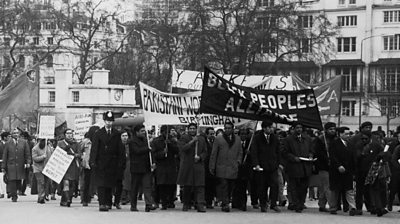
The term BME (black and minority ethnic) has its roots in the idea of ‘political blackness’, used by many in the anti-racist movement in the 1970s. The term evolved to become ‘BAME’ as it was pointed out there were other minority ethnic groups in the country as well as black, with ‘A’ standing for ‘Asian’.
The term ‘BAME’ is used in the BBC, by government and in the market research industry as a classification for broader commonalities in order to highlight disparities e.g. recent Covid investigations highlighted similarities in infection rates amongst ‘BAME’ patients. On a practical level, the acronym is used as it isn’t always possible to list out all ethnic minority groups or to recruit robust samples within research due to population size.
Some also see the term as a positive signifier of inclusion and representation. However, for others, the term ‘BAME’ has become contentious for many individuals who fall within its acronym. The term is problematic when it’s used as a ‘catch-all’ phrase which fails to recognise the individual identities and masks the differences between communities and their experiences.
While there are mixed reviews towards the use of ‘BAME’, we need to be mindful that some of our colleagues and audiences do not find the term ‘BAME’ appropriate nor do they identify as ‘BAME’. A review is also underway to ascertain the validity of the word and help us establish a possible alternative.
In the meantime, the sentiment felt across staff and audiences alike illustrates the need to have a more sophisticated understanding of the term. But it can be complex. Within a group such as black and Asian, there is diversity within diversity; nuance within nuance. How you identify when it comes to your race or ethnicity is a personal choice.
Language takes on a different meaning for each and every generation, it has the ability to formalise your position in society, it can reveal your cultural heritage and background and is often a tool used to cast judgement or acceptance. The fluidity of language is something that cannot be contained nor can its power be diminished, therefore how we label one another is critical to how we are perceived and viewed in the world.
Not all of us dance bhangra or admire Bollywood.

Ah, BAME – this acronym, which means black, Asian and minority ethnic, joins many other appellations offered over the decades (not all of them very nice), painstaking attempts to address the complexities of a multicultural society. But isn’t it, despite its best intentions, rather limiting?.... And if we take the ‘A’ – what constitutes a (British) Asian?
Not all of us emanate from the Punjab or Gujarat or Bangladesh, or made a prolonged stopover in East Africa. Not all of our parents arrived in the UK in the 1960s or 1970s. Not all of us live in a large, dense community, or speak its language – or even wish to. Not all of us dance bhangra or admire Bollywood. Our families may not all have served in or near the Raj and we may not have a strong memory of or feelings about partition. (Source: The Independent)
I am British-born Chinese. So call me British-born Chinese.

There is a problematic misconception that all Asians are one monolithic block. For example, East & South East Asian communities are experiencing more hate crimes due to the virus. I’d be rich if I had a penny for the number of times I’ve had ‘Ni Hao’ said to me. It’s from these small microaggressions to violent hate crimes and incidences towards East & South East Asians that shows we absolutely need further distinction and individual representation between Asian groups, far away from the term BAME as possible.
My experience as a Chinese person varies from a Vietnamese, Japanese, Thai, Indian, Bangladeshi person. So data-driven representation should represent that. Rather than just labelling us all as BAME. As a British Born Chinese person, I cannot speak on behalf of all Asians and their own experiences. (Source: The Tab)

[Referring to the use of the term ‘black’] To put it mildly then, it is insulting, reductive, counterproductive, lazy, disingenuous and deeply, deeply, deeply problematic to attach a single label - one of Western invention as a shield against racism, one as porous as a description of skin pigmentation, as ‘black’ - to a group of people so vastly varied and numerous. Whenever we beg for nuances, for our differences to be articulated, for more diversity and accuracy in how our communities are described, in the characters written for ‘black’ authors on stage, on television, or in film, our voices are either silenced or ignored.
- An Excerpt from The Good Immigrant, Nikesh Shukla [2016] by Inua Ellams, Poet, Playwright, Performer


Discover more
Code of Practice Progress Report 2024/25
An update of progress on the BBC Creative Diversity Commitment
Elevate
Supporting deaf, disabled and neurodivergent talent in the TV industry.
Reflecting our world
Inspiring organisations around the globe to create content that fairly represents our society.

