
Over 8 out of 10 UK Indian Restaurants are owned by Bangladeshis
Introduction
Note: We’ve noted the importance to distinguish between the different South Asian countries as the region is one of the most diverse parts of the world, and the culture is completely entwined in language, ethnicity, and religion.
Over 8 out of 10 UK Indian restaurants are owned by Bangladeshis, most of whom originate from Sylhet, a city in the North East of Bangladesh. Many of the Bangladeshis who live in the UK send money back regularly to support (often extended) families and local developments, making Sylhet now one of the richest towns in the country.
A staggering 60% of Bangladeshis live in East London’s Banglatown and Brick Lane, an area rapidly evolving and feeling the effects of gentrification.
This community has made a positive impact on UK culture with their arrival, bringing new foods, traditions and workers for the British industry.
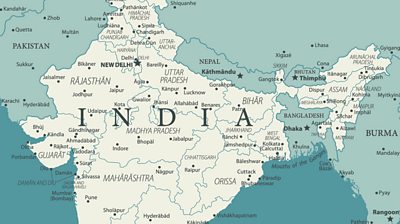
Bangladesh is a relatively new country that has only existed since 1971 after breaking away and gaining independence from Pakistan following the Liberation War which took place that same year.
History
Bangladesh is a relatively new country that has only existed since 1971 after breaking away and gaining independence from Pakistan following the Liberation War which took place that same year.
The Liberation war in 1971 was a revolution and armed conflict sparked by the rise of the Bengali nationalist movement in what was then East Pakistan, created after Partition.
East Pakistan was an oddity in that it was separated from Pakistan by a 1,000-mile stretch of India. It also differed from main Pakistan in ethnicity and language; Pakistanis are primarily Punjabi and Pashtun, as opposed to the Bengali East Pakistanis. East Pakistan struggled under financial and political neglect from West Pakistan.
Bengal is the region of north eastern South Asia that generally corresponds to the country of Bangladesh and the Indian state of West Bengal. The cultural roots of the Bengali people run deep into the past and about 98% of the Bangladeshi population identifies as Bengali ethnicity. The national identity has become increasingly linked to Islamic symbols as opposed to the Hindu Bengali, a fact that serves to reinforce the difference between Hindu West Bengal and Islamic Bangladesh.
The Pakistani Military regime based in West Pakistan launched a military operation to curb the Bengali nationalist movement. It pursued the systematic elimination of nationalist Bengali civilians, students, religious minorities and armed personnel. In December 1971, Indian troops were sent in to fight the Pakistan army in support of the Bengali nationalists in their struggle for independence. The intervention brought a conclusion to the war in nine short days, ending a nine-month campaign of genocide and ethnic cleansing that had left countless dead, many millions displaced and an estimated 10 million Bengali refugees fleeing to neighbouring India.
In a New York Times article in 2017, K Anis Ahmed said,
“The war is indeed the most momentous event for the people who were once East Bengalis, then East Pakistanis and now Bangladeshis. It awarded us the pride of standing as an equal among the nations of the world’. Other subnational groups in both India and Pakistan were also annoyed at the gross inequities committed by an imposing federated state. Yet only in Bangladesh did rebellion against such injustice and the idea of a distinct cultural identity — in this case, Bengali and secular — lead to a new nation.”
Bangladeshi migration to the UK started as early as the 19th century, with more settling in the UK before World War 1 largely from the region of Sylhet. The largest migration came in the 1970s as people fled from the civil unrest in their homeland. In addition to the war, natural disaster, changes to Britain’s immigration laws, the desire to escape poverty and seek a better life were the main reasons for the migration seen during that decade. Their arrival brought with it new foods, traditions and workers for British industry.
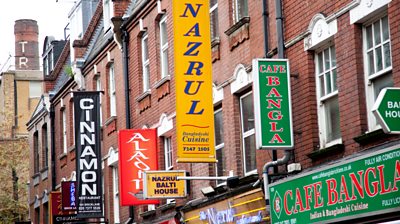
The majority of those that arrived settled in Tower Hamlets in London, particularly around Spitalfields and Brick Lane. This new influx of Bangladeshis often took on unskilled and semi-skilled work in factories. Once the ‘Indian restaurant’ concept became popular some Sylhetis started to open cafes and from these beginnings a network of Bangladeshi restaurants, shops and other small businesses started to pop up in Brick Lane and the surrounding areas.
By the late 1970s, the Brick Lane area had become predominantly Bengali, replacing the former Jewish community which had declined as they increasingly migrated to the suburbs of London.
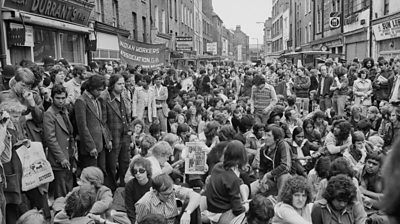
Following their arrival there was an increase in the number of racially motivated attacks on Bangladeshis in the area. The anti-immigrant National Front became active in nearby Bethnal Green and white youths known as skinheads targeted and terrorised the Bangladeshi community – women and children included. Residents began to fight back by creating committees and youth groups such as the Bangladesh Youth Movement, which was formed by young activists led by Shajahan Lutfur.
Things came to a head with the racially motivated murder of 25 year old Bangladeshi factory worker Altab Ali on the 4th May 1978 by three white British teenage boys as he walked home from work.4 Ali’s murder mobilised the Bangladeshi community in Britain and over 7,000 people, mostly Bangladeshi, marched behind his coffin in a demonstration against racial violence 10 days after his murder.
In April 2001, the London Borough of Tower Hamlets council officially renamed the ‘Spitalfields’ electoral ward Spitalfields and Banglatown. By this stage, 60% of those living in the ward were of Bangladeshi origin.
Symbolically, Bangladeshi identity is centred on the 1971 struggle for independence from Pakistan.
Culture
The expat Bangladeshis that now live in London are referred to as ‘Londonis’. Many marriages take place between the native Bangladeshi and the ‘Londonis’, with either men or women travelling back to get married.
However, second and third generation Bangladeshis are more likely to get married within British culture in the UK and as with other ethnic minorities, we see the clash of cultures for younger generations and older generations wanting their children to be more closely tied to their culture.
Young Bangladeshis are constructing a new British identity that brings together what it means to be British, Bangladeshi and Muslim. With this, they are forced to manage the very real threat that comes from being a Muslim in Britain today. There is a constant struggle to feel a sense of belonging and acceptance when you are seen as the ‘violent, terrorist, un-British other’.
THE SIGNIFICANCE OF INDEPENDENCE
Symbolically, Bangladeshi identity is centred on the 1971 struggle for independence from Pakistan. During that struggle, the key elements of Bangladeshi identity coalesced around the importance of the Bengali mother tongue and the distinctiveness of a culture or way of life connected to the floodplains of the region.
Drawing parallels between Bangladesh and other countries on the Indian subcontinent such as India or Pakistan may offend your Bangladeshi counterpart. Bangladeshis often get these comparisons yet take great pride in being culturally and politically distinct from both India and Pakistan.
Being Bangladeshi in some sense means feeling connected to the natural land–water systems of the Ganges, Brahmaputra, and other rivers that drain into the Bay of Bengal.
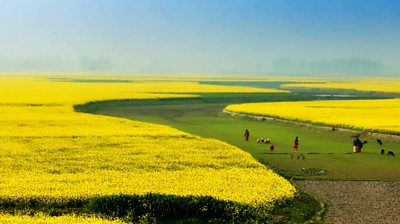
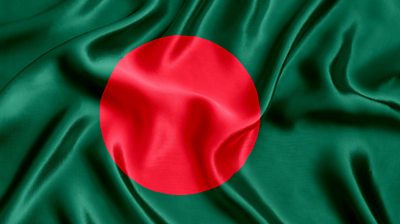
There is an envisioning of nature and the annual cycle as intensely beautiful, as deep green paddy fields turn golden, dark clouds heavy with monsoon rain gradually clear, and flooded fields dry. The Bangladeshi flag holds this dear - the dark green symbolises the trees and fields of the countryside, with the red circle representing the rising sun and the blood of Bangladeshis spilled in the 1971 war for liberation.
FAMILY
The family is central to one’s social life in Bangladesh, forming the basis of individuals’ support networks. The typical household in Bangladesh, especially in villages, often includes several generations. Indeed, if individuals do not live in a village, they will usually still have many relatives.
Family make-up will vary by generations with earlier generations having a more traditional family set up.
In traditional families, fathers are very much the head of the family with mothers tending to look after the more emotional side of family life. But it is clear that women do assert themselves in subtle ways, finding in each other an important source of strength.
In Bangladesh today, and in some first and second UK based generations, arranged marriages are still tradition, although it appears that more and more British Bangladeshis are moving away from this custom and children are setting up independent households and choosing their own life partners. Due to the impact multigenerational households have on each other when children move away this can cause feelings of immense loss and dislocation in families.
Family and community tend to be put before those of the individual and where strong social connections are created, there is an expectation that they will be long-lasting and reliable. Bangladeshis can almost always trust in their social ties for assistance in virtually any activity.
Elders are often viewed as wise and are granted a high amount of respect. Hence, one would adopt a slightly more formal attitude and give precedence to an elder, avoiding remarks that criticise or disregard their status or opinion.
Immigrant families often succeed through collaboration and by putting the needs of those around them first. ‘Immigrant mentality’, once a negative term, has been reclaimed and now describes the unique perspective and qualities that those from immigrant backgrounds bring to the world of business. A key characteristic of many successful immigrants is the family element to their businesses.
The immigrant mentality my father had made him hungry to have something solid he could pass down to his children if the acceptance of Asian people in the workplace didn’t improve. He has passed the information he’s learnt to his children. We are now able to run the business while he can take more of a backseat and reap the fruits of his hard labour.
FOOD
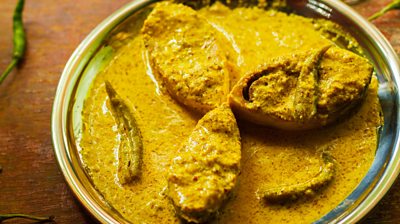
With 85-90% of ‘Indian’ restaurants owned and run by Bangladeshis, Bengali food has been successful at infiltrating British palettes. Flavours vary by region, for example Dhaka in the north is influenced by Persian and Mughal cuisine and hot and spicy food and flavours emerge in the East such as Sylhet.
There are also distinct differences between Bangladeshi and Indian food. The staple carb of Bangladesh is rice whereas wheat- based flatbreads supplement rice in Indian cuisine. Bangladesh is the fourth largest producer of rice in the world.
Rice is eaten every day in all its forms: flattened, puffed, ground and broken. Fried flatbreads such as luchi and porota are usually reserved for breakfast or special occasions. Bangladeshi cuisine is also eaten in courses (as is Bengali food in West Bengal, India) unlike Indian food.
Traditional Bengali dishes include Hilsa/Ilish curry, Biryani and Changri malai curry, which is the most famous Bangladesh curry dish.
LANGUAGE
Bengali (Bangla), is the national language of Bangladesh and is the mother tongue of almost the entire population. Shared with the Indian state of West Bengal, it has evolved over the centuries. However, the indigenous minority groups have their own languages and dialects.
As most Bangladeshis in England come from the rural Sylheti region, they speak Sylheti, a distinct dialect of Bengali. Linguistic heritage is valued, and parents encourage their children to learn Bengali. At home families will often use a combination of Sylheti, Bengali and English while siblings might communicate in English amongst themselves.According to ONS data, there were around 231,000 Bengali speaking people in Britain in 2018, making it the fifth most-spoken language.
Arabic is also learned by children, many of whom attend Qur’an classes at mosques or the madrasah (educational institution).
SPORT
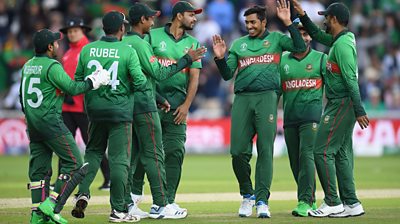
Cricket forms a large part of Bangladeshi culture. It’s a sport where Bangladesh has managed to break into the mainstream, qualify for World Cups and rank in the Top 10. The Bangladeshi cricket team’s performance at the Adelaide Oval in 2015 cemented their undeniable rise in the sport. Rubel Hossain knocked England out of the World Cup, ensuring Bangladesh’s quarter-final berth.
“Cricket is and has been much bigger than winning mere matches – it has given Bangladesh a positive identity and unites the whole country. Cricket has given an entire generation the courage to dream.” -Ahmed Sajjadul Alam Bobby, Cricket Organizer And Director, Bangladesh Cricket Board [2017]
The sport has indeed become a way for the younger generation to connect with their heritage. It’s also a part of Bangladeshi culture that can be shared with others as people who aren’t Bangladeshi have heard of Bangladeshi players like Shakib Al Hasan.
However, Kabaddi is Bangladesh’s national sport, a decision made after Independence by Prime Minister Bangabandhu Sheikh Mujibur Rahman. There were a few eyebrows raised when kabaddi not football, nor cricket - was named the national sport.
However, the complexity of Bangladesh’s formation and the chaotic and bloody aftermath saw competitive football and cricket leagues become less of a priority for the new nation. It’s also possible that there was a need to promote a sport that broke with the colonial past and had roots in the country and kabaddi fit that bill.
Other popular games in Bangladesh include football, hockey and even chess. In fact, Bangladesh has produced many of the world’s best chess players like Niaz Murshed, the first grandmaster out of South Asia (1987).
FESTIVALS
The main religious national holidays are the two festivals of Eid ul-Fitr and Eid-ul-Adha (see Pakistani section for more detail). Eid Festival celebrations in Trafalgar Square are one example of Eid celebrations in London.
In addition to traditional religious Muslim celebrations, the Boishakhi Mela is the Bangla New Year celebration, observed by the Bangladeshi diaspora in the United Kingdom, United States and Canada as well as many other countries with significant Bangladeshi populations.
The main celebration held in Bangladesh and West Bengal, called Pohela Boishakh, dates back to the Mughal reign when Emperor Akbar introduced the Bangla New Year. Since the inception of the Bangla New Year, Bengalis have celebrated the Pohela Boishakh by organising a traditional mela or fair.
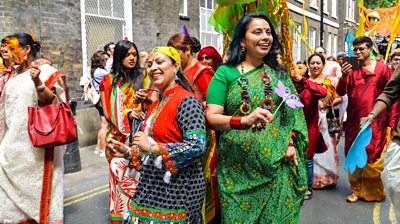
Boishakhi Mela has been celebrated by the Bangladeshi community every year between April and May since 1997 in London’s Banglatown. It is the largest Asian open-air event in Europe, and the largest Bengali festival outside Bangladesh.
The celebration attracts just under 100k visitors and consists of a parade, music events, food and games for the whole family.
EDUCATION
Older generations work hard and put great emphasis on education for younger generations. The strive towards more academic career ambitions is rooted in the hope that their children do not go through the same hardships earlier generations suffered, a sentiment we see in other ethnicity groups too. While this does result in stereotypes that ethnic parents always want their children to become doctors and lawyers, what is often overlooked is the reason behind it.
Bangladeshi parents are also taking female education more seriously, tracing back to 1991 when Khaleda Zia became the first female prime minister in Bangladesh’s history. The country has had a female prime minister for 22 of the last 25 years. The success rates of female students who outperformed boys by eight per cent in 2015 may be evidence of the commitment by young female Bangladeshis and their parents to be taken more seriously.
As Bangladeshis have become more successful, younger generations have become more aspirational.
“Before you were an outlier going to university. As more people did, it started to open the doors.” -Rushanara Ali, the first MP born in Bangladesh in 2010. [2016]
Nasim Ali, a Bangladeshi councillor in Camden believes that, “the focus was on young people getting jobs when they turned 16 a generation ago, but now parents are more willing to spend extra money on tuition”.
MUSIC
Bangladesh has a very rich musical heritage which plays an important role in the lives of the people. The music can be categorized into several genres. The main genres are: classical music (Rabindra Sangeet, Nazrul Geeti), folk songs (Adhunik Gaan) and modern music with western influences. Each of these categories are very broad and can incorporate a number of different styles and musical movements and are most likely to be enjoyed by older generations.
For younger generations, their taste preferences can often gravitate towards R&B and hip hop and taste in non-English music often centres around Bollywood or Indian music.
Whilst Bangladeshi music in the UK today still focusses on traditional sounds there are a rising number of British Bangladeshi musicians fusing their sound with other genres.
An example of this fusion comes from Bangladeshi rap and hip-hop artists who rap with Bengali lyrics especially using the Sylheti dialect. British Bengali rap and hip hop are quite popular and musicians like Anik Khan are playing an important role in the UK music industry, with tracks being played not only on local Asian radio but also on other mainstream radio stations like BBC Asian Network and BBC Radio 1.
RELIGION
The official religion of Bangladesh is Islam which makes up approximately 87% of the nation, and most are practicing Sunni Muslims although there are a small number of Shia Muslims. You can see this visual representation for more information on the different branches of Islam. To read more about Islam, visit the Pakistani chapter.

Media Portrayal
Due to the homogenisation of the ‘South Asian’ identity, and the often lack of character development within film and television, representation in media isn’t often broken down by specific ethnicity. As such the Indian and Pakistani chapters, in particular the associated stereotypes, also speak to this community. Due to limited data on Bangladeshi representation, we haven’t been able to cover as much depth.
Stereotyping people of colour whether it is as criminals, servants or as terrorists continues to be rife in programming. As stereotypes follow ‘South Asian’ we have covered a lot of this ground in the Indian and Pakistani chapters so we would encourage you to read these too.
"Here, in Britain, there are lots of stereotypes of Muslim women. They've all got worse recently. So, if you go for a job or try and get decent housing, you will not be treated equally. Or, even walking down the road in a lot of cities in this country, you are not going to be safe. You are a target of all their stereotypes, which holds us back all the time. This is true for a lot of women but it's even more so for Asian women. You are a target of all their prejudice. So, if you go out of your own area, you have to ask, 'Am I safe here?' -Sajjad, Young British Bangladeshi, an 18-year-old in sales [2005]
Bangladeshis can count on one hand the number of times their country has featured in a Hollywood film. Portrayal of Bangladesh and Bangladeshis in the handful of film around, leave the community not with pride but indignation. Similar themes – lack of authenticity and negatively portrayed people from the Sylheti community are felt by audiences.
Konnie Huq is an English born Muslim, the daughter of parents who emigrated to the UK from Bangladesh in the 1960s. Huq made herself a household name from being the longest serving female presenter on BBC’s Blue Peter having co-hosted it from December 1997 until January 2008. Huq also fronted numerous other shows including Top of The Pops. Her most notable job since Blue Peter was presenting solo The Xtra Factor on ITV2 in 2010.
Huq who stormed to victory in the 2017 Radio Times’ Best Ever Blue Peter Presenter poll says,
A Shift in Media Portrayal
Whilst representation is far from where it should be, there have been some good news stories that have managed against the odds to break-through the barriers and have a profound impact not just on their communities but the whole country.
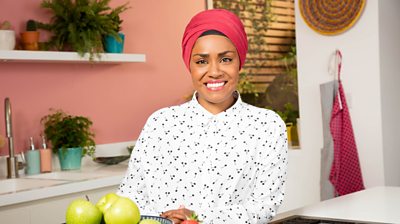
Nadiya Hussain who won the sixth series of The Great British Bake Off in 2015 is a baker, TV chef, presenter, and author.
After winning over Paul Hollywood and Mary Berry with her inventive flavour pairings and flair for presentation, and capturing the nation’s hearts, Nadiya has gone on to publish numerous books, Nadiya’s Kitchen, Nadiya’s British Food Adventure and Nadiya’s Family Favourites to name a few. Nadiya is of Bangladeshi heritage- her parents are first-generation Bangladeshi immigrants to the UK.
Nadiya said her sole aim in life had always been to be a positive role model to her children and she never dreamt she would become an idol to thousands of young Muslims and non-Muslims across the UK.
Alongside the positive interaction Hussain received she also revealed that both she and her husband were met with some abuse after she went on the show. In an interview back in 2016 she said,
She was also asked to bleach her hands before making the Queen’s cake.
Hussain, told columnist and author Yasmin Alibhai-Brown on the opening night of the Asia House Bagri Foundation Literature Festival 2016 that she would have liked her skin colour and religion to have been “unnoticed and incidental” when she won the BBC show.
More recently in 2020, BBC Four released an episode of A Very British History focusing on the history of British Bangladeshis and Bangladeshi emigration to the United Kingdom from the 1960s onwards.
Drawing on rich film archive from the period, meeting those who settled in London and Luton, and through his own experiences growing up in East London, Dr Aminul Hoque tells the stories of Bengalis who worked hard, fought racism and made their homes here over the course of two key decades. Hoque said he deliberately wanted to focus on the many positive and important contributions of migrant communities to the wider socio-cultural scene of British life.
Approximately 452,000 UK residents specified their ethnicity as Bangladeshi, forming 0.7% of the total population.
Life in the UK today
Bangladeshis in England and Wales are largely a young population and are one of the largest immigrant communities, heavily concentrated in London’s inner boroughs. The largest Bangladeshi populations outside London are in Birmingham, where there were an estimated 32,000 Bangladeshis in 2011, Oldham with 16,300, and Luton, Bedfordshire with a population of 13,600.
In early 2020, the Bangladeshi presence in Brick Lane, while noted to still be highly visible, is also under threat. The report Beyond Banglatown Continuity, Change And New Urban Economies In Brick Lane highlights a steep decline in Brick Lane’s curry restaurants, with a decrease of 62% in just 15 years. In the mid-2000s there were 60 outlets compared to just 23 in early-2020.
Gentrification has boomed in the Brick Lane region with the opening of hipster cafés, vintage clothes shops, delicatessens and boutique chocolatiers while Bangladeshi-run curry restaurants have plummeted. This may explain why we are starting to see Bengalis shifting out to other parts of eastern London like East Ham, Ilford, and Barking.
As such activities and cultural flows are now rarely visible in the Brick Lane area; many Bengali residences have been sifted over to other communities, and shops are changing hands as well. For example a renowned Bengali restaurant, Clifton’s, was replaced by a Turkish chain, Efes.
The mini-diaspora may perhaps be related to the younger generation moving on in other areas and taking their families with them, or perhaps the area may not hold the same sentiment for third generations as for first generations.
People from Bangladeshi (26.3%) groups were the most likely to live in the most income-deprived neighbourhoods in England.
Households with younger children, families living on one income (women tend to be stay at home mums especially first and second generation) and the fact that men in some instances tend to be in part time work or self-employment are some of the contributing factors.
Even so, things are looking up. Until 2009 British Bangladeshis in England were performing below the national average but are now the fastest improving ‘BAME’ group with 62% achieving five good GCSEs (including English and maths) in 2015.


Discover more
Code of Practice Progress Report 2024/25
An update of progress on the BBC Creative Diversity Commitment
Elevate
Supporting deaf, disabled and neurodivergent talent in the TV industry.
Reflecting our world
Inspiring organisations around the globe to create content that fairly represents our society.

