Key points about perimeter

The perimeter is the total distance around the edge of a 2D shape.
The total distance is a measure of length. The perimeter of a shape is usually measured in millimetres (mm), centimetres (cm) or metres (m).
Larger perimeters, such as the distance around a coastline, could be measured in kilometres (km) or miles (mi).
Make sure you are familiar with the properties of other 2D shapes as this is useful when calculating perimeters.
Check your understanding
How to find the perimeter of 2D shapes
To find the The total distance around the edge of a shape. of a geometric shape, add up the lengths of all the sides.
The perimeters of some shapes can be expressed using a A fact, rule, or principle that is expressed in terms of mathematical symbols. The plural of formula is formulae. .
For example, the perimeter of a A quadrilateral with opposite pairs of sides that are both equal in length and parallel. All four interior angles are right angles. is equal to the sum of two lengths and two widths, which gives the formula:
𝑃 = 2𝑙 + 2𝑤
When finding the perimeter of a A closed 2D shape bounded by straight lines. All sides are equal in length. All angles are equal. , it is important to remember that all the sides of the shape are equal in length.
Follow the worked example below
GCSE exam-style questions

- What is the perimeter of the regular pentagon?
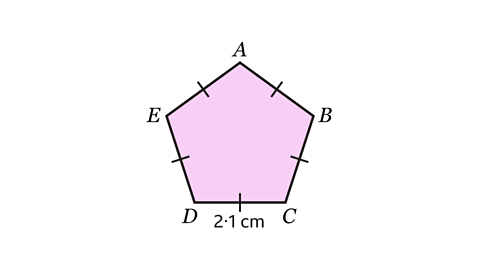
𝑃 = 10·5 cm
In a regular 2D polygon, all the sides are the same length.
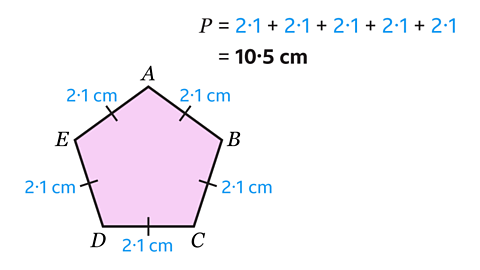
Each side of the pentagon measures 2·1 cm.
Find the perimeter by adding all the sides together.
𝑃 = 2·1 + 2·1 + 2·1 + 2·1 + 2·1 = 10·5
- What is the perimeter of the kite?
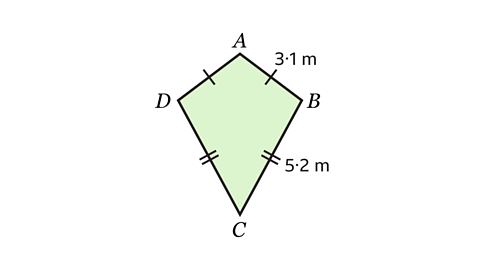
𝑃 = 16·6 m
A kite has two pairs of adjacent sides that are equal in length.
The length of side 𝐶𝐷 is equal to the length of side 𝐵𝐶.
The length of side 𝐷𝐴 is equal to the length of side 𝐴𝐵.
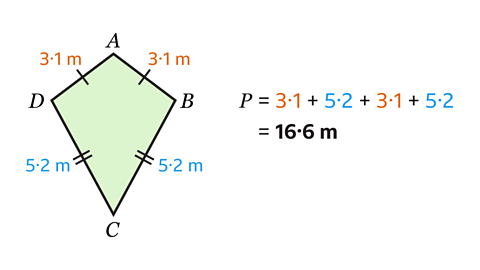
Find the perimeter by adding all the sides together.
𝑃 = 3·1 + 5·2 + 3·1 + 5·2 = 16·6
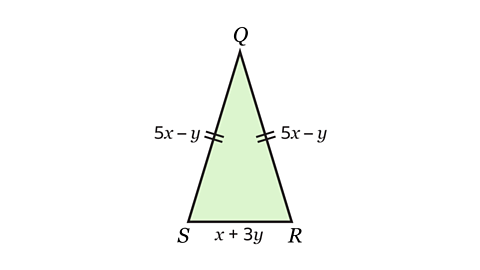
- Find an expression for the perimeter of the isosceles triangle.
𝑃 = 11𝑥 + 𝑦
An isosceles triangle has one pair of sides that are equal in length.
The length of side 𝑄𝑅 is equal to the length of side 𝑆𝑄.
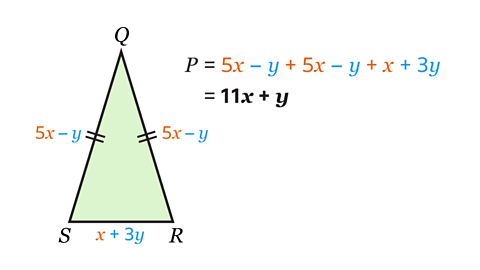
Find an expression for the perimeter by adding the lengths of the sides together.
𝑃 = 5𝑥 – 𝑦 + 5𝑥 – 𝑦 + 𝑥 + 3𝑦.
By collecting like terms the perimeter can be written as 11𝑥 + 𝑦.
Perimeter of compound shapes
A compound (or composite) shape is made up of several 2D shapes.
To calculate the perimeter of a A shape formed by combining two or more shapes. Also called a composite shape. , label and add up the length of each side.
If the length of a side is not given, it can be calculated using the geometric properties of the shape.
Follow the worked example below
GCSE exam-style questions
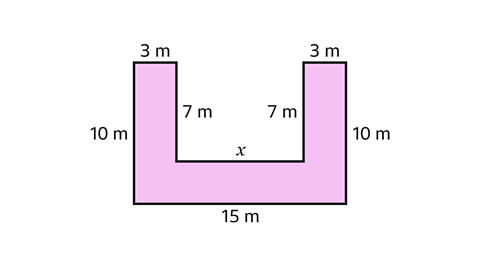
- What is the perimeter of this compound shape?
The perimeter of the compound shape is 64 m.
The lengths of the three shorter horizontal sides must add up to the length of the longest horizontal side.
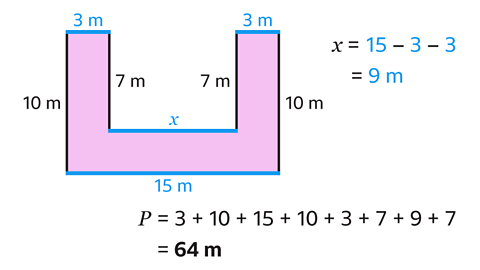
𝑥 = 15 - 3 - 3 = 9 m
Length 𝑥 is 9 m.
Find the perimeter by adding all the lengths of the sides together.
𝑃 = 3 + 10 + 15 + 10 + 3 + 7 + 9 + 7 = 64
- The perimeter of the composite shape is 34 cm. Find 𝑥.
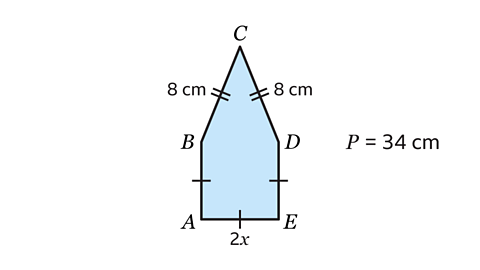
𝑥 = 3 cm
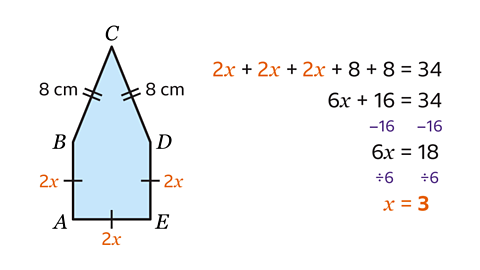
In the composite shape the lengths of sides 𝐴𝐵, 𝐷𝐸 and 𝐸𝐴 are all equal to 2𝑥.
The perimeter of the shape can be expressed algebraically by adding all the sides together.
𝑃 = 2𝑥 + 2𝑥 + 2𝑥 + 8 + 8
Collecting like terms, 𝑃 = 6𝑥 + 16.
The perimeter also equals 34 cm.
Equating these gives the equation 6𝑥 + 16 = 34.
To solve the equation, subtract 16 from both sides.
This gives 6𝑥 = 18.
To calculate 𝑥, divide both sides by 6.
This gives the answer 𝑥 = 3 cm.
Quiz – Perimeter
Practise what you've learned about perimeter with this quiz.
Now you've revised perimeter, why not have a look at angles?
More on Geometry and measure
Find out more by working through a topic
- count10 of 35

- count11 of 35

- count12 of 35

- count13 of 35