Key points about congruent and similar shapes

Two shapes are Shapes that are the same shape and size, they are identical. when both their sides and angles are identical.
Prove two triangles are congruent by showing they satisfy one of four criteria.
Two shapes are One shape is an enlargement of another. The angles in each shape are the same, and the side lengths are in the same proportion. if one is an A transformation of a shape which results in a shape increasing or decreasing in size. of the other. When given two similar shapes, the The ratio between corresponding sides in an enlargement. of the enlargement can be found.
Find missing lengths by using the scale factor.
The relationship between similar shapes may be expressed as a ratio. Make sure you are confident at working with ratios to help understand similarity.
Video – Congruence conditions for triangles
Watch this video to learn how to work out whether two triangles are congruent or not, by considering whether they fit the SSS, SAS, ASA or RHS conditions.
The video contains a worked exam-style question.
Katie: What are the congruence conditions for triangles?
These five triangles are congruent because they are identical in size and shape, but they might look slightly different because some have been rotated or flipped.
There are different ways to tell if two triangles are congruent by looking at their sides and angles.
Triangle B has exactly the same side lengths as triangle A, so these triangles are identical in shape and size.
In other words, they are congruent.
This is an example of the side side side, or SSS, condition.
What about triangle C?
Triangle A and triangle C both have sides of 5 cm and 3 cm, and the angle between the sides is 53 degrees.
This time, triangle C is congruent to triangle A by the side angle side, or SAS, condition.
The triangle D has two angles 37 degrees and 53 degrees, and the side between them 5 cm, equal to the corresponding angles and side on triangle A.
These two triangles are congruent by the angle side angle, or ASA, condition.
And finally, triangles A and E both have a right angle, a hypotenuse of 5 cm, and another side of 3 cm.
They are congruent by the right angle hypotenuse side, or RHS condition.
Let's look at an example question.
Identify which triangles are congruent to triangle A.
Give reasons to support your answers.
Pause the video and have a go.
To start, work out the missing angle in triangle A so that you have all the information.
180 subtract 56 subtract 26 equals 98, so the missing angle is 98 degrees.
Now let's look at triangle B.
This has two angles of 98 degrees and 56 degrees, and a side of 3 cm in between those angles.
Triangle A has the same two angles and side in between.
This means triangles A and B are congruent using the ASA condition.
The two sides and angle in triangle C match two of the sides and angle in triangle A.
Remember, the SAS condition only applies if the angle is in between the two given sides.
Here, the angle is not between the two sides, so SAS doesn't apply.
This means not enough information has been given to determine if triangle C is congruent to triangle A.
The angles in triangle D match the angles in triangle A, but this is not enough to say that they are congruent, as triangle D could be an enlargement of triangle A, but still have the same angles.
Triangle E has a right angle which is equal to 90 degrees.
This does not match any of the angles in triangle A, so these two triangles are not congruent.
Finally, triangle F has two sides of 3 cm and 6 cm and an angle of 98 degrees in between those two sides.
Triangle A has the same two sides and angle in between, so triangles A and F are congruent using the SAS condition.
Remember, two triangles are congruent if they have all three sides the same, SSS, or two sides and the angle in between the same, SAS, or two angles and the side between the same, ASA, or a right angle, hypotenuse and side the same, RHS.
What are the conditions for congruence?
Two shapes are described as congruent if they are identical.
A transformation of a shape which results in a mirror image of the shape with respect to a line.or A transformation of a shape which results in a turning effect on the shape. change the orientation of a shape, but they are still congruent to the original shape.
Congruence conditions for triangles
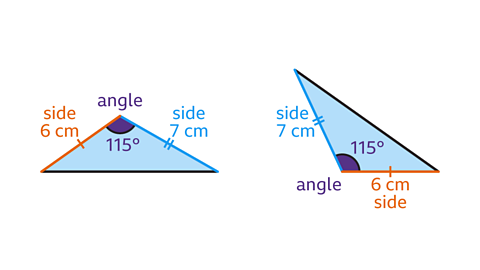
Two triangles can be shown to be congruent by matching one of the four conditions.
Side, side, side (SSS) – If two triangles have three pairs of matching length sides, they are congruent.
Side, angle, side (SAS) – If two triangles have corresponding sides and the An angle between two given sides. that are equal, they are congruent.
Angle, side, angle (ASA) – If two triangles have two corresponding angles and the A side between two given angles. that are equal, they are congruent.
Right-angle, hypotenuse, side (RHS) – If two right-angled triangles have a matching The longest side in a right-angled triangle. and a matching length side, they are congruent.
The first three conditions are equivalent to the information required to construct a triangle.
Follow the worked examples below
GCSE exam-style questions
- What condition do these two congruent triangles meet?
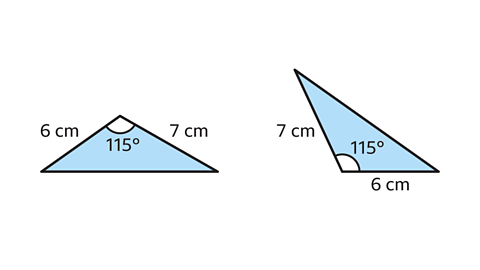
The triangles are congruent by the side, angle, side (SAS) condition.
The triangles have two corresponding sides and the included angle that are equal.
- These two triangles are congruent.
What is the size of angle 𝐹?
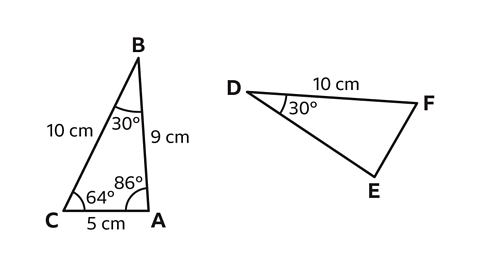
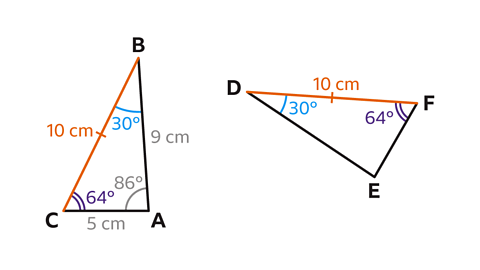
Angle 𝐹 = 64°
The side measuring 10 cm, 𝐵𝐶, corresponds to the side 𝐷𝐹 in the second triangle.
Angle 𝐵, measuring 30°, corresponds to angle 𝐷.
Angle 𝐹, must correspond to angle 𝐶, which measures 64°.
What are similar shapes?
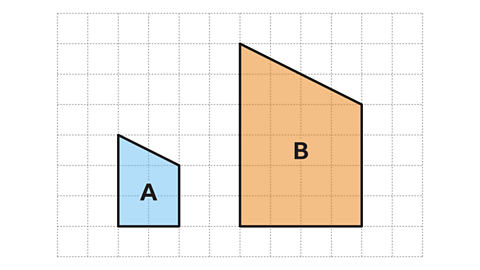
Two shapes are described as One shape is an enlargement of another. The angles in each shape are the same, and the side lengths are in the same proportion. if one is an A transformation of a shape which results in a shape increasing or decreasing in size. of the other.
The sizes of corresponding angles must be equal between the two shapes.
If one side of the enlarged shape doubles in length, all sides must be double the original size shape.
The increase in size from one shape to another is called a The ratio between corresponding sides in an enlargement..
When given two similar shapes, divide the corresponding sides to work out the scale factor.
The relationship between corresponding sides can also be expressed as a ratio.
Similar shapes must also be proportionally the same.
For example, if the length of a rectangle is three times its width, a similar shape must also satisfy this property.
Find missing lengths on similar shapes by calculating and using the scale factor.
Find out more below
GCSE exam-style questions
- Which two rectangles are similar?
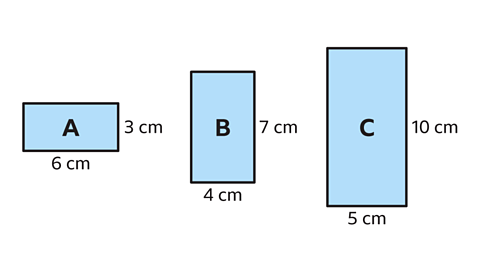
Rectangles 𝐴 and 𝐶 are similar.
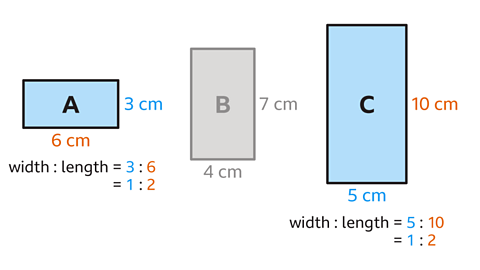
In both rectangles 𝐴 and 𝐶, the length of the rectangle is double the size of the width.
These rectangles are proportionally the same.
The ratio of width to the length simplifies to 1 : 2.
- These boxes are similar.
What is the ratio of the volume of box 𝑋 to box 𝑌?
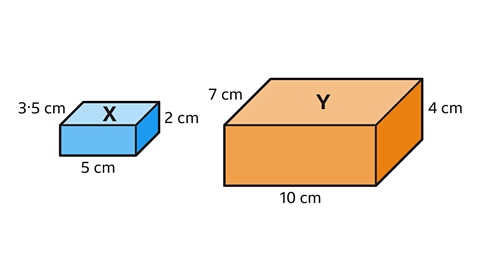
1 : 8
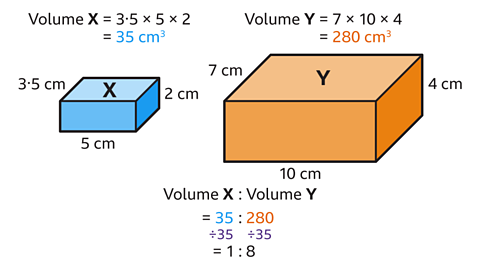
- Find the volume of a cuboid by multiplying the three dimensions.
The volume of box 𝑋 is 3·5 × 5 × 2 = 35 cm³.
The volume of box 𝑌 is 7 × 10 × 4 = 280 cm³.
The ratio of volume 𝑋 to volume 𝑌 is 34 : 280.
- Divide both sides by 35.
The ratio simplifies to 1 : 8.
Using equations to calculate missing sides in similar shapes
Missing lengths on similar shapes can be calculated by forming and solving an A mathematical statement showing that two expressions are equal. The expressions are linked with the symbol =., using the ratio of the sides of each shape.
Use this method when the sides of the shape are expressed using algebra.
Find out more below, along with a worked example
GCSE exam-style questions
- Triangles 𝑃𝑄𝑅 and 𝑆𝑇𝑈 are similar.
Work out the value of 𝑥.
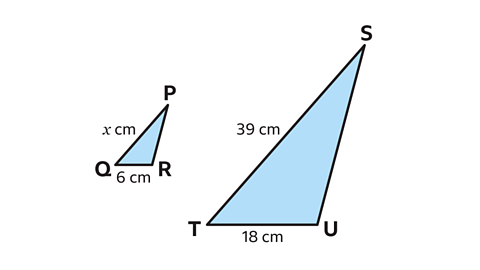
𝑥 = 13 cm
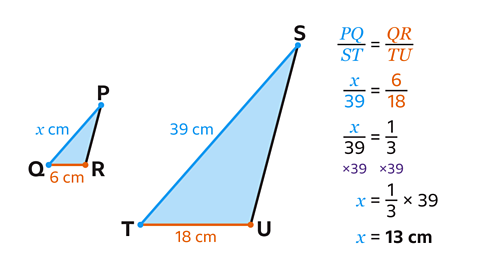
- Find 𝑥 by writing an equation using two pairs of corresponding sides.
For these triangles \(\frac{𝑃𝑄}{𝑆𝑇} \) = \(\frac{𝑄𝑅}{𝑇𝑈} \)
\(\frac{𝑥}{39} \) = \(\frac{6}{18} \)
The fraction \(\frac{6}{18} \) simplifies to \(\frac{1}{3} \) so the equation becomes
\(\frac{𝑥}{39} \) = \(\frac{1}{3} \)
- Multiply both sides by 39 to solve the equation.
𝑥 = \(\frac{1}{3} \) × 39 = 13
- 𝐴𝐵 and 𝐶𝐷 are parallel lines.
𝐴𝐷 and 𝐵𝐶 meet at 𝑃.
Work out the length of 𝐴𝑃.
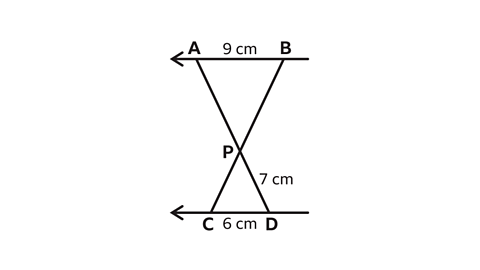
𝐴𝑃 = 10·5 cm
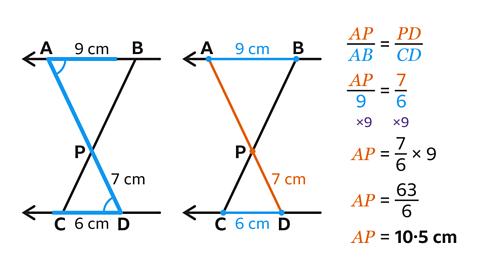
In the triangles, the opposite angles 𝐶𝑃𝐷 and 𝐴𝑃𝐵 are equal.
The parallel lines, 𝐴𝐵 and 𝐶𝐷, means angle 𝐵𝐴𝐷 and angle 𝐶𝐷𝐴 are alternate angles and are equal.
Similarly, angle 𝐴𝐵𝐶 and angle 𝐷𝐶𝐵 are also alternate and are equal. Two triangles are similar is all three angles are the same.
The alternate angles showing implies sides 𝐴𝐵 and 𝐶𝐷 are corresponding, and sides 𝐴𝑃 and 𝑃𝐷 are corresponding.
- Find 𝐴𝑃 by forming an equation using two pairs of corresponding sides.
For these triangles \(\frac{𝐴𝑃}{𝐴𝐵} \) = \(\frac{𝑃𝐷}{𝐶𝐷} \).
\(\frac{𝐴𝑃}{9} \) = \(\frac{7}{6} \)
- Multiply both sides by 9 to solve this equation.
𝐴𝑃 = \(\frac{7}{6} \) × 9 = \(\frac{63}{6} \)
Written as a mixed number, the fraction \(\frac{63}{6} \) is 10 \(\frac{1}{2} \).
Check your understanding
Quiz – Congruent and similar shapes
Practise what you've learned about congruent and similar shapes with this quiz.
Now you've revised congruent and similar shapes, why not look at reflection?
More on Geometry and measure
Find out more by working through a topic
- count26 of 35

- count27 of 35
- count29 of 35