Key points about nets, plans and elevations

The A group of joined 2D shapes which fold to form a 3D shape. of a 3D shape is what a shape looks like when it is opened out into a 2D shape.
Plans and elevations are 2D drawings of a 3D shape when looked at from different perspectives.
A method of drawing a 3D shape from a specific perspective. dot paper is used to draw or visually represent a 3D shape.
When drawing nets to create 3D models, make sure you know how to measure properly using a ruler, and are confident with the process for constructing accurate triangles.
What are nets?

The net of a 3D shape is what the shape looks like when it is unfolded and laid flat.
For example, there are 11 different possible nets for a cube. The net in the shape of a cross, in the top left of the image, is the most commonly used.

The net of any 3D shape, such as a cuboid or tetrahedron, can be drawn, but each face must be measured and constructed accurately.
Find out more about drawing nets
GCSE exam-style questions
- Complete the net for the triangular prism.
The two-dimensional shapes that form a net can be arranged in different ways for a particular 3D shape, so the positions of the triangles in the net can be varied.


The cross-section of the prism is a right-angled triangle with side-lengths 3 cm, 4 cm and 5 cm.
The prism is 2 cm long.
The net is made up of two right-angled triangles and three rectangles.
The dimensions of the rectangles are 3 cm by 2 cm, 4 cm by 2 cm, and 5 cm by 2 cm.
Draw the 5 cm by 2cm rectangle to the right of the two given rectangles. Place the triangles opposite each other, on one of the rectangles.
- A cuboid measures 6 cm by 3 cm by 3 cm. Complete the net for the cuboid.

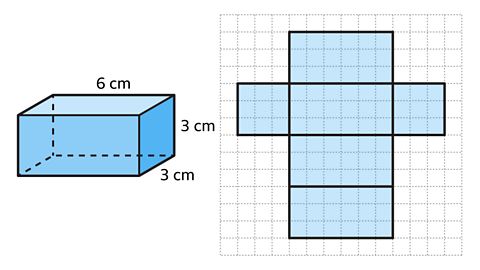
A cuboid has 6 rectangular faces. The opposite faces in a cuboid are always congruent.
In this cuboid, four of the rectangles measure 3 cm by 6 cm. Draw these vertically below the given rectangle.
The two remaining faces are both 3 cm by 3 cm squares.
One of the squares must be attached to the left-hand side of any of the rectangles, with the other square attached to any of the right-hand sides.
How to draw plans and elevations

Plans and elevations are 2D drawings of a 3D shape when looked at from different perspectives.
A plan is a scale drawing showing a 3D shape when it is looked at from above.
An elevation is the view of a 3D shape when it is looked at from the side or from the front.
Find out more about drawing plans and elevations
GCSE exam-style questions
- Here is the front elevation, side elevation and plan view of a 3D shape.
What is the name of the shape?

The shape is a cylinder.

The plan view of an upright cylinder is a circle.
The front and side elevations of an upright cylinder are rectangles.
- A solid shape is drawn on isometric dot paper.
Using squared paper, draw the front elevation, side elevation and plan view of the 3D shape.

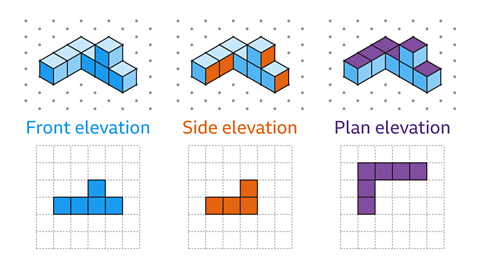
To draw each elevation and the plan view of the shape, consider which faces of the shape will be visible from each perspective.
Each of these faces is a square, so draw a 2D representation of these combined faces.
Quiz – Nets, plans and elevations
Practise what you've learned about nets, plans and elevations with this quiz.
Now you've revised nets, plans and elevations, why not learn about line and rotational symmetry?
More on Geometry and measure
Find out more by working through a topic
- count15 of 35
- count16 of 35