Ensuring structural integrity
Fibres and fabrics can be To strengthen a material that could weaken when a force is applied. or stiffened to improve the The mechanical, physical or optical properties of materials that define how they behave in use. of the material and resist the forces that it is subjected to.
Forces act on materials all the time - even if a material appears stationary it still has a force acting on it. There are five terms used to describe what type of force can act on a material:
- Pulling force exerted by each end of an object such as a string or rope. - a pulling force
- Being squashed. - a pushing force
- A bending force is applied at an angle causing a material to be in compression and tension at the same time. - forces at an angle to the material
- A twisting force. - a twisting force
- A force across a material, eg scissors cut by applying a shear force. - forces acting across the material
Tension
Tension is the force that stretches a fabric. Some fabrics, such as acrylic, have a high Tensile strength is the ability of a material to resist pulling forces without snapping, eg a guitar string has high tensile strength. making them strong and hard to tear, whereas chiffon is an example of a fabric with low tensile strength. A single line of stitching to hold a fabric in shape and stop it being stretched or distorted. around the edge of a fabric can hold it in shape. This simple row of stitching along a curve stops it stretching and becoming misshapen during machine sewing.
Compression
Compression refers to how much a fabric can squash or flatten; heavy knitted woollen fabrics have high compressibility. Fabrics that have high compressibility are usually warm and comfortable as the weave of the fabric can create air pockets that help To help maintain the temperature. the wearer.
Torsion
Being able to twist some fabric is important. Textiles products such as towels need to be The act of twisting fabric in opposite directions to extract liquid. out to dry without being damaged, whereas woollen clothing becomes permanently misshapen if it is twisted.
Bending
Textiles are generally easy to bend. Folds can be used to create pleats or to create volume by gathering. In soft furnishings the edges are often protected from wear by adding A fabric covered cord used as a decorative, protective edge to soft furnishing.. Used to shape a garment on the bust, waist or back by sewing parallel lines on the inside. are folds that are placed and sewn into the fabric, typically carried out to create shape for the user, eg a dress to fit the curves of the body. The fold created by the dart not only alters the How something looks. but also strengthens the fabric, enabling it to resist bending forces at the point of the fold.
Shear
Shear affects a fabric most when it is pulled in opposite directions, and the shear strength of a fabric is affected by the way it is Threads interlocked to make a fabric., knitted or bonded. Plain weave fabrics have the lowest shear strength and tear much easier than knitted fabrics. Shear strength can be improved by weaving a different pattern, eg denim is stronger because it has a twill weave. Knitted fabrics are made up of interlocking fibres and are therefore more resistant to shear and hard to tear.
Image caption,
1 of 3
Reinforcing
Fabrics can be strengthened by Bonding layers of material together to improve strength. or layering them with another fabric or fibre. Bonding fabric layers together to make a laminated or layered fabric can also improve properties such as making them waterproof or warmer. For example, quilting is made from wadding enclosed and sewn between two layers of fabric:
Rows of stitching that act as strengtheners. and Flexible plastic strips used to hold fabric rigid, commonly used in corsetry. can also provide garments such as ball gowns with a strong shape.
Boning is typically made from polyester and comes in thin strips and is used by designers to give a product shape and Resistance to bending., preventing it from deforming under all forces, but particularly bending.
Knitted rib is a method of knitting that creates columns of knit that produce added texture and thickness. is thicker, warmer and more Resistance to bending. than standard knitting.
Stiffening
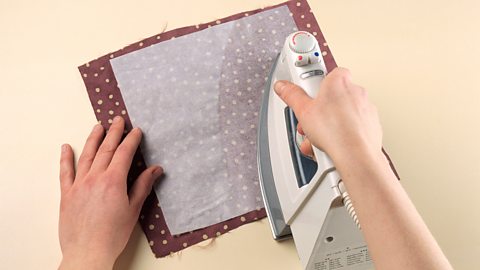
Some products will need to have particular areas of stiffening, such as shirt collars and cuffs. This can be achieved by To attach one material to another with adhesive.Used to add stiffness to a fabric. to the inside, which will be covered by the outer fabric. Interfacing can be stitched or ironed onto the back of a fabric to improve rigidity or add thickness.
Making materials more flexible
The ability of a fabric to regain its shape when stretched can be improved by adding elastic fibres into the blend, eg A durable fibre used in stretchy sportswear., which is used for leggings and sportswear.
