Large-scale production processes
Fibres and fabrics can be formed and shaped using different methods in a Associated with business and profit. setting:
- weaving
- dyeing
- digital Positioning pattern pieces onto fabric in the most economical way, minimising fabric wastage.
- bandsaw cutting
- printing
- industrial sewing machines and overlockers
- automated presses
- A machine used in industrial textile production to shape fabrics.
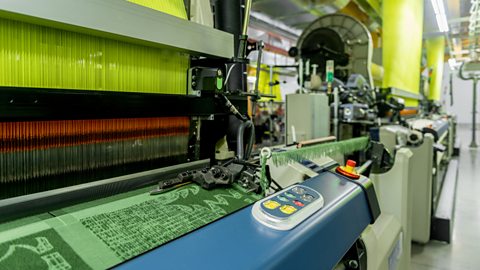
Weaving
Large, automated industrial Machine for weaving threads. are controlled by The process of creating a 2D or 3D design using computer software. software that allows colour schemes and The pattern made when weaving threads in different colours or styles. to be controlled.
Dyeing
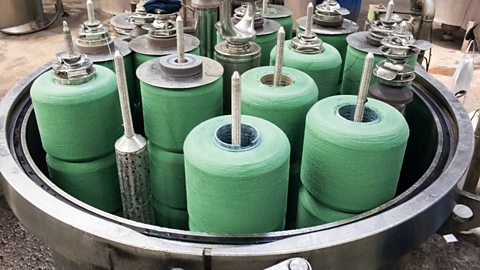
There are several different ways of dyeing fabrics:
- stock or yarn - dyes the fibres before they become fabrics
- piece - dyes pieces of fabric
- garment - dyes clothing once it is made
Dyeing usually takes place in large Large container. before being heated and dried.
Digital lay planning
Lay planning is crucial in the management of material, space and labour. It involves the careful preparation of all parts of a product being laid out on the fabric to minimise waste. The use of computer technology ensures this is accurate before the material is cut out.
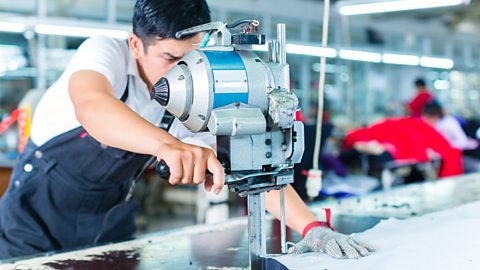
Bandsaw cutting
Bandsaws for fabrics function much like a bandsaw for cutting wood, but have a blade with a different tooth setting suitable for cutting through fabric. It is used to cut large amounts of fabric, either a roll or several layers together, ready for manufacture.
Printing
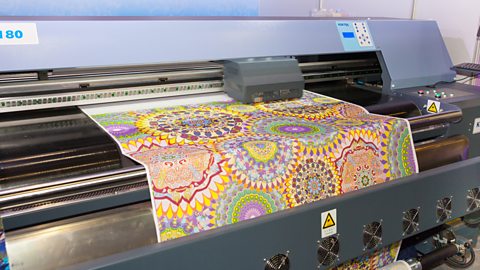
Associated with business and profit. printing prints pattern onto the top surface of fabrics. There are a variety of printing methods available:
Sublimation printing uses A dye suspended in a liquid for printing on to hard surfaces. to print onto coated paper - once heated, the image is transferred onto fabric
Digital printing allows fabric to be printed on directly from an inkjet head - it is expensive but offers a wide range of colours
Flatbed screen printing is when a screen with the stencil of the pattern has dye wiped over it to produce an accurate, repeatable print. A separate screen for each colour is required.
Rotary screen printing or roller printing can be used for long, striped patterns. A roller for each colour has a pattern To stamp a pattern onto a surface so that it stands out. on it. As the fabric passes through, the pattern is added.
Industrial sewing machine and overlockers
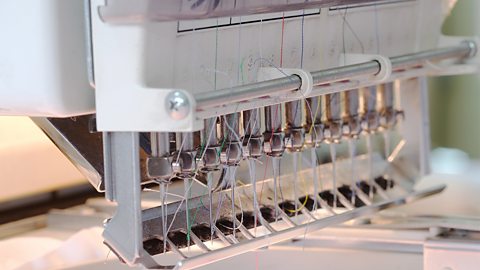
Industrial sewing machines and A multi-threaded machine that is often used to enclose a seam when making clothes. operate in the same way as domestic sewing machines. They are used to stitch materials together, and overlockers stitch and finish seam edges. The main difference from domestic machines is that an industrial sewing machine is built with a more powerful motor and more Strong and long lasting. parts, enabling it to work for several hours at a time. Industrial sewing machines are operated by a trained, skilled A person who uses a sewing machine in the industrial production of textile products., and some machines are equipped with several threads and needles to allow different coloured threads or needles to be used without having to set up the machine at each changeover.
Automated presses
An Turning a set of manual steps into an electronic operation that requires no human input. press uses a large, flat hydraulic press to exert a large force onto the material. This will give off large amounts of heat or steam to remove creases and fully flatten the material, making it presentable and ready to be packaged.
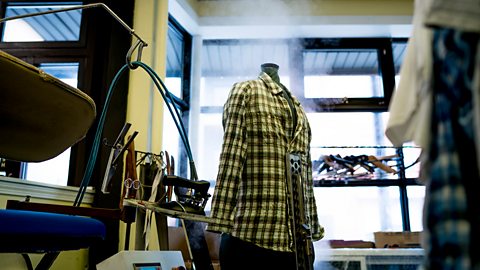
Steam dollies
Steam dollies use a A body-shaped model. to place the clothing on with steam exerted to remove creases on the clothing and ensure full shape to the product.