Governments’ attempts to improve public health
For a long time, national governments took only small steps or ineffective action to improve the people’s health. However, this trend started to change during the 19th century. This case study compares the effectiveness of national government action on public health in industrial Britain and Britain since c.1900.
Government action in industrial Britain, c.1750-c.1900
The 1848 Public Health Act
The act allowed, but did not force, local authorities to take action on public health:
- The act set up the General Board of Health.
- It allowed areas to set up a local board of health and increase the A payment made by householders to their local council. if there was support from 10 per cent of rate payers.
- It forced towns to set up a board of health where the death rate was high.
- By 1853, only 163 places had set up a board of health.
Joseph Bazalgette’s sewers, 1859
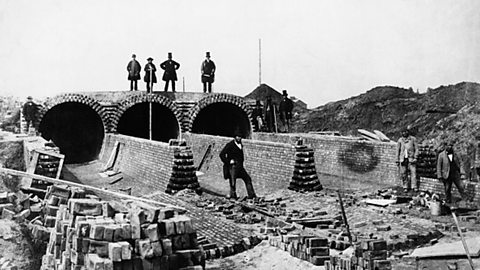
Joseph Bazalgette was the chief engineer of a huge building project that revolutionised London’s sewers following the ‘Great Stink’ of 1858:
- 1,300 miles of new brick sewers were laid.
- Pumping stations took waste eastwards, where it was dumped far downstream of the city.
- London had far fewer deaths from cholera during the next An infectious disease which spreads rapidly to a large number of people in a short period of time. (1865-1866).
- Bazalgette’s sewers are still in use today.
The 1875 Public Health Act
This was much stronger than the 1848 act. All local authorities had to:
- appoint medical officers and sanitary inspectors
- take responsibility for sewers, water supplies, rubbish collection, public toilets and public parks
- ensure all new houses had piped water, proper toilets, drains and sewers
- inspect slaughterhouses and shops
The 1875 Artisans’ Dwelling Act
This act gave local councils the power to buy up slum areas and then clear and rebuild them using government loans. However, only ten towns had used their powers by 1881.
The 1875 Sale of Food and Drugs Act
The 1875 Sale of Food and Drugs Act set basic standards for the quality of food. It also introduced harsh punishments for those who sold Mixing one product, such as food, with other products to bulk it out. or contaminated food.
Government action since c.1900
Housing
| 1909 Housing Act |
|
| 1919 Housing Act |
|
| 1930 Housing Act |
|
| 1945 onwards |
|
| 1909 Housing Act |
|
| 1919 Housing Act |
|
| 1930 Housing Act |
|
| 1945 onwards |
|
Liberal reforms, 1906-1911
The Liberal government of 1906-1911 introduced a series of reforms:
- Local authorities were allowed to provide free school meals so that children would eat at least one decent meal per day.
- Every local education authority had to set up a school medical service. They provided regular medical checks and treatment in school clinics.
- People aged over 70 with no other income received an old age pension of five shillings per week.
- National Insurance gave certain low-paid workers up to 26 weeks of sick pay and free medical care. In some industries, unemployment benefit was available for up to 15 weeks.
The National Health Service
Until 1948, about 8 million of Britain’s population had never seen a doctor because they could not afford it. In 1948, the introduction of the National Health Service (NHS) made health care free to all. The NHS offered a range of services, including hospital care, vaccination and maternity services.
Air quality
The 1956 Clean Air Act required factories and homes in specified areas to burn special types of ‘smokeless’ fuel. The smokeless zones grew over time.
Smoking
| Date | Government action |
| 1964 | Television adverts for cigarettes were banned. |
| 1971 | Tobacco companies were forced to put health warnings on their packaging. |
| 1986 | Cinema adverts for cigarettes were banned. |
| 1998 | The government offered free nicotine replacement therapy for people trying to give up smoking. |
| 2007 | Smoking in all public places was completely banned. This was aimed at tackling ‘passive smoking’ (where non-smokers inhale smoke from smokers), which was killing over 11,000 people every year. |
| 2016 | Parliament passed a law saying all cigarette packaging had to be completely plain, with no attractive colours or designs. |
| Date | 1964 |
|---|---|
| Government action | Television adverts for cigarettes were banned. |
| Date | 1971 |
|---|---|
| Government action | Tobacco companies were forced to put health warnings on their packaging. |
| Date | 1986 |
|---|---|
| Government action | Cinema adverts for cigarettes were banned. |
| Date | 1998 |
|---|---|
| Government action | The government offered free nicotine replacement therapy for people trying to give up smoking. |
| Date | 2007 |
|---|---|
| Government action | Smoking in all public places was completely banned. This was aimed at tackling ‘passive smoking’ (where non-smokers inhale smoke from smokers), which was killing over 11,000 people every year. |
| Date | 2016 |
|---|---|
| Government action | Parliament passed a law saying all cigarette packaging had to be completely plain, with no attractive colours or designs. |
Healthy lifestyles
In 2009, the government launched the Change4Life campaign, which promoted daily exercise and maintaining a healthy diet.
This was particularly aimed at children. It included ideas for after-school activities and healthy recipes that children would enjoy.
Comparing government action in c.1750-c.1900 and since c.1900
Question
How far do you agree that national government took more effective action to improve people’s health in the period c.1750-c.1900 than in the period since c.1900?
- Identify two effective government actions from the industrial period. Make sure you can say why they were effective.
- Identify two effective government actions from the period since c.1900. Make sure you can say why they were effective.
Two examples of effective government action in c.1750-c.1900 are:
- Bazalgette’s sewers
- In 1858, in response to the ‘Great Stink’, the government ordered Joseph Bazalgette to build 1,300 miles of new sewers across London.
- This was effective in improving people’s health because in the next cholera epidemic, fewer people died.
- The 1875 Public Health Act
- The act was effective because it forced local councils to clean up the towns, provide clean water and collect rubbish. New houses had to have piped water and sewers.
- This was a big improvement because before this date, local towns were not compelled to do these things. Most had chosen not to because they involved raising taxes.
Two examples of effective government action since c.1900 are:
- Liberal reforms
- In the early 1900s, the Liberal Party passed a series of laws to tackle poverty, such as Deductions from gross pay which are paid to HMRC towards some benefits, including the state pension. This gave certain workers sickness benefits and free medical care if they became ill.
- These were effective because until then, workers had needed to carry on working through illness or get no pay. This meant they had no chance of affording medical help.
- The NHS
- The NHS was set up in 1948. This was a huge improvement on what had been available before for most people. Until 1948, about 8 million of the British population had never seen a doctor because they could not afford it.
- By making health care free to everyone, the NHS effectively improved the health of millions of people.
Evaluating the effectiveness of government action
On the whole, it would be unfair to say one period was more effective than the other, because the governments of the two periods had to deal with very different problems. National Insurance and the NHS may have had a bigger impact overall, and in a shorter period of time, than measures introduced between c.1750 and c.1900. However, the government only had the opportunity to begin to make improvements in those areas because the more urgent challenges of water supply and waste had already been attended to in the earlier period.
