Living conditions
Towns have always suffered worse living conditions than rural areas, on the whole. This case study compares the main problems faced by people living in towns in early modern Britain and industrial Britain.
Early modern Britain, c.1500-c.1750
By 1750, towns had grown in size as many people moved to find work. Some areas of towns became overcrowded, although this was minor compared to later changes between 1750 and 1900. Only around 20 per cent of people lived in towns.
Middle of the period
Food
- Wealthy people’s diet was enriched with new products from abroad.
- Hunger was common for labourers in times of a bad harvest, when the price of bread increased.
- Hot chocolate, tea and coffee became popular. These were all sweetened with sugar.
- Coffee houses became popular in towns. By 1750 there were over 500 coffee houses in London.
- High consumption of sugar and an unbalanced diet led to rotting teeth, obesityand gout among the wealthy.
- Cheap gin became a big problem in towns. Crime went up, families fell into poverty and there was an increase in the death rate.
Streets and housing
- Streets were made of earth or gravel and got dusty and muddy. They were often covered with animal dung.
- Houses were often three storeys tall with overhanging ‘jetties’, leading to a lack of natural light and dark streets.
- More people began to burn coal on their fires.
- The dust, soot and smoke caused respiratory diseases.
Waste and water
- Water was obtained from conduits or water-sellers.
- Most houses used privies built over a cesspit, which could leak into cellars.
- Scavengers cleared wealthy people’s cesspits every year or two, carrying barrels of excrement through the house. Poorer people emptied their own cesspits, building dunghills in yards or alleys.
- Scavengers collected household waste, such as food and paper, once or twice a week.
- Rats were common, making outbreaks of plague much worse in the towns.
Question
What had changed by the end of the period?
Food - Under the 1751 Gin Act, anyone caught selling gin illegally was imprisoned and whipped for a second offence. A third offence could result in transportation. Gin drinking was hugely reduced.
Streets and houses - Many town councils encouraged builders to construct streets and squares of large terraced houses for wealthy people.By the 1700s, many towns had introduced oil-burning lamps on the streets, streets paved with stone, and footways for pedestrians.
Waste and water - Some towns started to bring in water from the countryside to reservoirs. People could pay for their house to be connected to water pipes.
Industrial Britain, c.1750-c.1900
Towns and cities experienced unprecedented growth in this period. The fast pace of growth also meant that town infrastructures simply could not cope with the pressure of the expanding population.
Middle of the period
Food
- Unskilled workers struggled to buy enough food to feed their whole family. They relied on basics such a bread, potatoes and weak tea. This was an unbalanced diet and caused malnutrition.
- Food adulteration was widespread. For example, milk was sold mixed with chalk and water to make it go further. This caused diarrhoea and food poisoning.
Streets and housing
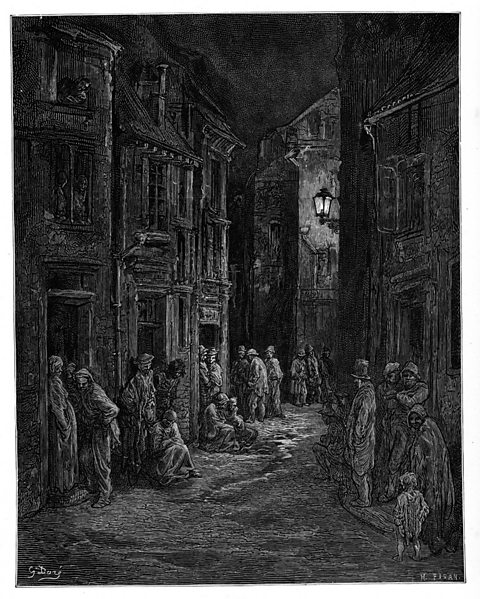
- Workers’ housing was built back to back, often around an enclosed yard. These houses were difficult to ventilate and were often very damp. Diseases such as tuberculosis thrived in these conditions.
- Lodging houses were large houses that had been divided up into smaller rooms. They were dirty and overcrowded, so fleas and body lice were common, causing typhus to spread.
- Cellar dwellings had no sunlight. They sometimes flooded with rain or even sewage from the street.
Waste and water
- Back-to-back houses shared a privy, sometimes between ten houses or more.
- Privies were connected to cesspits. Night-soil men emptied the cesspits. However, if they weren’t paid by landlords, cesspits overflowed into the streets and yards.
- Water companies supplied water to be shared between a court or a street, accessed by a water pump. Water was sometimes only available for a few hours per day.
- Water pumps might be placed near cesspits. These often leaked or overflowed, causing outbreaks of cholera and typhoid.
- Water companies sourced water from the rivers, which were contaminated by human waste and pollution from industry. Even rainwater might be unsafe as it had fallen through the smoke from factories.
Question
What had changed by the end of the period?
Food - The 1875 Sale of Food and Drugs Act set basic standards for the quality of food. It also introduced harsh punishments for those who sold adulterated or contaminated food.
Streets and housing - The 1875 Artisans’ Dwelling Act gave local councils to powers to buy up slum areas to clear and rebuild them. However, only ten towns had used their powers by 1881.
Waste and water - 1,300 miles of new sewers in London were designed by Joseph Bazalgette in 1859. There were far fewer deaths from cholera during the next An infectious disease which spreads rapidly to a large number of people in a short period of time. of 1865-1866.
Comparing living condition between c.1500 and c.1900
Question
How far do you agree that living conditions were the same in early modern Britain and industrial Britain?
- Identify two continuities in living conditions, ie conditions that were the same in both periods.
- Identify two changes in living conditions. These could be conditions that got worse or conditions that improved.
Two examples of continuities are:
- Food and diet
- In the early modern period, poor diet was a problem for the poor. Hunger was common for labourers in times of a bad harvest, when the price of bread increased.
- Many people turned to gin in this period when it became very cheap. Thousands of gin shops opened up in cellars and rooms, increasing crime and leading to a higher death rate.
- By the industrial period, workers’ diets were still unhealthy.
- Low wages meant people struggled to have a balanced diet. They relied on bread, potatoes and tea. Many people were malnourished.
- Waste
- Another continuity was the problem with human waste. In the early modern period, most houses used privies built over a cesspit, which could leak into cellars.
- Scavengers cleared cesspits every year or two, carrying barrels of excrement through the house.
- These methods were not safe for health. They contributed to outbreaks of dysentery and typhoid.
- Similarly, human waste was a big problem in industrial Britain. Night-soil men emptied the cesspits. However, if they weren’t paid, cesspits overflowed into the streets.
- Where there were nearby water pumps, cesspits contaminated the water supply, causing outbreaks of cholera.
Two examples of changes are:
- Housing
- Housing conditions changed a great deal between c.1500 and c.1900. In the early modern period, houses were often three storeys tall with overhanging ‘jetties’. These caused a lack of natural light and dark streets.
- These kinds of problems got much worse during the industrial period because of the rapid growth of towns. Workers’ housing was now built back to back, often around an enclosed yard. The houses were difficult to ventilate and were often very damp.
- Diseases such as tuberculosis thrived in these conditions. By 1800, problems linked to housing were much more widespread than in 1750.
- Waste (by 1900)
- By 1900, some conditions in towns had got much better.
- Joseph Bazalgette designed a modern sewer system for London. Deaths from cholera decreased as a result.
- The 1875 Public Health Act said that all local authorities had to take responsibility for sewers, water supplies, rubbish collection, public toilets and public parks. They also had to ensure that new housing had proper toilets and sewers.
- This meant that by 1900 problems with human waste, although much worse for a time, had actually improved since the early modern period.
Waste could be either a continuity or a change, depending on whether it is being measured in the middle or at the end of the industrial period.
Extent of continuity
On the whole, there was more change than continuity. This is because, by the mid-1800s, although there were still similar problems - such as with waste - they had got much worse because of the rapid pace of industrialisation. Additionally, much had actually improved by 1900 due to government intervention in public health.
