Key features of Britain since c.1900
Since c.1900, there have been many changes in the social, economic and political features of Britain. The social, economic and political landscape in the present day is also very different compared to c.1900, with important implications for the health of people living in Britain.
The role of government
In c.1900
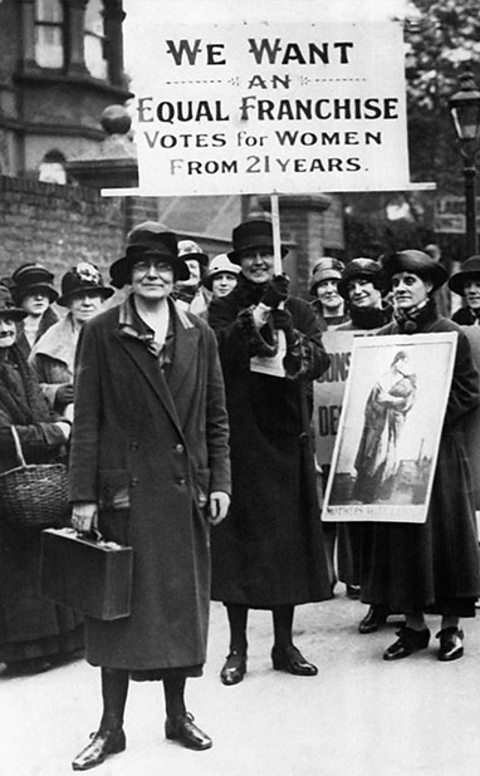
After 1884, most working men over 21 could vote. This forced governments to make further changes to help working people. Between 1906 and 1911, the Liberal Party introduced the first old age A sum of money paid to people upon their retirement., A tax system in the United Kingdom paid by workers and employers to fund state benefits. and free school meals.
Present day
By 1928, women in England had been given the right to vote, meaning every adult aged over 21 could vote. This was one of the factors that led to a growth in the A state (or country) where the government provides welfare benefits, such as education, health care and unemployment payments, to its population free at the point of use, although they are paid for by general taxation. In 1948, the National Health Service (NHS) was set up to protect citizens “from the cradle to the grave”.
Beliefs and attitudes
In c.1900
Most people still went to church, although A person who does not believe in the existence of God or gods. and Someone who holds that it is impossible to know whether some things asserted by theists, such as God or the afterlife, really exist. were growing.
Present day
The influence of religion on people’s lives has decreased. In the 2011 Census (national survey), 63 per cent of people said they were Christian, although most of these people said they did not attend church. In the same census, 28 per cent of people said they had no religion.
It can be said that society has become more open minded on ethical topics. Things that different religions used to preach were spiritually wrong have, in some cases, become somewhat more accepted within certain religious groups and in wider society.
Science and technology
In c.1900
Cars and the use of electricity in people’s homes were becoming more popular. There were new developments in cinema, radio and A system for sending messages or information by wire over a distance. communications. All these things meant that ideas and people could travel around more quickly and easily.
Present day
There has been scientific innovation on a massive scale. Televisions, computers, planes, the internet, phones and other technologies have transformed people’s lives. Medical advances such as Substances that control the spread of bacteria in the body by killing them or stopping them reproducing. have improved the treatment of disease. However, some scientific developments have led to problems, particularly for the environment.
People
In c.1900
The population was around 37 million. The class structure was still fairly rigid:
| The upper classes | The middle classes | The working classes |
|
|
|
| The upper classes |
|
|---|---|
| The middle classes |
|
| The working classes |
|
Present day
The population was around 69.3 million in 2024 and was now much more diverse than in c.1900. After World War Two, migration to Britain from An association comprising the UK, its dependencies, and many former British colonies. countries, such as the Caribbean and India, increased.
Free education was expanded after 1944 and the school leaving age was raised to 15. New universities were introduced in the 1960s. The middle classes have grown but the class system has become much more fragmented.
Work
In c.1900
The working class still mainly carried out manual labour in Britain’s factories, shipyards and mines. However, by 1900, A trade union is a type of organisation whose main purpose is to represent the interests of employees in a specific type of business. had won better wages and safer working conditions. The average working week was 54 hours.
The workface was predominantly male. Working-class women were often employed as domestic servants but were expected to give up work when they married.
Present day
Britain’s economy changed after the 1950s. Jobs in mines, shipyards and factories are now rare and the service industry has grown. Many people now work in areas such as tourism, retail and hospitality. Work is more desk-bound. More women now go out to work. The average working week has become much shorter - between 40 and 45 hours a week.
Leisure
In c.1900
Workers usually had Saturday afternoons and Sundays off work. People went to watch football and cricket, but they also spent much of their free time being physically active: playing sport, cycling or working on an allotment. There was a growth in British seaside holiday resorts, such as Blackpool and Torquay.
Present day
People now enjoy more holiday time. Leisure still involves physical activity for many people, but there has also been a growth in activities involving less physical activity, such as watching sport on television, listening to music and watching films.
