Responses to epidemics
The plague first hit Britain in 1348, but it kept returning until 1670. This case study compares how people in Britain responded to An infectious disease which spreads rapidly to a large number of people in a short period of time. in the medieval and early modern periods.
Medieval Britain, c.1250-c.1500
Beliefs about the plague
Medieval people did not know that the plague, known as the Black Death was spread through rats and fleas. There were three main beliefs about the disease:
- God was punishing people for sinning, or allowing the Devil to test their faith.
- Plague spread through Smells from decomposing material, such as animal and human waste, that were thought to cause disease. - an invisible poison in the air. Some people believed that the movements of the planets were to blame for miasma.
- People with unbalanced Four bodily fluids – yellow bile, black bile, blood and phlegm – used in ancient times to analyse and describe people's state of health. were most likely to catch the disease.
Responses from government
There was only a very limited response from the king and his government:
- In April 1349, Edward III ordered the mayor of London to clean the city’s streets.
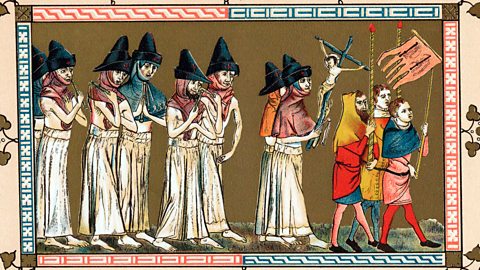
- The king also ordered bishops to organise parades of priests in the cities as a display of public prayer and confession.
Reponses from ordinary people
People tried many things to prevent and cure the Black Death. The methods they tried were based on their beliefs:
| Belief | Responses |
| God’s punishment |
|
| Miasma |
|
| Imbalanced humours |
|
| Belief | God’s punishment |
|---|---|
| Responses |
|
| Belief | Miasma |
|---|---|
| Responses |
|
| Belief | Imbalanced humours |
|---|---|
| Responses |
|
People also tried home-made herbal remedies such as applying camomile lotion to An inflamed swelling of a lymph node, especially in the armpit or groin. They are characteristic of certain infections, such as bubonic plague and syphilis. Some people even placed live chickens and toads on them to warm and soften the swellings.
Early modern Britain, c.1500-c.1750
Beliefs about the plague
There was still no understanding of the role of rats and fleas in how the disease was spread. People held a range of beliefs about the plague:
- It was spread by foul air, or miasma, caused by filthy streets, stagnant water, cats and dogs, or the movement of the planets.
- God was sending the plague as a punishment.
- Towards the end of the period, people put more emphasis on the idea that the disease spread through close contact with other people.
Responses from government
Although there was still a lack of understanding of the real causes of plague, governments were more proactive in trying to prevent its spread during this period:
- In 1518, Henry VIII introduced the policy of isolation in London. His proclamation stated that houses infected with the plague should be clearly identified with bundles of straw, which should be hung from their windows for 40 days. Other towns also took action to shut up infected houses.
- Elizabeth I’s 1578 Plague Orders required infected houses in towns to be completely shut up for at least six weeks, with all members of the family still inside. Watchmen were appointed to enforce this. The orders also instructed People who assisted mayors in running towns and cities. to collect money to support the sick in their town. Streets had to be cleaned, and cleared of dogs, cats and pigeons.
- Elizabeth’s Plague Orders also ordered special prayers to be said in church and the burning of barrels of tar in the streets to clear smells.
- The 1604 Plague Act extended help to sick families and introduced harsh punishments for anyone who broke the policy of isolation.
Reponses from ordinary people
People tried to avoid or cure the plague in many different ways:
- supporting family and friends by bringing them food
- avoiding the sick - sometimes infected children and servants were thrown out of their homes
- sniffing flowers and herbs to avoid miasma
- fasting and praying to God to repent of their sins
- moving out of the town to the countryside - only the rich could do this
- experimenting with a variety of lotions and herbal remedies, made at home or bought from an Someone like a modern-day chemist, apothecaries understood both the healing and poisonous properties of plants and herbs. or plague doctor
- bloodletting to rebalance the humours
Summary of changes and continuities
Question
How far do you agree that responses to plague were the same in the medieval and early modern periods?
Look at the 12 responses listed below.
- Place the responses that apply only to the Black Death in the left circle.
- Place the responses that apply only to plague in the early modern period in the right circle.
- Place the responses that could apply to either period in the middle.
| 1. Blood-letting was used to balance the humours | 2. Families and friends mainly helped - but some did eject infected children or lodgers | 3. People avoided miasma (poisoned air) by sniffing flowers and herbs |
| 4. The rich moved out of towns to the countryside | 5. People avoided touching victims out of a belief that the disease spread from person to person | 6. Central government printed plague orders, which were sent to local government leaders |
| 7. National government did almost nothing to help | 8. Local government (mayors and aldermen) had to carry out plague orders, eg isolating victims, burning barrels of tar and collecting money to aid the sick | 9. People engaged in religious responses, eg prayer, confession of sins and church attendance |
| 10. People used lotions and herbal remedies | 11. People cleaned the streets | 12. Priests ran away from parishes |
| 1. Blood-letting was used to balance the humours |
| 2. Families and friends mainly helped - but some did eject infected children or lodgers |
| 3. People avoided miasma (poisoned air) by sniffing flowers and herbs |
| 4. The rich moved out of towns to the countryside |
| 5. People avoided touching victims out of a belief that the disease spread from person to person |
| 6. Central government printed plague orders, which were sent to local government leaders |
| 7. National government did almost nothing to help |
| 8. Local government (mayors and aldermen) had to carry out plague orders, eg isolating victims, burning barrels of tar and collecting money to aid the sick |
| 9. People engaged in religious responses, eg prayer, confession of sins and church attendance |
| 10. People used lotions and herbal remedies |
| 11. People cleaned the streets |
| 12. Priests ran away from parishes |
Extent of continuity
On the whole, in terms of beliefs and the actions of ordinary people, there was more continuity than change because the cause of the disease remained unknown. However, in relation to government action, there was a huge amount of change. Early modern governments took a much more active role in trying to prevent the spread of the plague.
