Pilgrimage and festivals
Hanukkah
The Jewish festival of lights, celebrated in November or December. It commemorates the rededication of the Temple in Jerusalem and the miracle of one day’s worth of oil lasting for eight days to keep a lamp lit., often called the ‘festival of lights’, is celebrated in November or December. It commemorates the reclaiming of the The central place of Jewish worship in Jerusalem from biblical times until AD70. in the 2nd century AD. The word Hanukkah means ‘rededication’. The Jews had to rededicate the Temple to God.
The Jews had to clean and repair the Temple before they could rededicate it to God. They did this by lighting a lamp called a Seven-branched candelabrum which was lit daily in the Temple and is part of each synagogue.. This was a symbol of God’s presence. They could only find one small jar of oil. This was enough to keep the lamp lit for one day, but miraculously the lamp stayed alight for eight days.
Hanukkah celebrations
Hanukkah is celebrated by lighting one candle on a An eight-stemmed candelabra. One stem is lit on each night of Hanukkah. each night. This symbolises how God looked after the Jewish people at this difficult time.
Doughnuts are often eaten, as well as other foods cooked in oil, to remember the miracle of the oil.
Pesach
The Jewish festival (Passover) which remembers the redemption of the Israelites from slavery in Egypt. (Passover) is a festival held in March or April that celebrates the Jews’ escape from slavery in Egypt. It lasts for seven or eight days and begins with the A Jewish ritual meal, held outside Israel on the first and second day of the Passover festival. In Israel it is held on the first day only., which consists of a service and a meal.
This day must be one that you will remember. You must keep it as a festival to God for all generations. It is a law for all time that you must celebrate it.
Wine is served, as it is at all Jewish festivals. However, on Pesach it takes on another meaning as a symbol of the lambs’ blood painted onto the doorposts to save Jewish children from the final one of the The ten plagues that God sent to Egypt until the Pharaoh released the Israelites as Moses requested.. Unleavened bread eaten by Jews at Pesach. is eaten to represent the fact that the Jews did not have time to let the bread rise before their escape.
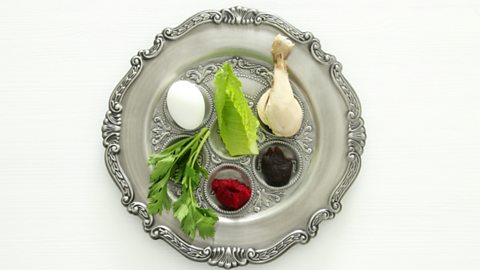
The foods on the seder plate each symbolise a part of the Exodus story, which is retold during the meal using a book of ritual called the The narrative of the Exodus from Egypt, including many stories and songs, that is used as the ritual guide of the Passover seder.. These foods are:
- karpas - a green vegetable dipped in salt water and symbolising both new life and the tears shed by the Jews in slavery
- maror - bitter herbs, symbolising the bitterness of slavery
- baytsah - an egg (not to be eaten), representing sacrifices in the Temple
- z’roah - a lamb bone (also not eaten), representing the lamb sacrificed before the Exodus
- charoset - a sweet paste, reminding Jews that life is sweeter now
Shavuot
Shavuot commemorates God giving the Law; teaching. The word Torah can be used in a narrow sense to mean the first five books of the Hebrew Bible (The Five Books of Moses) and also in a wider sense to include the whole of the Hebrew Bible and the Talmud. to The man chosen by God to save the Jews from slavery and take them to the promised land. In the Qur'an he is a messenger chosen by God to give the revelation of the Torah to the Israelites. on A mountain in the Sinai desert, believed to be where Moses received the Ten Commandments.. It is also a harvest festival. There is no set date for the festival, but it takes place seven weeks (fifty days) after the first day of the spring festival of Pesach, so it is sometimes called the Jewish Pentecost. The word ‘Pentecost’ here refers to the count of fifty days after Pesach.
Jews believe that Shavuot was commanded by God:
From the day after the Sabbath, the day you brought the sheaf of the wave offering, count off seven full weeks. Count off fifty days up to the day after the seventh Sabbath, and then present an offering of new grain to the Lord.
Prayers are said on Shavuot (especially at dawn) to thank God for the Torah and for his law. Some people also spend the first night of Shavuot studying the Torah.
Building for Jewish public prayer, study and assembly. are decorated with flowers and plants on this joyous occasion to remember the flowers of Mount Sinai.
Dairy products are eaten during Shavuot. There are many interpretations of why this custom is observed. It is believed that once the rules about the preparation of meat (called In Judaism, the laws relating to keeping a kosher (fit or proper) home.) had been revealed in the Torah, the people of Sinai were reluctant to eat meat until they fully understood the rules.
