Shabbat
The fourth of the The list of rules, revealed by God to Moses, found in the Old Testament books of Exodus and Deuteronomy. Also known as the Decalogue. tells Jews that they must keep the Sabbath day holy (Exodus 20:8–10). To fulfil this commandment, Jews treat the period from sunset on Friday until sunset on Saturday as a weekly day of rest. This is called The seventh day of the week; a day of spiritual renewal and rest commencing at sunset on Friday and terminating at nightfall on Saturday.. If the scriptures are interpreted strictly, no work, including tasks such as cooking and driving, should be done during this time.
The idea of a day of rest comes from the story of Creation in the Book of Genesis. After creating the universe over the course of six days, God rested on the seventh day. Shabbat is part of the deal between God and the Jewish people, so celebrating it is a reminder of the An agreement or promise. and an occasion to rejoice in God’s kept promises.
Shabbat services in the synagogue
Many Jews go to a Shabbat service on a Saturday morning. This service is called In Judaism, a Shabbat (Saturday) morning service held in a synagogue.. Services vary between different Building for Jewish public prayer, study and assembly., but they tend to follow a broadly similar overall structure:
- The Shabbat service opens with morning blessings, which contain readings from books of the The collected 24 books of the Jewish Bible. There are three sections: Torah, Nevi'im and Ketuvim (TaNaKh). May also be spelled Tenakh. . These help worshippers to enter into the proper reflective and Deep thought. state of mind before the main service begins.
- Next the Major Jewish prayer affirming belief in one God. The Shema is found in Exodus 20:2-14, Deuteronomy and Numbers. prayer and blessings are said, followed by the Shabbat One of the most important and most ancient prayers in Judaism, prayed in a standing position three times daily. Also called Tefillah (Prayer)..
- After the Amidah comes the Law; teaching. The word Torah can be used in a narrow sense to mean the first five books of the Hebrew Bible (The Five Books of Moses) and also in a wider sense to include the whole of the Hebrew Bible and the Talmud. service, during which the The Torah scroll, handwritten on vellum (the skin of an unborn calf). These are kept in the synagogue and are treated with the utmost respect. is removed from the The Hebrew word for the cabinet in a synagogue where the scrolls of the Torah are kept. (ark) and the weekly Torah portion is read.
- Then there is a reading associated with the weekly Torah portion and the Torah is placed back in the ark.
- Finally there is the closing prayer (A key Jewish prayer said at the conclusion of each Sabbath service.), which focuses on the duty to praise God and the hope that one day all human beings will be united in service to God.
Shabbat at home
In Jewish homes, a number of preparations are made before Shabbat. The house is tidied, food is prepared and two candles are placed on the dining table.
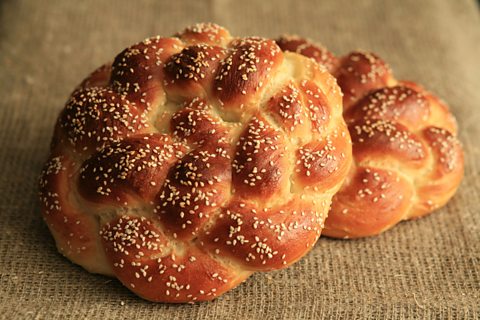
Also on the table will be placed two loaves of A special braided bread eaten on Shabbat. to represent the food God provided for the Jews when they were walking through the desert in flight from Egypt.
On Friday evening, Shabbat is welcomed with the lighting of the two candles. Traditionally, the mother of the family places her hands over her eyes and recites a blessing to welcome Shabbat.
The family eats a meal together on Friday evening. Before any food is eaten, blessings are said for the children, and A prayer sanctifying the Sabbath and festival days, usually recited over wine. is said over the wine to make Shabbat holy. Drinking wine on Shabbat shows that this is a joyful, celebratory time. The bread (challah) is blessed and everyone takes a piece. Typically, the meal lasts for a few hours with everyone enjoying family time, often singing songs and telling religious stories.
On Saturday, after visiting the synagogue, the family shares another meal. The afternoon is spent studying the Torah, relaxing and playing games as a family.
Havdalah
Meaning 'distinction'. Ceremony at the conclusion of the Sabbath separating the Sabbath from the working week. means ‘distinction’. It is the ceremony that takes place on Saturday evening to conclude Shabbat. It recognises the moment that falls between Shabbat and the working week ahead.
The Havdalah service begins as the sun is setting on Saturday evening. Blessings are performed over a cup of wine to thank God for what he has provided. A box of spices is passed around for everyone to smell. This reminds Jews that Shabbat is the spice of the week – a time for reflection, family and rejuvenation before the next week. A candle with several wicks is lit and blessed. The candle brings light into the home after Shabbat has ended.
Different practices
Jewish people differ as to the extent which they keep every rule of Shabbat. Jews who live by the Torah and rabbinic law (halakhah) and who only accept changes that can be supported by the Torah. tend to follow the rules of Shabbat more strictly whereas progressive Jews may be less strict. For example, Jews who have adapted their laws and practices as modern life has changed. may use their phones or drive on Shabbat, but still take time out to relax with their family, eat special meals and observe other rituals.
