Tenakh and Talmud
The The collected 24 books of the Jewish Bible. There are three sections: Torah, Nevi'im and Ketuvim (TaNaKh). May also be spelled Tenakh. is the main sacred Jewish text and governs all aspects of Jewish life.
The The first part of the Christian Bible which corresponds to the Hebrew Bible but is arranged differently. in the Christian Bible is made up of the books of the Tenakh, although they appear in a different order.
The word Tenakh is an A word formed from the initial letters of other words. made up of the three sections found within the book:
- Law; teaching. The word Torah can be used in a narrow sense to mean the first five books of the Hebrew Bible (The Five Books of Moses) and also in a wider sense to include the whole of the Hebrew Bible and the Talmud. (Law)
- Prophets. The second section of the Tenakh. (Prophets)
- Writings. The third section of the Tenakh. (Writings)
Jews place great importance on the Torah and Talmud and consider them to be the source of all the significant teachings in Judaism. Some Jews spend their whole life studying the Torah.
T - Torah (laws and teachings)
The Torah is the first five books of the Old Testament:
- Genesis
- Exodus
- Leviticus
- Numbers
- Deuteronomy
The Torah was given to The man chosen by God to save the Jews from slavery and take them to the promised land. In the Qur'an he is a messenger chosen by God to give the revelation of the Torah to the Israelites. by God and it contains the Commandments or laws in Judaism., including the The list of rules, revealed by God to Moses, found in the Old Testament books of Exodus and Deuteronomy. Also known as the Decalogue..
Sefer Torah and Chumash
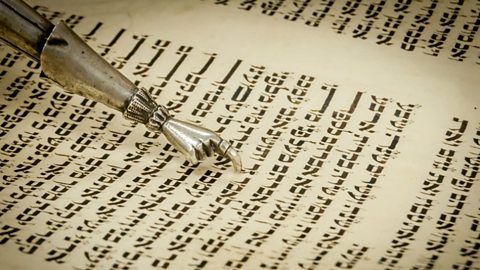
The The Torah scroll, handwritten on vellum (the skin of an unborn calf). These are kept in the synagogue and are treated with the utmost respect. is the Torah scroll, which is handwritten by a specially trained scribe onto Lambskin, kidskin, or calfskin treated and prepared for writing on.. This is treated with the utmost respect. It is an honour to be asked to read from it at a service in the Building for Jewish public prayer, study and assembly., and importantly no one is allowed to touch it with their bare hands. Instead, a pointer called a Hand-held pointer used in reading the Torah. is used to follow the words.
A The Torah in printed book format. is a printed version of the Torah in the form of a book. Although it carries the same message, it is not treated with the same reverence as the Sefer Torah.
N - Nevi’im (prophets)
The Prophets. The second section of the Tenakh. consists of eight books that trace Jewish history and say more about Jewish laws. Each of the books is named after one of eight prophets who are believed to have been chosen by God to encourage Jews to follow God’s laws.
There are two sections to the Nevi’im. These are the former and the latter prophets. The books of the former prophets talk about the history of the Israelites. The books of the latter prophets contain the words of 15 prophets, including Isaiah.
K - Ketuvim (writings)
The Writings. The third section of the Tenakh. contains 11 books, including A book in the Old Testament (Hebrew Bible) containing songs of praise and worship. and A book within the Ketuvim of the Tenakh; A book in the Old Testament.. Many of these books contain writings on philosophy.
The Talmud (oral law)
The Torah is Universally valid, or capable of being viewed without relation to other things. and everlasting. However, as the world changes, some Jews look for new interpretations of the Torah’s words. The A work that is part of rabbinic oral law and made up of the Mishnah and the Gemara (a commentary on the Mishnah). helps with this as it interprets the laws of the Torah and relates them to modern issues.
The Talmud is a collection of teachings and discussions from early An ordained Jewish religious leader who is trained in interpreting and applying the sacred scriptures to contemporary issues and circumstances. about the Torah. It is split into two parts:
- The Literally ‘teaching’, the first document of rabbinic Judaism, assumed to have been written down from the oral tradition about AD200. was compiled by Rabbi Judah Ha’Nasi, who wrote down the oral law so that it could not be misinterpreted in the future. The Mishnah explains how to apply and follow the mitzvot.
- The The Talmud’s commentary on the Mishnah. is a collection of discussions and comments relating to the Mishnah.
Question
What do the letters T, N and K stand for?
Torah, Nevi’im and Ketuvim.
