Yom Kippur
The Day of Atonement in the Jewish calendar. This is the most sacred and solemn day of the year for Jews. is the holiest day of the Jewish calendar. It is also called the Day of A person atones when they show they are sorry for doing something wrong.. Jews focus on asking God for forgiveness as it is believed that he will make his final judgement on the day of Yom Kippur sometime in the future.
On this day atonement will be made for you, to cleanse you. Then, before the Lord, you will be clean from all your sins.
Kapparah
On the eve of Yom Kippur, some Jews who live by the Torah and rabbinic law (halakhah) and who only accept changes that can be supported by the Torah. practise a ritual called Kapparah. In this ritual, Jews hold a live rooster (for a man) or a hen (for a woman) above their head and swing it three times in a circle. At the same time, the person says: This is my exchange, my substitute, my atonement; this rooster [or hen] shall go to its death, but I shall go to a good, long life, and to peace.
The bird is then killed and the meat is donated to the poor for food. In this ritual, Jews hope that the sacrifice of the animal will make up for (atone for) their sins.
Yom Kippur synagogue services
The most important part of Yom Kippur is the time spent in the synagogue. It is the only day of the year when the synagogue holds five services. The day is spent in continuous prayer for forgiveness. The sound of the A ram's horn that is blown like a trumpet, especially during Rosh Hashanah and Yom Kippur. marks the end of the holy day.
Neilah
In Judaism, the last, closing service of Yom Kippur. is the last of the five Yom Kippur services. As the service that closes Yom Kippur, it is considered the most sacred of the year. The service is full of solemn melodies and prayers. When the shofar sounds at the end of the Neilah service, the day-long fast that marks Yom Kippur is over. Many Jews view the Neilah as representing the symbolic closing of the gates of Heaven, which will happen when God’s final judgement is passed on humans.
Sukkot
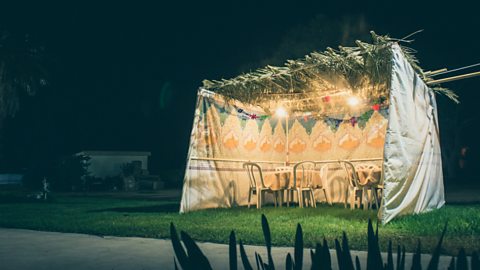
A festival which celebrates the harvest and commemorates the period after the Exodus, when the Jews wandered in the wilderness. occurs five days after Yom Kippur and is typically celebrated for eight or nine days. During this festival, Jews eat and sometimes even sleep in their own sukkah as a reminder of their ancestors who lived in this way in the wilderness.
Question
Which day is regarded by Jews as the most solemn and sacred of the year?
Yom Kippur (the Day of Atonement).
