Features of the synagogue
Building for Jewish public prayer, study and assembly. means ‘assembly’. A synagogue is a place of worship for Jews. It is also an important centre for Jewish communities where meetings take place and social gatherings happen.
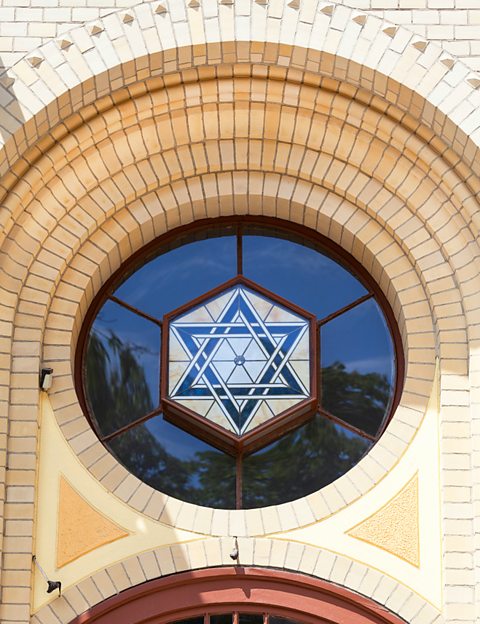
On the outside of the building there is a A six-pointed shape of two interlinked equilateral triangles. Used as a Jewish and Israeli symbol. and often a Seven-branched candelabrum which was lit daily in the Temple and is part of each synagogue..
There are certain features that appear in all synagogues, regardless of whether they are Jews who live by the Torah and rabbinic law (halakhah) and who only accept changes that can be supported by the Torah. or Jews who have adapted their laws and practices as modern life has changed..
Key features of a synagogue
There are no images of God or people in a synagogue, as the The list of rules, revealed by God to Moses, found in the Old Testament books of Exodus and Deuteronomy. Also known as the Decalogue. forbid making and worshipping idols.
- The Hebrew word for the cabinet in a synagogue where the scrolls of the Torah are kept. - All synagogues have a large cupboard facing Jerusalem called the aron hakodesh. It symbolises the The box that the Ten Commandments were believed to have been kept in., which held the tablets of stone on which were carved the Ten Commandments received by The man chosen by God to save the Jews from slavery and take them to the promised land. In the Qur'an he is a messenger chosen by God to give the revelation of the Torah to the Israelites.. It is the centrepiece of the synagogue and holds the Law; teaching. The word Torah can be used in a narrow sense to mean the first five books of the Hebrew Bible (The Five Books of Moses) and also in a wider sense to include the whole of the Hebrew Bible and the Talmud. scrolls. The aron hakodesh is thought of as the holiest part of the synagogue.
- The Torah scroll, handwritten on vellum (the skin of an unborn calf). These are kept in the synagogue and are treated with the utmost respect. - The Sefer Torah is a scroll kept inside the aron hakodesh. Handwritten by a scribe, it is covered with a mantle or cloth that is ornately decorated.
- The always-burning lamp that hangs near the ark in a synagogue. - A light above the aron hakodesh that never goes out:
Keep the lamps burning before the Lord (Exodus 27:20)
- A raised platform primarily for reading the Torah in the synagogue. Also known as a dais. - A raised platform with a reading desk. From here, the Sefer Torah is read. The bimah is often placed in the centre of an Orthodox Jewish synagogue, whereas Reform Jewish synagogues often have the bimah close to the aron hakodesh. The bimah represents the altar in the The central place of Jewish worship in Jerusalem from biblical times until AD70..
There are no images of God or people in a synagogue, as the second of the Ten Commandments forbids The worship of an idol, object or person instead of God.:
Do not represent [such] gods by any carved statue or picture of anything in the heaven above, on the earth below, or in the water below the land. Do not bow down to [such gods] or worship them. I am God your Lord, a God who demands exclusive worship.
A day in the life of Jess, a young Progressive (Reformed) Jew
A day in the life of Nachi, a young Orthodox Jew
Mikveh
The Jewish ritual bath for immersion to restore ritual purity. may be found in a synagogue and is a large bath where Jewish purification rituals take place. The water must be non-flowing and from a natural source such as a lake, sea or rain water. Jewish women are required to bathe in the mikveh before marriage. Being fully submerged in the mikveh is an important part of converting to Judaism for many Jewish communities.
The Temple
Until around AD70, temple worship was a central feature of Judaism. The Jews built two temples, both of which were destroyed by their enemies. In the temples, Jews made animal sacrifices to please God. This was done on a sacrificial A table used for Eucharist, Mass, Lord’s Supper. Some denominations refer to it as Holy Table or Communion Table.. The bimah in the synagogue reminds Jews of this.
Wherever possible, synagogues face the city of Jerusalem, where the The central place of Jewish worship in Jerusalem from biblical times until AD70. once stood. For synagogues in the UK, this means that they face east. Jews ensure they are facing Jerusalem when they are praying.
Question
How does the aron hakodesh remind Jews of the Temple?
The aron hakodesh is the cupboard that houses the Torah scrolls. The cupboard resembles the Ark in which the stone tablets engraved with the Ten Commandments were kept in the Temple.
