Marriage and death rituals
Marriage in Judaism shows holiness in everyday life and fulfils the commandment to be fruitful and multiply (Genesis 1:22). A spiritual bond is created through the merging of two souls:
Hence a man leaves his father and mother and clings to his wife, so that they become one flesh.
Kiddushin (betrothal)
Betrothal, or Betrothal. The first stage of the Jewish wedding process., is usually a 12-month engagement period before a wedding. For Jews, this is the first stage of the wedding process. Traditionally, a ceremony is held a year before the wedding to mark the betrothal.
Wedding ceremony
A Jewish wedding can happen on any day other than The seventh day of the week; a day of spiritual renewal and rest commencing at sunset on Friday and terminating at nightfall on Saturday. or one of the Jewish festivals. There are several stages to the wedding ceremony:
- The couple To go without food and drink for a set period of time. before the wedding to cleanse themselves of Act of rebellion or disobedience against the known will of God in Judaism, Christianity or Islam.. Additionally, Jews who live by the Torah and rabbinic law (halakhah) and who only accept changes that can be supported by the Torah. couples do not see each other for a week before the wedding ceremony.
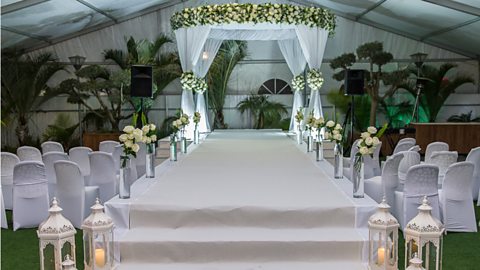
- A wedding ceremony happens underneath the A canopy used during a Jewish wedding. It is representative of the couple’s home.. The chuppah symbolises the home that the bride and groom will share together. The groom gives the bride a ring. Alternatively, in Jews who have adapted their laws and practices as modern life has changed., the bride and groom tend to give rings to each other.
- Seven wedding blessings are recited, including praise to God for his creation.
- The An ordained Jewish religious leader who is trained in interpreting and applying the sacred scriptures to contemporary issues and circumstances. blesses the couple.
- The bride and groom sign the Jewish marriage contract stating the rights and obligations of both partners. in front of witnesses. This contract can include the bride’s rights, particularly if a divorce were to happen.
- The bride and groom share a glass of wine. The groom then breaks the glass under his foot to show regret for the destruction of the The central place of Jewish worship in Jerusalem from biblical times until AD70. and to symbolise the fact that life involves hardship as well as happiness.
- The people at the wedding wish the couple good luck.
- The bride and groom have a short period of time together in a private room.
- There is a wedding reception. Orthodox Jews also have separate receptions for men and women before the wedding.
Death and mourning rituals
Death in Judaism triggers a series of important rituals. As soon as a Jew hears of the death of a loved one, they make a tear in their clothing to show their grief. This action is called The ritual tearing of an item of clothing performed by a mourning relative or close friend in Jewish custom. This is a symbol of loss and grief. Sometimes a black ribbon is worn on the clothing and this is cut instead. and it is a symbol of loss and grief.
Upon death, the eyes are closed (if they are not already) and the body is washed and prepared for burial. The Mourner's prayer in Judaism, traditionally recited by the oldest son on the occasion of a parent's death. is a prayer for people who mourn. It is usually said by the deceased’s eldest son on the day of the death. This prayer is said to help people focus on God at a time when they may feel far from him.
A person who was a close relative (a parent, child, sibling or spouse) of the deceased becomes an In Jewish mourning rituals, an onan is a person who has experienced the death of a close relative (a parent, sibling, spouse or child) who has not yet been buried. while awaiting the burial. Out of respect for the deceased person, the immediate relatives must be fully focused on the burial of the person who has died, even if they are not involved in making burial arrangements.
In Jewish tradition, burial should happen as soon as possible after death. The coffin should be simple to show equality. The burial ceremony takes place at a cemetery, not in a Building for Jewish public prayer, study and assembly..
Funeral services include prayers, psalms and a A speech at a funeral outlining the good deeds and values of the person who has died.. Families must buy a gravestone so that the dead are not forgotten.
Stages of mourning
| Shiva | Avelut | Yahrzeit |
| Shiva is the first seven days of mourning after the burial. Some Jews (particularly Orthodox Jews) do not leave the house during this period of mourning. Instead, others visit them and create a minyan for communal worship in the home. | If someone has lost a parent, they will mourn for a whole year. During the avelut year, they will not attend parties and will say a blessing called the kaddish every day. | Yahrzeit is the anniversary of a death. The night before, many Jews light a candle in remembrance of the dead person, which is kept burning for 24 hours. The kaddish is said on this day. People may fast and make charitable donations to mark the anniversary of a death. |
| Shiva | Shiva is the first seven days of mourning after the burial. Some Jews (particularly Orthodox Jews) do not leave the house during this period of mourning. Instead, others visit them and create a minyan for communal worship in the home. |
|---|---|
| Avelut | If someone has lost a parent, they will mourn for a whole year. During the avelut year, they will not attend parties and will say a blessing called the kaddish every day. |
| Yahrzeit | Yahrzeit is the anniversary of a death. The night before, many Jews light a candle in remembrance of the dead person, which is kept burning for 24 hours. The kaddish is said on this day. People may fast and make charitable donations to mark the anniversary of a death. |
