The synagogue – worship and community
The main services in the Building for Jewish public prayer, study and assembly. happen in the prayer hall, which is usually rectangular with seats on three sides facing inwards. Usually a An ordained Jewish religious leader who is trained in interpreting and applying the sacred scriptures to contemporary issues and circumstances. will lead these services. Often a An official who sings liturgical music in a synagogue., called the hazzan, stands at the front facing the The Hebrew word for the cabinet in a synagogue where the scrolls of the Torah are kept. to lead prayers, which are often sung or chanted. The The literal meaning is order, ie the order of the synagogue service. The term is used for the daily prayer book used by Jews. is used during each service. It contains the daily prayers.
Opening prayers are usually said, followed by the Major Jewish prayer affirming belief in one God. The Shema is found in Exodus 20:2-14, Deuteronomy and Numbers., which declares faith in only one God:
Hear O Israel, the Lord our God, the Lord is one.
Services also contain readings from the Law; teaching. The word Torah can be used in a narrow sense to mean the first five books of the Hebrew Bible (The Five Books of Moses) and also in a wider sense to include the whole of the Hebrew Bible and the Talmud.. These are followed by final prayers, such as the A key Jewish prayer said at the conclusion of each Sabbath service., which is a prayer that praises God.
Worship in Orthodox synagogues
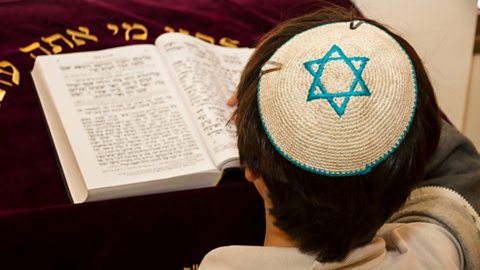
Jews who live by the Torah and rabbinic law (halakhah) and who only accept changes that can be supported by the Torah. synagogues hold three daily services in Hebrew. These are known as Shacharit (morning), Minchah (afternoon) and Arvit (evening). The person leading the congregation faces the aron hakodesh. Men and women sit separately, and men cover their heads with a skull cap called a Head covering worn by Jews as a sign of their Jewish identity. . Married women wear a scarf over their head or a hat, which shows respect for God. Orthodox Jews often sway, which helps them to concentrate on the words being said.
Worship in Reform synagogues
Jews who have adapted their laws and practices as modern life has changed. synagogues don’t usually have daily services like those held in Orthodox synagogues. However, when they do, the service is in both Hebrew and the language of the country the synagogue is in. Reform synagogues hold their main services on The seventh day of the week; a day of spiritual renewal and rest commencing at sunset on Friday and terminating at nightfall on Saturday.. Men and women sit together, and often musical instruments are played.
Differences between Orthodox and Reform synagogues
Men and women sit in separate sections in Orthodox Jewish synagogues, while Reform Jews of different genders sit together to worship. In most Orthodox synagogues, only men can be counted in the minyan, whereas in Reform synagogues women are included too.
Question
Which prayer is a declaration of faith in only one God?
The Shema.
