Are dinosaurs coming back?
When you think about bringing back dinosaurs, particularly via their DNA, your mind probably goes to the original Jurassic Park film, in which scientists extracted dinosaur DNA from preserved mosquitoes and used it to recreate the giant reptiles.
While that’s still the stuff of science fiction, scientists have been making new discoveries when it comes to dinosaur fossils.
Read on to find out if dinosaur DNA still exists and, if we could re-create dinosaurs, would you even want to…?
1. Does dinosaur DNA still exist?
“DNA is a whole long sequence, and there’ll be bits missing.” – Professor Susannah Maidment, Natural History Museum
The short answer is no. That’s because DNA, the genetic code that makes up our genes and which dictate each creature’s specific characteristics, degrades over time. The oldest DNA found in a fossil was one million years old. Dinosaurs lived on earth between 66 and 245 million years ago – too long ago for their DNA to still be intact.
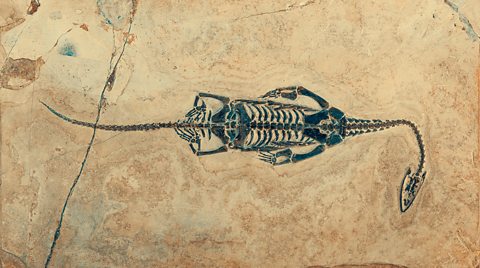
But what scientists have discovered is dinosaur collagen: not a beauty treatment but the protein which supports animals’ skin, bones, muscles and tissues. Researchers at the University of Liverpool, among others, found bits of collagen in the hip bone of an Edmontosaurus fossil.
While that raises the possibility of scientists finding bits of DNA, in fossilised blood for example, it will likely be too damaged, and there’s not enough of it, to make a dinosaur.
Dinosaur expert Professor Susannah Maidment from the Natural History Museum explains: “DNA is a whole long sequence, and there’ll be bits missing… If you just have fragments of DNA you don’t really know where your holes are, because you’ve got a bit there and a bit there, so you don’t really know how all these bits go together.”
2. Are scientists bringing back dinosaurs?
Even though scientists have found collagen inside fossils, it doesn’t mean they’re bringing dinosaurs back. The closest we might get to bringing back an extinct species is something from the Ice Age, the pleistocene, which is thousands rather than millions of years ago.
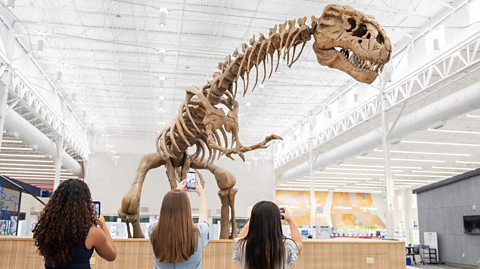
Professor Maidment says: “With much more recent animals there’s a much greater chance of bringing those back from the dead.” She explains that with animals like mammoths, we have their blood and their genome, the complete set of their DNA, so we could in theory bring them back, but, “there’s a much broader question about why you would want to do that."
When asked what life would be like if dinosaurs and humans did exist together, she adds: “I think we’d be dead quickly! They’re a different sort of predator than we have on earth now, much larger than any predatory animal that’s after us today. [Also]… did you not see the film?!”
3. Will artificial intelligence recreate dinosaurs?
It still seems extremely unlikely that artificial intelligence (AI) will bring dinosaurs back, based on the lack of viable DNA. However, AI could potentially help with other more recently extinct species. As Professor Maidment says, AI can “speed up the analysis of large data sets,” which might make it quicker and easier to sequence mammoth DNA, for example.
4. Do we know everything about dinosaurs?
While it may seem like an anticlimax, analysing dinosaur fossils and the products found inside them can still tell us a lot about dinosaurs and what earth was like all those millions of years ago. Professor Maidment adds that so far: “We’ve probably uncovered much less than one per cent of all the dinosaurs that ever lived!”
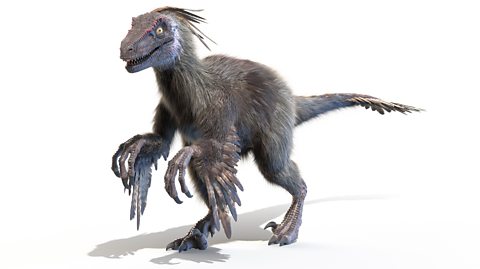
In the meantime, keep yourself occupied with these 5 fun facts about dinosaurs:
- Many dinosaur species had feathers, including Velociraptors.
- Birds are descended from dinosaurs
- Most dinosaurs didn’t carry babies, they built nests and laid eggs
- The T-rex lived closer to us in time than to the Stegosaurus
- Dinosaur fossils have been found on all seven continents of the world
Where can I learn more about dinosaurs?
It's not quite Jurassic Park… but the Bitesize website has lots more fun and interesting dinosaur content for you to enjoy!
- Horrible Science: Meteor for the Dinosaurs
- How dinosaurs footprints get made in solid rock
- Why did this fake dinosaur image go viral?
- Walking With Dinosaurs: What do we get wrong about these amazing creatures?
- Did an asteroid kill the dinosaurs?
If you're interested in other unusual animal facts, check out these pages:
