What can you find in outer space?
Space, the final frontier. A silent expanse hanging 62 miles from the Earth's surface. Space has been a fascination of scientists and stargazers for centuries, but what can you actually see in space?
Well, here at BBC Bitesize, we've put together a breakdown of some of the things you might see when staring up at the night sky.
1. Meteoroids
What is a meteoroid?
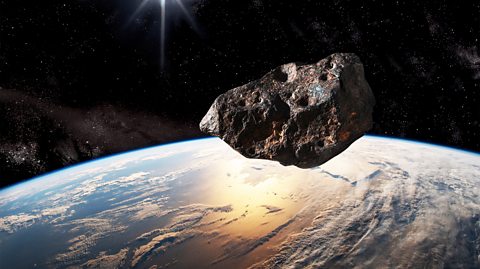
A meteoroid, not to be confused with a meteorite, is the name given to a piece of space rock whilst it's still in space.
Meteoroids come in a range of shapes and sizes. Some are no bigger than a grain of sand, whilst others are closer to the size of a small asteroid.
Meteoroids can originate in a number of places, most are actually pieces of asteroids that have broken off the main bodies - whilst others have been known to come from the Moon or even other planets!
2. Meteorites
What is a meteorite?
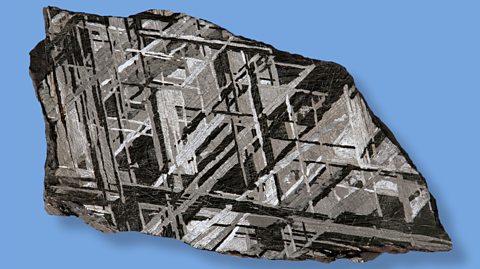
Most meteoroids that make their way to Earth burn up on their descent through the atmosphere. But in some cases, small sections of these survive the trip and make their way to the surface - these are called meteorites.
Generally sizing up somewhere between a pebble and a fist, meteorites come in three main categories:
- Iron meteorites
- Stony-iron meteorites
- Stony meteorites
Usually far older than any rock found on Earth, meteorites are vital tools for scientists seeking to understand the history of our solar system.
Whilst the vast majority of meteorites are pieces of broken off asteroids, some meteorites have been found to originate on the Moon, or on other planets! We've got definite evidence of meteorites originating on Mars, with researchers also investigating whether some meteorites found on Earth's surface may have originated on the planet Mercury!
How to identify a meteorite
The size of a meteorite generally ranges between the size of a sand grain and the size of a standard Earth rock.
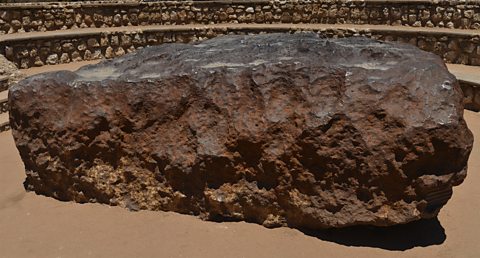
There are exceptions to this, such as the Hoba Meteorite, which is the largest located meteorite on record - clocking in at a whopping 2.4m wide and weighing around 60 tonnes.
Whilst many meteorites resemble normal Earth rocks, they often have a burned outer layer that can appear shiny.
The appearance of a meteorite will also vary dependent on what kind of meteorite it is. Iron meteorites, for example, are generally heavier and easier to spot than their stony counterparts - according to American space agency NASA.
How many meteorites hit the Earth each day?
Scientists estimate that around 44,000kg of meteoritic material falls on the Earth each day, that's around seven to 10 elephants worth!
That said, the majority of this will burn up in the Earth's atmosphere, never even reaching the surface. And of the rocks that do reach the surface, even fewer will cause any real issues or damage.
3. Asteroids
What is an asteroid?
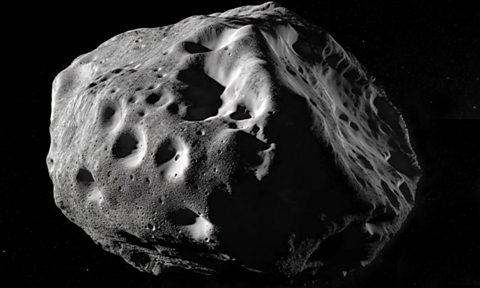
Asteroids are big chunks of rock which float through space, in orbit of the sun. Asteroids, like other space rocks, vary in size - with some clocking in at around 10m wide whilst others are closer in size to a small planet.
The size of an asteroid is what helps differentiate it from a meteoroid, which are much, much smaller than asteroids - in fact, meteoroids often form as a result of two asteroids colliding and small pieces breaking off.
The majority of asteroids spend their time between the orbits of Mars and Jupiter, in an area known as the asteroid belt.
But how do asteroids end up falling to Earth?
Well, Jupiter, which is the largest planet in our solar system, has an extremely strong gravitational pull - so much so that it occasionally pulls an asteroid out of the belt. Lots of these asteroids will then begin on a path to the inner solar system - sometimes setting them on a collision course with planet Earth.
Were the dinosaurs killed by an asteroid?
One day, around 66 million years ago, it really did not pay to be a dinosaur. As an asteroid fell to Earth off the coast of Mexico, landing with a thump so mighty it ended the entire Cretaceous period.
The resulting crash not only eviscerated anything in the crash zone, but also triggered earthquakes, tsunamis and wildfires. As well as sending up clouds of dirt, dust and gas which blocked out the sun - effectively plunging the Earth into a permanent winter.
This affected dinosaurs' ability to eat, breed and perform other functions vital for survival - leading to them going extinct. At least until Jurassic Park rolls around…
4. Meteors
What is a meteor?
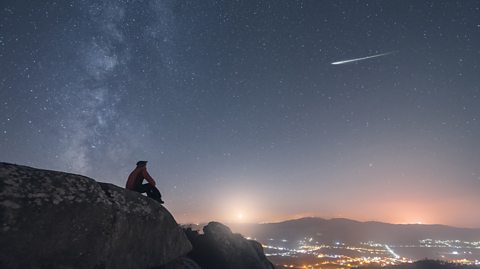
When meteoroids enter the Earth's atmosphere, they begin to burn up as they head for the ground - this is what we call a meteor.
Also known as shooting stars - clear night skies can provide views of many a meteor as they crash across the sky. Tending to be bright in colour, meteors are characterised by the beautiful trail of light they leave amongst the stars.
When lots of meteors can be seen in quick succession, this is known as a meteor shower.
How can I watch a meteor shower?
Despite sounding vaguely magical and ethereal, lots of meteor showers actually take place annually, or at regular intervals - meaning with a good clear sky you've a solid chance at spotting one.
Meteor showers are usually named after a star or constellation close to the meteor's origin point in the sky. A list of 2025 meteor shower dates can be found below:
| Shower name | Active period | Peak |
|---|---|---|
| Quadrantids | 26 December - 12 January | 4 January |
| Lyrids | 16 April - 25 April | 22 April |
| Eta Aquariids | 19 April - 28 May | 5 May |
| Alpha Capricornids | 3 July - 15 August | 30 July |
| Delta Aquariids | 12 July - 23 August | 30 July |
| Perseids | 17 July - 24 August | 12 August |
| Draconids | 6 October - 10 October | 8 October |
| Orionids | 2 October - 7 November | 22 October |
| Southern Taurids | 10 September - 20 November | 10 October |
| Northern Taurids | 20 October - 10 December | 12 November |
| Leonids | 6 November - 30 November | 17 November |
| Geminids | 4 December - 20 December | 14 December |
| Ursids | 17 December - 26 December | 22 December |
For more information on spotting meteor showers, check out this handy guide from the Royal Observatory.
5. Comets
What is a comet?
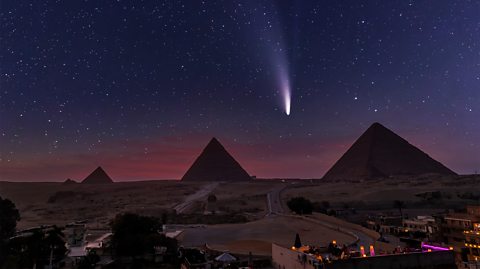
A comet is a frozen ball made up of ice, dust and gas that orbits the sun.
As a comet approaches the sun, the heat it produces begins to melt the ice and gas that's part of the comet's make-up - turning it from a solid to a gas. In turn, this process makes the comet produce a bright, colourful trail - which mesmerises as it crosses through the sky.
How can I see a comet?
Unlike many meteor showers, getting sight of a comet tends to be a completely random event - as such, spotting a comet is basically a case of pot luck.
There are some comets, such as Halley's Comet, that do have contact with the Earth at regular intervals - only these intervals span about 75 or 76 years. Halley's Comet was last visible in the UK in 1986, and is next expected to shine above our shores in 2061.
