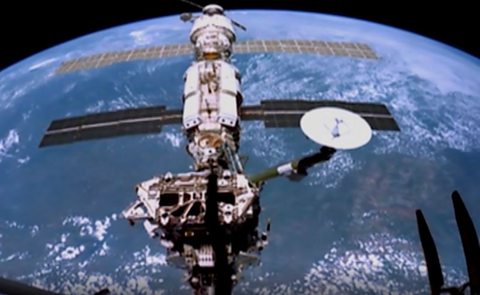
TIM PEAKE:Hi, I'm Tim Peake. I'm an astronaut based here at the European Space Agency, in Germany. And from December 2015 to June 2016, I spent six months orbiting Earth on the International Space Station. What I'm in is an exact replica of the Columbus Science Laboratory, which is where I lived and worked when I was in space.
TIM PEAKE:Now one of the most famous space phenomena, is Halley's Comet. You've probably been told about it at school, but did you know that it played a vital role in Sir Isaac Newton's discovery of gravity?
TIM PEAKE:To find out how, and how Halley also changed our understanding of the solar system, Let's join Professor Simon Schaffer.
PROF. SIMON SCHAFFER:'In 1680, a particularly bright comet caught the attention of Isaac Newton. 'It was a fascination 'that was to change the way we understand the universe.'
PROF. SIMON SCHAFFER:On November 19th, at 4:30 in the morning, in Cambridge, the comet was seen by some young man. And on the same day, at five in the morning, at Boston in New England, the comet was also observed.
PROF. SIMON SCHAFFER:What was extraordinary about this comet was that, it was visible in the sky. It was very bright. You could see it in October and November, in 1680, and then it disappeared behind the sun.
PROF. SIMON SCHAFFER:And then another comet appeared from behind the sun in December at the end of the year, and was visible right through to March of 1681. So the big question is, is this one comet or two? If it's one comet, then it's bent a lot near the sun.
PROF. SIMON SCHAFFER:Now here's a diagram, that Newton himself made, of the path of the comet, if it's one comet.
PROF. SIMON SCHAFFER:You see here that it was approaching the orbit of the Earth and the sun, in October and November of 1680. And then it disappears behind the sun and reappeared in December, and it stayed visible through February and March of 1681.
PROF. SIMON SCHAFFER:'For the sun to bend the path of a comet this much, 'Newton realised that there had to be an unseen force at work. 'He called it gravity. 'An idea which didn't come from an apple falling from a tree. 'But from a comet passing behind the sun.'
PROF. SIMON SCHAFFER:It was by thinking about this puzzle, that Newton began to formulate the idea of gravitation. Before 1681, Newton had no notion of universal gravitation. Newton between 1681 and 1684 began to suppose that comets come back. That they're therefore like planets, because they move in closed orbits.
PROF. SIMON SCHAFFER:That you should be able to calculate the shape of the orbit. That you could in fact predict when comets come back. 'And that is exactly what he and his friend Edmund Halley set out to do.
PROF. SIMON SCHAFFER:'If they could use the theory of gravitation 'to predict the return of a comet, 'they would not only prove Newton's theory, 'but would also show that comets were not omens or supernatural signs, 'but predictable, orbiting bodies 'like the planets.
PROF. SIMON SCHAFFER:'Halley collated tables of all the comet observations he could find, 'looking for similarities in their behaviour. 'What direction they came from. 'How close they got to the sun.
PROF. SIMON SCHAFFER:'At last he found three comets, who's descriptions were almost identical 'One recorded in 1531, one in 1607, 'and one he had observed himself in 1682. 'Each appearance was separated by 75 years.
PROF. SIMON SCHAFFER:'Convinced that these three sightings were of the same comet. 'Halley made a public prediction that it would return again 'in late 1758, or early 1759. 'It was an extraordinary piece of scientific bravado for the time. 'Neither Newton, nor Halley, lived to see the prediction fulfilled.
PROF. SIMON SCHAFFER:'But when on Boxing Day 1758, 'a comet was spotted in Germany. 'It was greeted with jubilation, 'and as a triumph of science over the supernatural. 'Tracing back through the historical records, 'comet Halley could be found reappearing like clockwork.
PROF. SIMON SCHAFFER:'This Babylonian tablet records it's appearance in 164 BC. 'The comets that Genghis Khan and William the Conqueror saw 'weren't messengers from God, 'but the regular appearances of comet Halley.
PAUL VAUGHAN:'A once in a lifetime meeting tonight, live on BBC One. 'After its latest visit to Earth, 'Halley's comet is already on course, 'back towards the icy wastes of outer space. 'In an attempt to…'
PROF. SIMON SCHAFFER:'The last time it visited in 1986, 'it was greeted like an old friend. 'Around the world, people were transfixed 'as the probe Giotto beamed back the first live pictures 'of a comet nucleus. 'It was the last we'll see of comet Halley, until 2061.'
TIM PEAKE:And I'll be 91 when Halley makes it's comeback in 2061. Can't wait.
Tim Peake introduces Simon Shaper.
In 1680 Halley’s Comet appeared brightly in the sky.
Isaac Newton noticed it on November 19th and over the next week it disappeared behind the Sun.
A comet was also observed coming out the other side of the Sun in December 1680.
If it was the same comet then its path must have bent a great deal.
Simon shows a diagram of an elliptical orbit drawn by Newton.
Newton realised that a force, he called gravity, must have been responsible.
Newton’s discovery of gravity was nothing to do with an apple falling! It was made by making careful observations of a comet.
Newton and Halley set out to predict when the comet would come back.
They predicted it would return 75 years later in December 1758.
Although neither lived to see the prediction fulfilled. Halley’s comet last visited Earth in 1986 and we will see it again in 2061
Teacher Notes
Key Stage 4
Could be used to introduce comets and the elliptical orbit.
It could be used to set the gravity section of the forces topic in historical context.
Students could be challenged to describe and explain the changing speed of a comet in its path around the Sun.
GCSE/Higher Levels
Could be used to introduce and set Newton’s Law of Gravitation in historical context.
Students could go on to use Newton’s Law of Gravitation to make calculations of the mass of the Sun, the radius of a planet’s orbit around the Sun or the velocity/time period of a planet’s orbit.
Students could also be challenged to describe and explain the changing speed of a comet in its path around the Sun.
As an extension, students could research the general equation of an ellipse and show how it reduces to the familiar form for a circle.
Curriculum Notes
This clip will be relevant for teaching Physics/Science at KS4/GCSE in England Wales and Northern Ireland. Also at National 4/National 5 and Higher in Scotland, and Cambridge IGCSE Physics.
More from the series Curriculum Collections: Physics
A scale model of the solar system. video
Dallas Campbell shows an orrery – a mechanical model of the solar system.
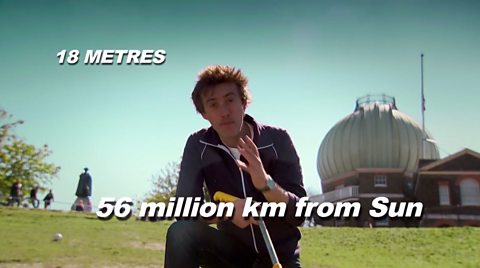
Centripetal force - explained. video
Tim Peake introduces Yan Wong who explains centripetal force using a cup of water on a tray hanging from a string.
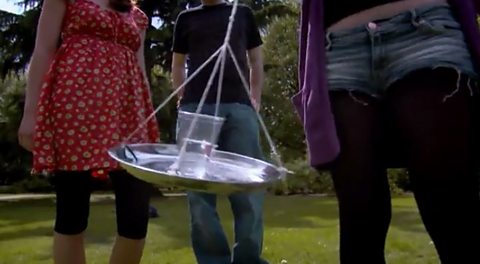
Days, Years and Seasons on Earth. video
Professor Brian Cox explains the seasons on Earth and the orbital periods of planets in the solar system.
The Origin of the Northern and Southern Lights. video
Helen Czerski explains the origin of the Northern and Southern Lights.
Landing a human on Mars. video
Tim Peake introduces the Physics behind sending a human mission to Mars.
Launching satellites into orbit. video
Tim Peake introduces Maggie Aderin-Pocock who explains how satellites are launched into orbit around the Earth.