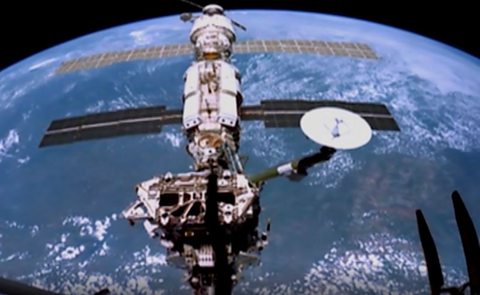
TIMHi, I'm Tim Peake. I'm an astronaut based here at the European Space Agency in Germany, and from December 2015, to June 2016, I spent six months orbiting Earth on the International Space Station.
TIM:When I was up on the ISS, that different perspective really brought home the sheer scale of the universe. The vastness of our Solar System and the distances involved is something that's hard to convey. Especially when scaled down on a chart or in a book, but Dallas Campbell thinks he's got a way of explaining it that's miles better.
DALLASI absolutely love this, it's called an orrery, and it's a little mechanical model of our solar system. You can see the planets here, orbiting the sun as they would do in real life.
DALLASBut it's more than just a little interesting knick-knack. It's actually the result of arguably the greatest revolution in the entire history of science.
DALLAS'Before the 17th Century, most people believed in a geocentric universe, with the Earth slap bang in the middle and everything else orbiting around it, including our sun.'
DALLASIt's only when the big guns Copernicus, Galileo and Kepler came along that our understanding shifted to a heliocentric model with the sun at the centre of things and the Earth, and the other planets, orbiting it. Like that.
DALLAS'But there's something wrong with this orrery, its scale. All the planets are far too close together. Let me demonstrate how they should be spaced out with a scale model of my own.'
DALLASNow our sun is a fairly average-sized star, there's much bigger stars than ours in the universe, so let's represent it with this football. How far would you have to travel away from our sun football here before we reach the first planet Mercury?
DALLAS'Well on this scale, every metre is 3 million kilometres, so the answer is…'
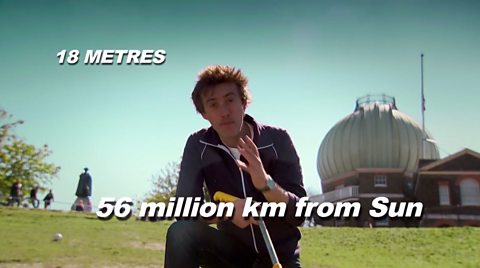
DALLAS18 metres, which is the equivalent of 56 million kilometres. Now if the sun was the size of our football up there, then mercury, by comparison, would be about the size of this grain of sand.
DALLASAnother 19 metres, of 52 million kilometres, you arrive at Venus.
DALLAS'And it's not very big. About the size of this nut.'
DALLASAnother 15 metres, or 42 million kilometres, you come to the most incredible planet in our solar system. A place that 6.8 billion people might find strangely familiar. But how big is the Earth, compared to our football sun over there? Well not very big at all really, about the size of this pea.
DALLAS'Okay next up about 234 million kilometres from the sun, the mighty Mars.'
DALLASAnd it's only the size of this tiny, insignificant grain of rice.
DALLAS'Mars represents the final frontier of the rocky inner planets. But as we move further away from the sun into the darkness of space, the planets are mainly made up of gas. First up, right at the edge of the park, it's Jupiter.'
DALLAS259 metres from our football sized sun, 777 million kilometres in the real world.
DALLAS'It's 11 times the size of the Earth, which makes it the giant of the solar system, which on this scale is' about the size of this golf ball.
DALLAS'Like Jupiter, the next giant of the solar system is mainly made up of gasses like hydrogen and helium. You'll find it just down the street, outside the park and it's called Saturn. It's 472 metres from our football, and that's…'
DALLAS1.5 thousand million km from the sun, and about the size of this table tennis ball. But with some of them nice rings going around it.
DALLAS'Finally I'm in Greenwich Town proper. Next up is a lump of ice and rock more formally known as…' Uranus. It's about a kilometre from our football over there
DALLASor 2.8 thousand million kilometres from the sun. It's started to get very cold and it's very dark. 'After that, 2.2 clicks from our football is Neptune, another icy lump the size of a grape. Probably a white one.'
DALLAS'Okay so travelling out from the Greenwich Observatory where we started with our football sized sun. You've got Mercury, Venus, Earth, Mars, Jupiter, Saturn, Uranus and Neptune. And until 2006 there was one more planet in our solar system, but not anymore.'
DALLASOver there by the dome is poor old Pluto, everybody's favourite demoted planet. Some two kilometres away from our football sun. That's 6 thousand million kilometres away from the real sun, and smaller than the tiniest grain of sand.
TIMWell it may be small, but something that's big on Pluto is the length of a year, which is 248 of our years. Because that's how long it takes to orbit the sun when you're that far away.
Tim Peake introduces Dallas Campbell. Dallas shows an orrery – a mechanical model of the solar system.
Before the 17th century most people believed in a geocentric model of the solar system.
Dallas explains the geocentric model and then the heliocentric model developed by Kepler, Copernicus and Galileo.
However, the orrery does not have the correct scale.
Dallas goes outside, near the Greenwich Observatory in Greenwich Park in East London to build his own scale model.
This is based on the sun being the size of a football.
He sets off across the park with a trundle wheel to position the 4 rocky inner planets.
Jupiter sits on the very edge of the park and then the other planets spread out across East London.
Teacher Notes
Key Stage 3
Could be used as a starter or summary to a research lesson or homework.
Students could research models of the solar system and produce a written report, poster or class presentation.
They could focus upon features of the model, who the model is named after and evidence for the model.
Could be used to explain the size and scale of the Solar System.
Students could write a description of the scale and size of the solar system based on the video.
Key Stage 4
Could be used to demonstrate the evidence proving the heliocentric model of the solar system
Students could research the heliocentric and geocentric models of the solar system.
They could produce a report on the features of each model and state the evidence which disproved the geocentric model (Jupiter had moons) and proved the heliocentric model (Mars’ retrograde motion).
Students could calculate the distances and sizes of the planets in the solar system based on the Sun being the size of a football.
Curriculum Notes
This clip will be relevant for teaching Physics/Science at KS3 and KS4 in England Wales and Northern Ireland. Also at 3rd Level, National 4/National 5 and Higher in Scotland, and Cambridge IGCSE Physics.
More from the series Curriculum Collections: Physics
A scale model of the solar system. video
Dallas Campbell shows an orrery – a mechanical model of the solar system.
Days, Years and Seasons on Earth. video
Professor Brian Cox explains the seasons on Earth and the orbital periods of planets in the solar system.
How Halley’s Comet inspired Newton’s Law of Gravity. video
Simon Shaper explains how Newton’s Law of Gravitation originated from observations of Halley’s Comet in 1680.
The Origin of the Northern and Southern Lights. video
Helen Czerski explains the origin of the Northern and Southern Lights.
Landing a human on Mars. video
Tim Peake introduces the Physics behind sending a human mission to Mars.
Launching satellites into orbit. video
Tim Peake introduces Maggie Aderin-Pocock who explains how satellites are launched into orbit around the Earth.