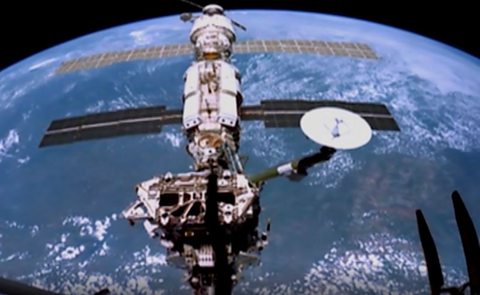
TIM PEAKE:Hi, I'm Tim Peake. I'm an astronaut based here at the European Space Agency, in Germany. And from December 2015 to June 2016, I spent six months orbiting Earth on the International Space Station.
200:00:14:21 00:00:27:09TIM PEAKE:One of the most exciting things when I was up there was seeing the northern and southern lights. The Aurora Borealis and Aurora Australis. An incredible green glow that covers the Earth's polar caps, and that people travel miles to see.
TIM PEAKE:Why it exists and the science behind it, are explained here by Helen Czerski.
HELEN CZERSKI:'The aurora forms crowns of light 'at the north and south poles of the planet. 'Each halo reaches altitudes of more than 300km. 'And they stretch in a ring around each pole, over 10,000km long.
HELEN CZERSKI:'The reason that these displays are only focused at the poles, 'is because of a fundamental property of our planet. 'Usually invisible, it's revealed in this footage, 'captured from the International Space Station.
HELEN CZERSKI:'As streaks that reach up from the aurora. 'Fingers of light tracing out the lines of the Earth's magnetic field.' The Earth has its own magnetic field and it's got a north and south pole, just like a bar magnet.
HELEN CZERSKI:There's a magnet in this box and it's pointed vertically, and you can see it's surrounded by a fluid that's got iron filings in it. And the beautiful thing about that is that the iron filings are lining up along the magnetic field lines, so you can see the shape of the magnetic field reaching from one side to the other.
HELEN CZERSKI:This is pretty similar to Earth's field. 'The light of the aurora is created at the poles of the planet magnetic field lines are coming down to Earth.
HELEN CZERSKI:'What causes the lights to appear here 'was first proposed by a Norwegian physicist, 'Kristian Birkeland.
HELEN CZERSKI:'He was convinced that the night time lights at the poles, 'were created by the way the sun interacted with the magnetic field. 'He even built a working model to test his theory.'
HELEN CZERSKI:This is a Planeterrella, it's a lovely bit of kit, and it's based on the experiment that Birkeland designed more than a hundred years ago. What he was doing, was making a small model of the solar system.
HELEN CZERSKI:So there's a big sphere over here that represents the sun, and there's a smaller sphere over here that represents the Earth. And the whole chamber here is a near vacuum. 'Birkeland had, what at the time, was an outlandish idea.
HELEN CZERSKI:'That the sun was emitting invisible charged particles. 'It wouldn't be until much later that his idea was confirmed. 'Around a million tons of charged particles, protons and electrons, 'stream out of the sun every second, 'in what we now call the solar wind.
HELEN CZERSKI:'Birkeland was convinced that it was the interaction 'between the solar wind and the magnetic field 'that created the aurora.'
HELEN CZERSKI:He made his sun so it's emitting electrons out in all directions, and then he knew that the Earth had a magnetic field, so he gave the smaller sphere here a magnetic field.
HELEN CZERSKI:And what you can see is that the electrons that leave the sun and travel towards our little Earth, are affected by the Earth's magnetic field.
HELEN CZERSKI:And the field lines make them funnel down towards the planet and they bump into the few air molecules left in this chamber and they make those molecules glow.
HELEN CZERSKI:So what we can see here in this lovely bit of kit is a really good analogy for the real aurora on Earth.
HELEN CZERSKI:'Just as in the Planeterella, the aurora that we see in the night sky 'are caused by charged particles from the solar wind 'that are captured and then streamed down the Earth's magnetic field lines 'and into our atmosphere.
HELEN CZERSKI:'As the charged particles crash down, 'they collide with molecules and atoms in the atmosphere. 'Giving each a kick of energy. 'Those molecules and atoms can't hold on to that extra energy for long. 'And they release it as light.'
TIM PEAKE:Amazing stuff. And seeing the aurora from the ISS was one of the most unforgettable parts of the whole incredible experience.
Tim Peake introduces Helen Czerski.
Images of the Northern and Southern Lights are showed as their location around the poles is described.
Images captured from the International Space Station show streaks reaching up above the aurora into space.
The streaks follow the lines of the Earth’s magnetic field. Helen shows a three-dimensional version of iron filings around a bar magnet.
The aurorae are created near the poles where the magnetic field lines are coming down to Earth.
The Norwegian Physicist, Kristian Birkeland, proposed the first theory to explain why.
He made his own model to test his theory. A modern-day version, called a Planeterrella, is shown. His idea was that the Sun was emitting invisible charged particles in a Solar Wind.
These followed the Earth’s magnetic field lines and eventually collided with air molecules in the Earth’s atmosphere making them glow.
Teacher Notes
Key Stage 4
When studying the motor effect, students could be challenged to use their knowledge in a novel situation.
The Sun emits charged particles which emit light when they hit molecules in the Earth’s atmosphere.
They could try to explain why the aurora only appear near the poles.
GCSE/Higher
When studying magnetic fields and the forces on charged particles moving in a magnetic field pupils could be challenged to explain or to research an explanation for the location and luminosity of the Aurora.
Curriculum Notes
This clip will be relevant for teaching Physics/Science at KS4/GCSE in England Wales and Northern Ireland. Also at National 4/National 5 and Higher in Scotland.
More from the series Curriculum Collections: Physics
A scale model of the solar system. video
Dallas Campbell shows an orrery – a mechanical model of the solar system.
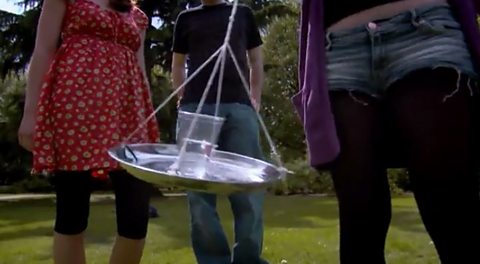
Centripetal force - explained. video
Tim Peake introduces Yan Wong who explains centripetal force using a cup of water on a tray hanging from a string.
Days, Years and Seasons on Earth. video
Professor Brian Cox explains the seasons on Earth and the orbital periods of planets in the solar system.
How Halley’s Comet inspired Newton’s Law of Gravity. video
Simon Shaper explains how Newton’s Law of Gravitation originated from observations of Halley’s Comet in 1680.
Landing a human on Mars. video
Tim Peake introduces the Physics behind sending a human mission to Mars.
Launching satellites into orbit. video
Tim Peake introduces Maggie Aderin-Pocock who explains how satellites are launched into orbit around the Earth.