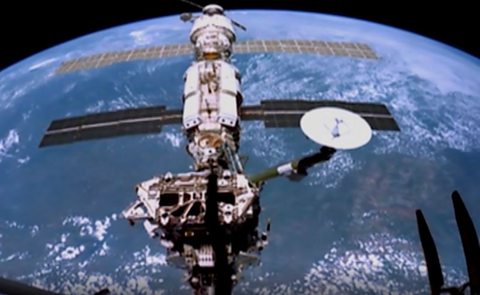
TIM PEAKE:Hi I'm Tim Peake. I'm an astronaut based here at the European Space Agency, in Germany. And from December 2015 to June 2016, I spent six months orbiting Earth on the International Space Station. What I'm in, is an exact replica of the Columbus Science Laboratory, which is where I lived and worked when I was in space.
TIM PEAKE:Now the ISS orbits the Earth around 15 and a half times a day. The moon orbits the Earth once every 27 days, and the Earth orbits the sun once a year.
TIM PEAKE:Travelling nearly 600 million miles through space as it does. What keeps each of these orbits happening rather than having us go travelling off away from the sun, is something called centripetal force.
TIM PEAKE:And for an explanation of what that is, and how it works, here's Dr Yan Wong.
DR YAN:Here you go, can you hold that tray for me?
GIRL 1:I can.
DR YAN:And I'll put a cup on it.
GIRL 1:Yeah.
DR YAN:A glass and fill it full of water. And now what I'd like you to do is just swing the tray a bit from side-to-side, okay? Now do you think you can get it all the way over your head?
GIRL 1:In a word, no.
HATTIE:No, are you joking?
DR YAN:Go on try it. Okay, now-- whoa, even like that, right the way round your head. Very good.
GIRL 2:Go Hattie!
HATTIE:No!
DR YAN:The weird thing is you think it sort of defies gravity when it's at the top there.
GIRL 2:Yeah.
HATTIE:Yeah.
GIRL 2:I don't understand why it wouldn't fall.
DR YAN:Yeah. But what's really going on is that it's going round fast enough, that gravity doesn't have time to cause any problems.
GIRL 3:It's so weird looking at it.
DR YAN:It really doesn't feel like it should do that does it?
GIRL 3:No it really doesn't, it's so strange.
DR YAN:So what do you think it is that's keeping the glass on the tray and the water, what's stopping the water coming out?
GIRL 1:My skills.
DR YAN:Yeah.
GIRL 1:Yeah personally.
HATTIE:Is it the force of how fast it's going round?
GIRL 1:Centrifugal force.
DR YAN:Ah well lots of people say centrifugal force. The interesting thing is that centrifugal force is just a human invention designed to make the calculations easier.
DR YAN:In fact it's actually called a fictitious force, and I'll show you why. Start swinging yourself round How fast can you go?
SCREAMS
LAUGHS
GIRL 2:Yeah because you pull–
HATTIE:Yeah that's so true!
DR YAN:You see there's some sort of-- it feels like there's something-- It feels like there's something pulling you out yeah?
HATTIE:Yeah.
DR YAN:Now if I was to let go, if we were going really fast and I were to let go about there. Yeah what would happen?
GUY 1:I would have fell.
DR YAN:Yeah well you would fly off that way yeah.
GUY 1:Yeah.
DR YAN:And that's just known as Newton's first law of motion.
GUY 1:Yeah.
DR YAN:Basically says that once an object starts moving, it just carries on going in the same direction in a straight line, unless something gets in the way of course.
DR YAN:That's exactly what you're feeling here. So there's no real force flinging you outwards, it's just that because you're moving, your body wants to go in a straight line.
DR YAN:When something like this is moving round in a circle, then there must be, not a force going outwards, but there must be an inward-- a force inwards pulling it in, and that's called centripetal force.
ALL: Okay.
DR YAN:For you it was you holding on to each other.
HATTIE:Yeah.
DR YAN:Yeah that was the force but for example, when the Earth orbits the sun it's because there's a centripetal force, gravity, that pulls them together. 'But in this case, it's the string doing the job of gravity.'
DR YAN:There's enough tension in the string to generate that sort of inwards pulling centripetal force yeah? And that's why it's going round in a circle, and the glass on it and the water in there are all going round in the circle and not flying off in one direction.
LAUGH
TIM PEAKE:Ouch. As demonstrated there, centripetal force doesn't work when you hit yourself in the head with your experiment.
Tim Peake introduces Yan Wong. Yan puts a glass of water on a tray hanging from a string.
He challenges various people in a park to swing the tray over their heads.
The water doesn’t fall out of the glass and the glass doesn’t fall off the try.
These people then try to explain what happened.
Two people swing each other around in a circle. Yan explains what happens if one person lets go in term of Newton’s first law of motion.
So, there must be a centripetal force pulling inwards on anything moving in a circle.
For the cup of water, it’s the tension in the string and for the Earth orbiting the Sun it’s gravity.
Teacher Notes
Key Stage 4
Can be used to explain what a centripetal force does.
A similar practical activity could be carried out using a bucket of water in which students are challenged to swing the bucket over their heads.
Students could be challenged to label a diagram with the directions of the velocity and acceleration of the cup of water at four equally spaced positions around a circle.
Students could be challenged to explain how the cup can be travelling at a constant speed but is also accelerating.
Students could then explain why a centripetal force is needed using Newton’s Second Law of Motion.
Students could apply Newton’s First Law of Motion to explain what happens if the string breaks.
GCSE/Higher Levels
Can be used to explain what a centripetal force does.
Students could be challenged to explain why an object orbits Earth in terms of Newton’s Laws of Motion
A similar practical activity could be carried out using a bucket of water in which students are challenged to swing the bucket over their heads.
Students could be set the challenge of calculating the minimum speed at which they would need to rotate the bucket so that they don’t get wet.
Answer: the critical speed occurs when the acceleration of the water due to gravity equals the centripetal acceleration, that is when g equals velocity squared divided by radius.
So students just need to estimate the radius using the length of their arm and height of bucket.
Curriculum Notes
This clip will be relevant for teaching Physics/Science at KS4/GCSE in England Wales and Northern Ireland. Also at National 4/National 5 and Higher in Scotland.
More from the series Curriculum Collections: Physics
A scale model of the solar system. video
Dallas Campbell shows an orrery – a mechanical model of the solar system.
Days, Years and Seasons on Earth. video
Professor Brian Cox explains the seasons on Earth and the orbital periods of planets in the solar system.
How Halley’s Comet inspired Newton’s Law of Gravity. video
Simon Shaper explains how Newton’s Law of Gravitation originated from observations of Halley’s Comet in 1680.
The Origin of the Northern and Southern Lights. video
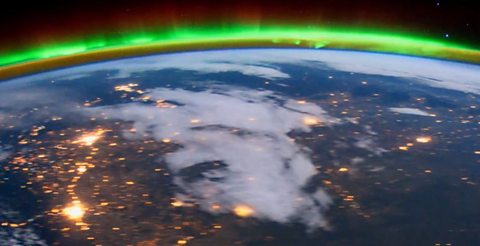
Helen Czerski explains the origin of the Northern and Southern Lights.
Landing a human on Mars. video
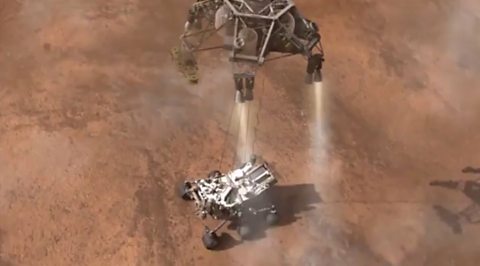
Tim Peake introduces the Physics behind sending a human mission to Mars.
Launching satellites into orbit. video
Tim Peake introduces Maggie Aderin-Pocock who explains how satellites are launched into orbit around the Earth.