Did the Moon landing really happen? It’s a conspiracy theory that continues to overshadow one of the greatest achievements in history. Fifty-seven years since Neil Armstrong and Buzz Aldrin became the first humans to walk on the Moon, why do some people still believe that the landing was a hoax?
What are conspiracy theories?
Conspiracy theories are beliefs that certain events are secretly controlled by highly influential groups. These theories often appear after major events, such as the assassination of US president John F Kennedy in 1963 and the 2001 attacks on the World Trade Centre in New York when there can be panic and uncertainty in society. Other conspiracy theories include the Earth being flat instead of a sphere and that the Covid-19 vaccine contained microchips. They often lack solid evidence and spread false information, causing confusion and distrust. These theories can often be spread by people who want to look knowledgeable about something that is 'secret' and learning to spot and question them is crucial for making smart decisions.
The Great Moon Hoax
There have been lots of conspiracies and fake news about the Moon. One of the earliest fake news stories happened in 1835. The "Great Moon Hoax" was a series of articles in The New York Sun claiming that a famous astronomer had discovered life on the Moon. These articles were intended to be a joke but showed how easily false information can spread.
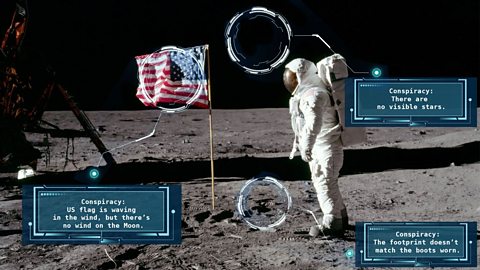
Was the Moon landing fake?
Despite plenty of evidence and scientific proof that this isn't the case, many people still, to this day, think the 1969 Moon landing was fake and that mankind has never taken "one small step", let alone "one giant leap" on the lunar surface. Much of this is down to a handful of conspiracy theories that continue to be shared online with popular moon conspiracy videos on TikTok racking up millions of views, and getting thousands of likes.
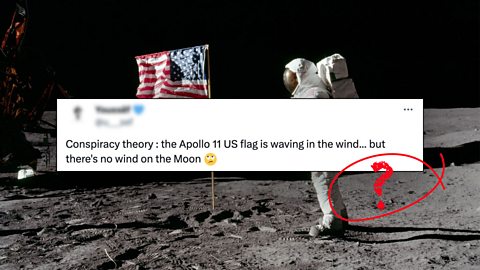
Conspiracy: waving flag
The Moon doesn't have a significant atmosphere and it doesn't experience weather as we know it on Earth, so why does the image show the American flag waving?
If you look closely at the image, particularly along the top edge of the flag, you will see a pole has been extended to help it hang correctly. When the astronauts were trying to perfectly place the flag in the ground, the movements led to the rippling effect you might see in images. As there’s little atmosphere, the flag stayed in the same position once they left.
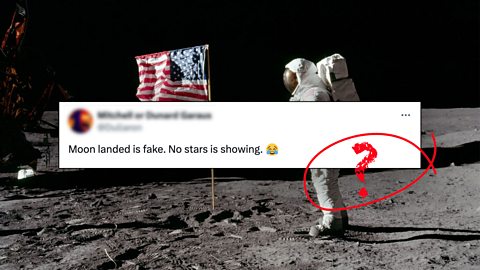
Conspiracy: no stars visible
Some argue that the lack of stars in the photos proves it was staged. If the image really was taken on the Moon, shouldn't we be able to see a sky full of stars?
The sky may look black, but remember, the image was taken during daytime on the Moon and both astronauts and the lunar landscape itself are brightly lit by the Sun.
If you're going to take a photo of a brightly lit scene, the camera settings will need to be different than those required to take photos in darker surroundings. In a bright environment, faint objects like stars simply aren't going to show up and the Moon landing image focuses on the subjects in the foreground rather than the background. For pointers about lighting when filming, check out this video which contains some advanced filming tips.
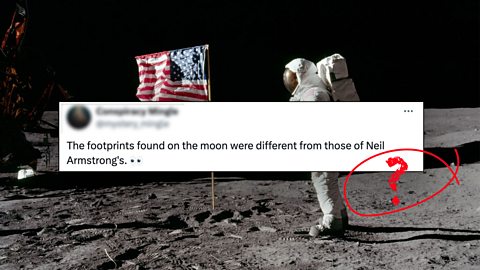
Conspiracy: footprint doesn't match boot
Conspiracy theorists claim that the Moon landing was faked because Neil Armstrong’s preserved space suit doesn’t match the footprint pictured on the Moon.
However, the Moon footprint in the photograph was made by Buzz Aldrin, not Armstrong. Also, the footprint was of a lunar overshoe - something both astronauts wore over their spacesuit boots to provide them with added traction in the dust. They left these overshoes on the Moon because of weight issues. The confusion arises from a photo of Armstrong’s suit, taken by astronomer Phil Plait in 2015 showing a different sole design. Without fact-checking these sorts of examples, you could be at the risk of spreading misinformation, which is when people unknowingly share false news.
When you're scrolling through your social feeds, think critically about what you're reading, watching and sharing. Here are some tips for fact-checking:
Check multiple sources: Reliable information is usually reported by several reputable sources.
Verify with experts: Trust information from experts in the field. For example, if you’re reading about the Moon landing, look for facts from scientists and educators.
Look for evidence: Credible claims are backed by evidence and scientific data.
Be aware of AI images on social media: Here's some advice on how to spot manipulated images.
This article was published in July 2024 and updated in July 2026

Not sure if the news you’re seeing on social media is true or false? Can you always tell if the things you see online are real or fake?
Learn how to get the other side of the story with our quizzes, videos and explainers about media skills and viral trends including popular food myths.
What do the colours on the weather map mean?
Why we're seeing darker reds appear in warmer summers
The Erling Haaland video that could be fooling his biggest fans
Has the Manchester City star been scared by his own reflection?