Parrot lizard: Fossil helps explain how dinosaurs developed feathers
- Published
- comments

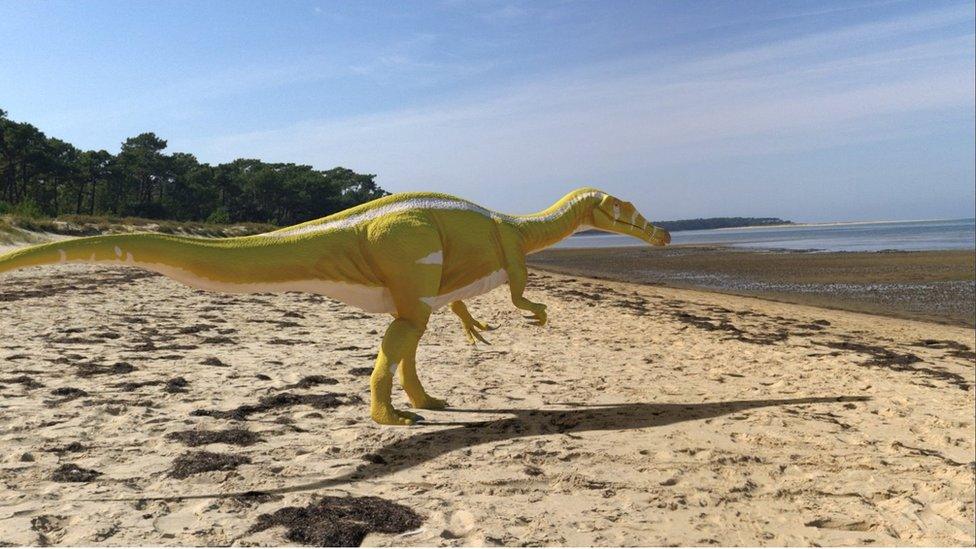
Experts believe the "parrot lizard" had scales in some areas and feathers in others
Scientists say a fossil of skin from a dinosaur could help to solve the mystery of how the creatures developed feathers.
A team has been studying a fossil from a Psittacosaurus - which is often known as a "parrot lizard".
Palaeontologists, which are fossil experts, think that the creature had reptile-like skin in some areas and bird-like skin in others.
Dr Zixiao Yang, who is part of the study done by the University College Cork in Ireland, said the fossil is a "hidden gem".

The preserved skin can only be seen under UV light
Experts say the plant-eating dinosaur would have been the size of large dog and lived in the forests of China, Russia and Mongolia around 130 million years ago.
The fossilised skin, which was found in north-eastern China, can only be seen under an ultraviolet light (UV).
Lead author of the study, Zixiao Yang said it is very rare to find preserved skin: "Initially we didn't really have much hope of finding any soft tissues because, to the naked eye, our specimen appears to preserve only the bones. We didn't give up, though, because we knew that during fossilisation soft tissues can be replaced by minerals, which may blend in with the sediments.
"When I turned on the UV light, I could feel my heart almost skip a beat. Large patches of scaly skin, covering the chest and belly, were glowing in a striking golden-yellow colour under the UV."
Researchers said the fossilised skin turned out to be made of silica - which is the material that is used to make glass.
The fact that the fossilised skin couldn't be seen without UV light, made the team believe there could be other exampled like this which are hidden away, waiting to be discovered.

The study suggests the Psittacosaurus has different types of skin in different areas of its body
Researchers said their study of the fossil suggested that the Psittacosaurus had different skin in different areas - with scales in some area, like the body, and bird-like feathers in others, like the tail.
Professor Maria McNamara, who also worked on the study, said that lots of fossils of feathers have been studied, but work on fossil skin is much more rare.
She said the study suggests bird-like skin and feathers initially developed in certain areas while the rest of the skin would have been scaly to protect against things like dehydration and parasites.
"The first dinosaur to experiment with feathers could therefore survive and pass down the genes for feathers to their offspring."
- Published10 June 2022
- Published14 February 2024
- Published22 May 2023