Five strange and funky facts about animals
The animal kingdom plays host to all manner of creatures, each with their own unique traits and quirks - but how much do you know about our planetary roomies?
Well, from ocular oddities to real-life regenerations, we've broken down five of the most fascinating facts about the creatures that make up our animal kingdom! Enjoy!
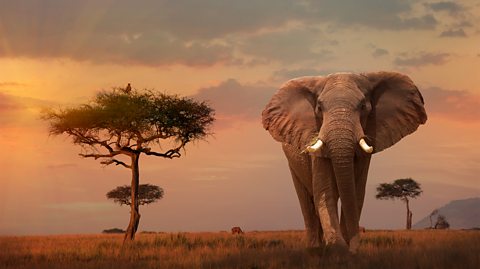
1. Elephants can't jump!
Sorry to sour Dumbo'sdreams, but elephants can't even jump - let alone fly!
They're not the only mammal this is true of. Hippos, rhinos and - perhaps unsurprisingly - sloths also lack a spring in their steps - though, unlike elephants, hippos and rhinos are able to lift all four feet off the ground when they run.
For the most part, this is simply a matter of size. Elephants are the biggest land mammal around, and their frame isn't exactly conducive to bouncing along a savanna. Adult male elephants weigh around 6000kg on average, which isn't a dissimilar weight to the average transport truck (which also, for reference, doesn't do a great deal of hopping).
Added to this, elephants have very little reason to jump, due to a lack of natural predators. While young or sick elephants may face threats as they roam in the wild, adult elephants have few natural enemies, eliminating the need for sharp, springy movements - as they mainly rely on their massive size to take on any foe they face.
2. Bees can recognise a human face
Yep, that's right, whilst we might readily mix up one fuzzy flier for another - the same doesn't go both ways!
A 2004 study at Cambridge University presented a batch of bees with photos of faces, pinned up to a wall. They attracted bees to a target face, by presenting them with a sugary solution upon arrival, and found that bees remembered the associated face for days after - even when they were no longer given any sort of reward.
The extent to which this means bees recognised the face itself is up for debate, and it's pretty likely that most bees don't actually make use of this skill when it comes to human faces, but maybe take a pause next time you try to swat away a stinger!
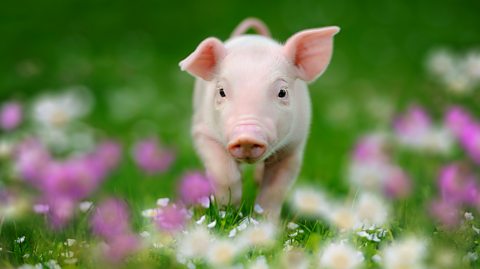
3. Pigs can't look up... or can they?
There's a fair bit of debate on the subject of a pigs ability to look upwards, but here's the gist!
Pigs are able to look up a bit and therefore can see portions of the sky, but as a result of their neck's anatomy they aren't able to look directly above them.
Pigs have short, muscular necks with limited mobility that prevents them from tilting all the way up. There are plenty of other ways for pigs to see the stars, such as rolling over on their backs, taking a few steps back from what they want to see and tilting the rest of their body in line with what they're looking at.
4. One jellyfish has cracked the code to immortality... sort of!
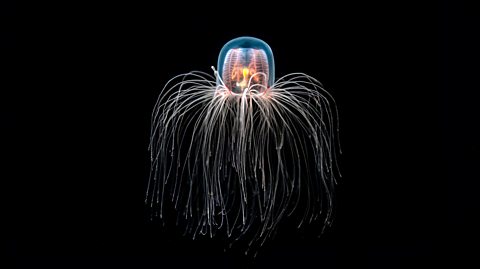
Nicknamed the 'immortal jellyfish', the Turritopsis dohrnii has developed the ability to stop the clock on death and regenerate itself into another form, sort of like in Doctor Who!
To figure out how they do this, we've got to dig a little deeper into the life cycle of the jellyfish. Jellyfish begin life as a larva, which comes about as a result of a fertilised egg. This larva spends a period swimming around, before finding a nice, hardy patch to call home. From here, it begins to mature and grow into polyps, which then spawn into free-swimming young jellyfish.
But what makes the Turritopsis dohrnii special is its ability to reverse this life cycle, and in turn, cheat death. When injured or facing extreme stress, this jellyfish shrinks back in on itself, dropping to the sea floor and reverting to a blob-like state.
After a couple of days, a polyp will develop from this blob - which will then mature once more into a fully fledged jellyfish.
This reversal can then be repeated if the new jellyfish form gets injured, meaning that it's conceivably possible that one of these jellyfish could live forever.
You're unlikely to see this process in action, however, as the 'immortal jellyfish' generally measures up at around the size of a pinky finger nail!
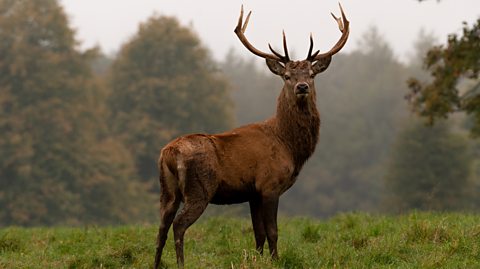
5. Is this thing orange? No i-deer!
While they aren't able to see the colour orange, the idea that deer are completely colour blind is actually a myth.
In the 1990s, the University of Georgia conducted an experiment which found deer are able to see colour, though they experience this in a different way than most humans do.
They found that deer were very good at spotting short wavelength colours, like blue. In fact, they found these colours were even more vivid in the eyes of deer than they are humans.
However, deer eyes have fewer cones than human eyes, meaning long wavelength colours like red and orange don't even register in the brains of deer, showing up in a sort of grey-brown colour instead.
This isn't the only difference between our vision and a deer's, as they have also been found to see much better in low light scenarios than we do.