Is that a car engine on your lap or is your cat just happy to be sitting on you?
That’s right - today we're looking at happy cats. You may find it cute when cats run their motors. You may have heard that purrs occur at specific healing frequencies, which is true! We think purrs are caused by the vibration of air through a cat’s larynx (voice box). The biggest cat species can't purr, but cheetahs and servals can. So why do cats purr and is it always a purrsitive - sorry, positive signal?
Is purring the language of love?
Purring is part of cat language - the ways your cat speaks to you or to other cats. A purr often signals that a cat is happy and relaxed, Cats Protection UK confirms. Look for other signs of relaxation to confirm this: ears in their normal positions, eyes relaxed (not open wide) with narrow pupils, and a willingness to lie down, sometimes with a satisfied flop!
A happy tail is held upright while standing, but heavy when lying down, drooping off the edge of furniture, curled around the cat, or even laid casually over you - a great honour that suggests you're considered cat property.
Naturally, purring also forms part of a good cuddle sesh. In this case, loud purring, along with more active body language like headbutting and snuggling against you, indicates that that cat is stimulated in a positive way.
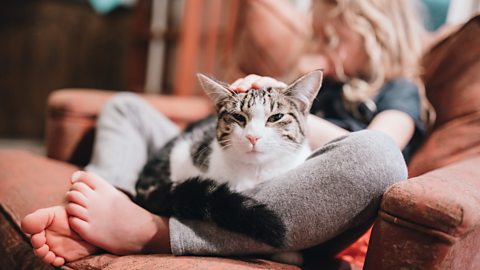
To stop stimulation becoming overstimulation, give your cat little breaks and allow them a chance to say 'more' or 'that's enough'. Cats, being small and easily manhandled, love being offered equal control of their social interactions!
A hand held close to a cuddly cat will often be butted and rubbed against, which is a good indication of what kind of touches the cat wants. A cat that gets up and moves a short distance away has likely had enough petting but still wants to be close to you. Existing near you while doing their own thing, and even sleeping close by, also count as social bonding for cats.
While chilling in the same room, you function as another set of eyes and ears to keep watch for predators, just like a fellow member of a cat colony. We don't know whether cats actually believe we're bigger, weird cats, as behaviourist Dr John Bradshaw thinks they do, but they certainly communicate with us using a specialised set of cat body language. Dr Bradshaw also says that a purr from your lap can simply mean 'stay still'! So, to your cat, you may be part fellow feline, part heated cushion…?
Kitten behaviour - knead and greed
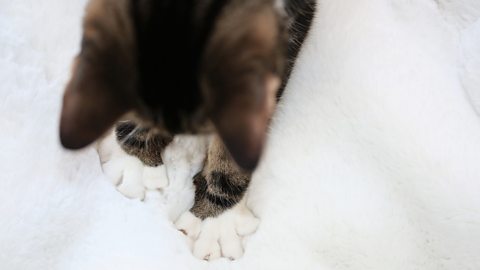
Even newborn kittens can purr. It serves as a way of maintaining contact with their mum, letting her know where they are and that they’re fine. It can also signal that they’re hungry - so if your cat seems extra purry around their meal times and their purr takes on a more urgent edge, it's not your imagination.
Another behaviour left over from kittenhood, frequently paired with a purr, is kneading. Kittens do this on their mother's tummy while suckling to stimulate milk flow. If they're feeling particularly lovey-dovey, they may do it on their beds - or on you. It's a happy behaviour, so be proud that you've made your cat feel safe - and maybe open up a bakery for all that bread they're making.
When do purrs mean pain?
Cats can also purr when they're very far from happy. In these cases, their purrs serve the function of calming themselves when they are stressed or in pain.
Cats are predators - but they're also prey for larger hunters. This has left them with a certain built-in paranoia, which is why they regularly change their sleeping places even when they’re safe at home. A cat who is sick, injured or in pain is more driven to hide their weakness than to seek somebody out for help. If you find your cat concealed somewhere dark, not interested in food or coming to greet you, it’s a strong indication that not all is well. In those circumstances, a purr is actually another warning sign.
As we mentioned in the intro, cats' purrs occur at specific frequencies that medical research associates with reducing pain and swelling and speeding up the healing of fractures. Along with cleaning their wounds, this could be a form of cat first aid.
Their drive to hide their pain means cats' distress signals can be subtle. Signs to spot include wide eyes with large pupils, flattened ears, whiskers standing forward, and either passive resistance to being moved, by turning floppy and heavy, or defensive growling and threats of a swipe or bite.
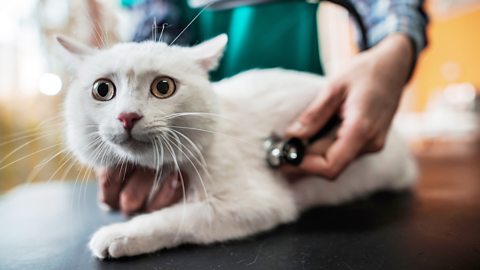
Be extra careful when handling a cat in this state to avoid further injuries to them or to yourself. Vets didn't exist when they were evolving - and, having had thousands of years less time than dogs have to grow to trust humans, cats don't tend to appreciate somebody touching them exactly where it hurts.
But with swift medical attention and a bit of their famous luck, your cat will soon be back home - and purring out of happiness again.
Why do cats purr?
- To communicat - sorry, communicate and express how they are feeling.
- For a way to heal and calm themselves.
- Because they love how safe and happy you make them feel.
Have pets pounced on your imagination?
Explore our back cat-alogue of animal crackers.
