Fun and interesting facts about giraffes
Giraffes are widely renowned as the tallest land animal around, towering over the expanse of African savannahs. In the UK however, giraffes can only be found in zoos or safari parks, so you might not know as much about them as you think.
Here at BBC Bitesize, we've put together an all-you-need to know guide to the giants of the animal kingdom - so you can see if people know their stuff, or if they're having a giraffe.
1. What sound does a giraffe make?
Far from being the chatty Cathys of the animal kingdom, giraffes prefer to keep the noise to a minimum - but despite what some may think, giraffes do actually make some sounds!
Giraffes' primary modes of verbal communications come in the form of grunts and snorts. These are usually emitted when giraffes feel threatened, as a warning to the rest of the herd. A giraffe's snort is a sharp, forceful exhalation through the nose, while their grunts are usually short and guttural. Female giraffes are also known to bellow to their young, helping mother and child stay together.
As well as their standard stock of snorts and grunts, giraffes verbal variety even extends… to song?
Well, sort of, anyway.
Studies have found that giraffes like to hum in their sleep, which many scientists believe is a way to keep connected to the rest of the herd in low light situations. However, if you prefer your theories with a little more whimsy, other scientists have speculated that this is a giraffe equivalent of snoring, or even sleep talking!

2. What do giraffes eat?
Giraffes are herbivores, so their diet is made up entirely of plant life and foliage. Their long necks give them access to food sources unavailable to most other animals, which they collect using their mega-long tongues - which tend to measure up to around 18 inches (45.7cm)!
Giraffes tend to feed on tender shoots and leaves of trees, with their absolute fave snack coming in the form of the thorny acacia tree.
They don't half like their food either, with large male giraffes often consuming around 143lb (65kg) of food per day!
3. How do giraffes sleep?
Oddly enough, standing up!
Yep, you read that right, giraffes sleep while standing up! While this may sound a little odd, there's actually a very good reason for it.
Giraffes aren't built for lying down and face serious difficulty when trying to stand up quickly (I mean you try lifting that neck!), so sleeping this way would leave them vulnerable to attacks from predators, like lions.
As such, giraffes tend to sleep in short bursts ranging between five and 30 minutes while standing up, to remain alert to any fearsome foes that might be lurking.

4. How tall is a giraffe?

Much like humans, the height of a giraffe can vary for a number of reasons, but what we know for sure is that giraffes are the largest land mammal on the planet.
Male giraffes tend to be taller than females, with the average male giraffe growing to around 18ft (5.5m) tall, whilst the average female giraffe tends to grow to around 15ft (4.5m). For reference, this puts male giraffes at a similar height to a two-storey building, and a female giraffe about the height of a one-and-a-half storey building.
Giraffes are usually born about 6ft (1.8m) tall, and tend to have reached almost full height by the age of four.
But how tall was the tallest ever giraffe?
Well, according to Guinness World Records, the tallest giraffe in history, named George, grew to a whooping 19ft tall (5.8m). George, who lived at Chester Zoo, was so big that his horns almost scraped the roof of the zoo's Giraffe House.
5. How many bones are in a giraffe's neck?
Despite its long appearance, the neck of a giraffe is actually made up of just seven bones!
These bones are known as cervical vertebrae, which are found in the neck of almost every mammal around.
Interestingly, despite vast differences in size and scale, this means the giraffe has the exact same number of neck bones as the common house mouse, to say nothing of the fact that we do too!
6. Why do giraffes have long necks?
Put simply, evolution!
Once upon a time, giraffe necks weren't quite so long - meaning they had to compete for food and resources with a larger number of animals.
Slowly but surely, some giraffes were born with longer necks, with these giraffes surviving for longer than short-necked giraffes - as they were able to get hold of more food and therefore mate and have more offspring.
Over time, this meant more giraffes were born with long necks, until the short-necked giraffe was completely gone.
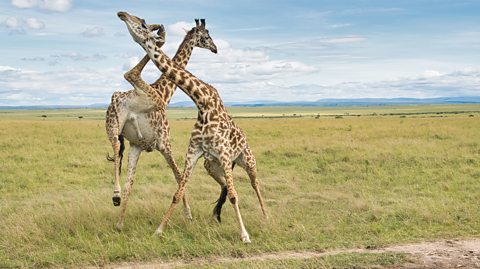
A giraffe's long neck has a number of advantages, they can reach food on trees that fellow animals could only dream of grabbing. It also aids them in combat, as they use their long necks to increase the force of their primary attack move - swinging their head at opponents' bodies.