Anree and Malaya's journey into higher education
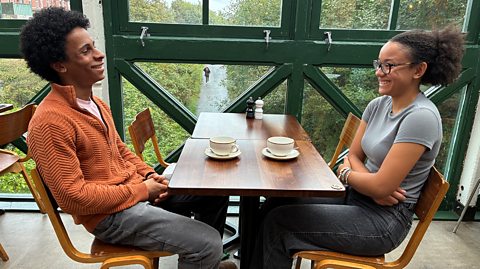
Anree and Malaya, both of whom were home educated, have now successfully moved into higher education.
BBC Bitesize sat down with the pair to discuss their journeys, the transition from home education to higher education, the challenges they faced along the way and what the application process looked like.
Video: The journey from home education to higher education
Anree: For me, I was like I want to do GCSEs for the sole purpose of I will just want to do A-levels. So because of that, it was very much of a really self-guided thing. It was just like, here's a textbook, let's go learn it.
Malaya: So I did something different. It's equivalent to a GCSE, but it's called an ICCE. Which no -
Anree: Yep, I've heard of it.
Malaya: Okay. No one knows it. Like I usually get like a blank stare. So I did that. And it's a follow on from the curriculum, so it didn't really make much of a difference. But in comparison to GCSEs, which is exam based, it's more like coursework based. And like you said as well, self studying GCSEs, like the national curriculum one is so rogue as home education.
Anree: It is!
Malaya: My older brother did it but I would just watch him, like you said, he was just sitting at his desk reading workbooks and for me, I don't know if I could manage that. Like -
Anree: Absolutely.
Malaya: - that wouldn't work for me.
Anree: So it was rough in the exact ways that I expected it to be, because at the time, like I still am, I'm not a very extroverted person. In the sense of like, I lose energy socialising with people, but I love socialising with people, right? And I suddenly went from basically being by myself in my house all the time to being in college, nine to four every single day. So, the thing that really hit was just like the exhaustion and knowing how to pace yourself.
Malaya: Yeah.
Anree: What about you, how was it?
Malaya: Really similar, that's why I was like, yeah! So I think academically, I found that hard because I could work like the workload was fine. The actual like studying was fine, the content, it wasn't unmanageable, but it was more the other factors and the adjustment that just mentally like-
Anree: Yeah.
Malaya: - frazzled me.
Anree: It's so much different than what you're used to. That like you also said, like the lesson length was quite something. I mean, it's the same thing for anything, it's like -
Malaya: Yeah, It's not like it's harder. It's just different.
Anree: To be honest, I found it, like, pretty normal. And I think that's just because, like, everyone around me, like at the time I was in college, everyone around me is basically also doing the exact same thing. And we've got like loads of support from our college careers team, like the Oxbridge team as well, in just terms of what they want, what to put in and how you go about making your choices and so on.
Malaya: You definitely get more support in that environment than you would at home, I think. That made me more comfortable being at sixth form, because I actually felt like at that point I'd become a part of the school. I think the biggest challenge to my home education journey was leaving it. And my biggest challenge there was sort of making a space for myself and making sure that I am heard when I'm talking, and that my teachers sort of understand what I'm asking and just sort of figuring that out and fitting myself back into that system.
Anree: To be honest, it gives you a whole other skill set to work.
Malaya: Yeah, 100%.
Anree: Because you've got, you're now used to being completely autonomous and also being given stuff to work with. The amount of autonomy increases with each stage, but you've kind of done it not not backwards, but you've gone from all autonomy to very little autonomy. It's just this nice middle ground.
Malaya: And I think in terms of getting through it, there's no like system to it. You just do it and it works out. So for me that's what I found, like it's hard and it was challenging and it's something that I look back on and I was like that was quite difficult.
Anree: Yeah.
Malaya: But then you get through it and it's like, okay, but now I'm happy with where I am and I think it worked out.
Where can I read more about home ed and higher education?
Keen to learn more about the move from home education to higher education? Check out our guide on signing your child up for exams. Or, for more subject specific content, be sure to read our guides on how to teach history, geography, science and English at home.
For more general advice, we've got articles on incorporating practical skills into home education, teaching communication skills and empathy, and developing life skills as part of home education.
Where can I find more support for home education and parenting?
The BBC Bitesize home education collection is designed to support you and your child’s learning at home with free resources for early years and foundation stage (EYFS), primary and secondary-age students.
Bitesize Parenting is the go-to place for the whole parenting community to find stories, expert advice and fun activities.
If your child has special educational needs and / or disabilities, be sure to check out the Parenting SEND collection. Bitesize also has a collection of Sensory Stories, an immersive video series that transports you on unique sensory adventures, for children with additional or complex needs.
For more information about home education, these BBC News articles cover the rise in families deciding to educate their children at home and, from 2021, the impact of Covid on home education.
Sign up to the BBC Bitesize newsletter! External Link
For home education news and stories plus updates on the latest Bitesize content, register for our newsletter today.

