Sign up to the BBC Bitesize newsletter! External Link
For home education news and stories plus updates on the latest Bitesize content, register for our newsletter today.

Teaching history can lend itself to a lot of fun at home, whether it’s role plays, re-enactments, immersive stories, gory details, fun TV and social videos, or the simple joy of learning about and understanding the past and how it has shaped our economies, cultures and societies.
Whether you’re a history buff or not, there are many inventive ways you can incorporate it into home learning.
How to teach history
Teaching history incorporates many aspects of learning, including reading and writing skills, critical thinking, use of creative arts and a broader cultural awareness – which can lead to greater empathy towards other people and countries.
It’s also a great way to lean into your child’s interests, whether they love castles, the Romans, or are fascinated by certain famous people from history.
To get going, make sure you have the basics:
- Pens, paper and colouring materials
- Access to the internet
- BBC Bitesize history as a guide to topics by age and educational stage.
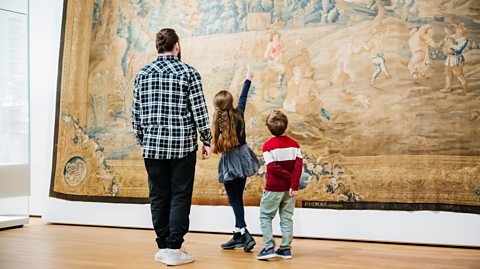
Be curious about history
Next, play detectives and show your child how to be a historian. For example:
- Start with a question or ‘enquiry’, such as ‘Who was Rosa Parks’?
- Read, listen to or watch relevant content to find clues
- Present your findings (‘key points’) by discussing, drawing or writing what you’ve found out
- Think where you can take it next, whether that’s going on a bus to investigate and compare your experiences to Rosa Parks, or delving further into other Astonishing Activists.
“Remember, you don’t need to be an expert – modelling how to solve a problem or find an answer is also a really valuable lesson to teach your child.” – Kate Armstrong
Kate Armstrong, Senior Learning Resources Manager for charity English Heritage, says enquiry questions are: “Challenging, open-ended questions that can guide historical investigation. You’re aiming for questions that are thought-provoking, can stimulate discussion and help children delve deeper into a topic.”
She adds that while you don’t have to be “constrained by traditional teaching approaches” it can help you feel more confident if you plan the learning journey you want to go on in advance, including thinking about, “any key themes and events and gathering any resources needed”.
She continues: “If you have space, consider creating a timeline that you can add to as you learn. This really helps children visualise the past and the sequence of events… Remember, you don’t need to be an expert: modelling how to solve a problem or find an answer is also a really valuable lesson to teach your child.”
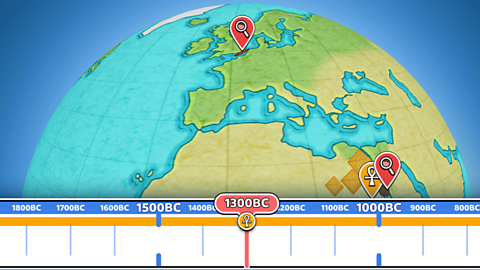
Play History Explorer: Secrets Through Time - an interactive timeline. game
Travel through different periods in history using the interactive timeline and globe, seeing which key events were taking place at the same time across the world.
Three top tips for teaching history to children aged 5-11
With a few good resources and an idea of themes and events you want to investigate, use these creative ways to learn history with your child. “Writing, art, drama, cooking, experiments… these are all great ways to develop understanding,” according to Kate Armstrong.
1. Start local
Kate Armstrong: “Personal connections are a fantastic and often overlooked resource for teaching history at home… Discuss people and places you know. Are there significant events within living memory of family members or friends that tie into the topic or did something significant take place in your local town or area?” You could make your own family tree or use a genealogy website.
Explore local history. Visit your local park and ask questions: ‘Who built it? What was their job? What era are they from? How did they make their money?’
“Many libraries and museums also have online archives or collections and offer virtual tours and online talks,” Kate advises. Compare maps for different periods of time, e.g. 50 years, and discuss how the local area has changed. Or create a timeline of events locally. Kate adds that “[fiction] books set in other periods can also bring history alive”, alongside non-fiction resources.
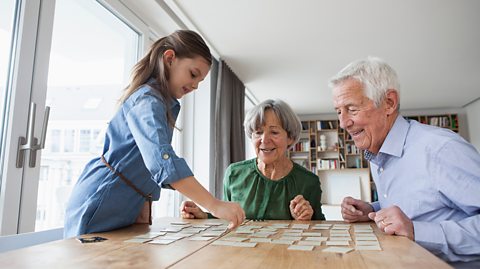
2. Explore similar people
Children enjoy learning about other people like them, so look at childhood through time. Be inventive: recreate a typical day for Florence Nightingale, write a diary from someone onboard HMT Empire Windrush or design a magazine cover for the Victorians.
Kate says: “Children often find it difficult to imagine the past, so it’s worth considering how you can relate it to their lives, things that they know and have experienced. Discuss how things are the same or different. You can also use stories to discuss the sequencing of events.”
She says ask questions such as ‘what did people wear, what did they believe, what did they eat, what did they do with their days and why is it important to tell these histories?’
3. Experience history
Explore historic buildings, monuments and events run by organisations such as National Trust, Historic Houses and Historic Royal Palaces.
A spokesperson from Cadw, which looks after Wales’ historic environment, said you can explore “castles to abbeys, ancient tombs, farms and forts” at their sites and “bring history to life for children of any age”.
Historic Environment Scotland host ‘Spectacular Jousting’ events annually, where your child can learn about medieval tournaments. Andrew James, Learning Manager at Historic Environment Scotland, says they also host regular re-enactment events: “Visitors can wander through the Living History camps boasting experiences from across history, from Picts and Romans to Vikings, Jacobites and First World War soldiers.”
You can look at the National Archives online (or in person). Museums also offer opportunities to uncover many aspects of history whether it’s art history, fashion or historical objects and animals. There’s usually dressing up involved too!
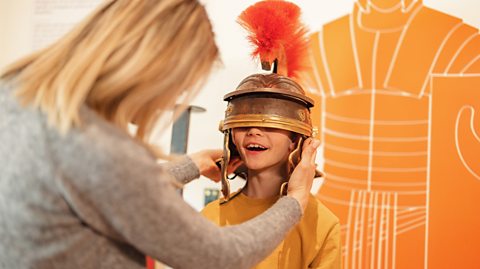
As Kate says: “Learning about the Battle of Hastings around the kitchen table can never offer the same depth of understanding as visiting the actual battlefield, seeing the landscape and even recreating the battle.”
But she adds: “Hands-on history can also be developed at home. For example, by cooking a historic dish, creating a battle re-enactment with toys or even recreating Stonehenge out of bourbon biscuits!”
You could also:
- Make a model castle
- Re-enact what shopping was like 50 years ago
- Create a bookmark or pop-up book
- Design and make a costume from a particular era
- Watch CBBC Newsround and discuss the historical relevance of a particular story
- Play online games or watch Horrible Histories together.
Remember to ask questions and analyse what you’ve seen or learned. You can also tie learning in with events throughout the year, such as VE Day on 8th May and Black History Month in October.
Three top tips for teaching history to children aged 11-18
“History can be found everywhere: in inventions, sport, transport, pets, politics, climate change and so much more…” – Kate Armstrong
When teaching this age group, discuss with your child whether they’ll want to study for a History GCSE or similar further down the line. If so, you may decide to tie their learning in with the curriculum.
Either way, the best way to engage older children with history is through their interests, whether they’re fascinated by science and health or the transatlantic slave trade.
1. Make it matter
Kate Armstrong says: “It’s important to make it relevant. Try to link historical events to current issues or topics they care about, bring in local history or use personal stories so it’s about more than dates. History can be found everywhere: in inventions, sport, transport, pets, politics, climate change and so much more…"
“Active learning through role play and debate can bring history to life, and it also builds empathy and understanding of different perspectives. It’s also important to allow young people the chance to think independently, by encouraging them to do research projects on topics that interest them and present their findings creatively, via video or posters, even through music."
"The skills used in studying the past are infinitely transferrable to modern life, and valuable: having a curious and critical mind, asking questions and seeking further information rather than just necessarily accepting something at face value.”
2. Understand sources
“Connections matter in history: comparing different sources and interpretations to identify cause and effect.” – Kate Armstrong
“Analysing and understanding sources is a vital part of studying history,” according to Kate Armstrong. “When your children are studying sources they should be looking at what it is, who produced it and why, when it was produced, what it tells us and consider whether it’s reliable and overall how credible it is. From this, they can further evolve their knowledge on the subject. Again, you should try to include a range of perspectives to support building a comprehensive and representative picture of the past."
“It's important as well to help your learner understand the context of an event and to analyse why things happened – or indeed didn’t happen! Connections matter in history: comparing different sources and interpretations to identify cause and effect can help to develop critical thinking.”
Popular Bitesize game History Detectives is built around finding and interrogating sources, helping children to build these skills. The game has scenarios in the English Civil Wars, the Tudor era, the Industrial Revolution and the Cuban Missile Crisis.
3. Use music to teach history
Kieran Kincaid is a history teacher in Greenock, Scotland. He says “incorporating music into history learning” can be, “a great tool to help young people connect emotionally with a topic, create a sense of historical atmosphere and reinforce key messages in a memorable way."
“For example, when teaching Migration and Empire… I’ve used ‘Scotland’s Story’ by The Proclaimers to introduce the diverse experiences of immigrants to Scotland. The song gives pupils a narrative and anchor for the content that follows in later lessons."
“When exploring racism and civil rights in the US, ‘Strange Fruit’ by Billie Holiday is an incredibly powerful way to set the tone for discussing lynching in the American South.” Please note, you’ll need to decide if you feel the lyrics of the song are age-appropriate for your child.
Kieran says you can chat about songs’ meanings, or just use music to help create atmosphere during a project: “When studying castles, I’ve played medieval lute music in the background as pupils designed their own castles. During lessons on World War One recruitment, pupils made their own propaganda posters while listening to songs from the era young men might have heard in local dance halls – like ‘I’ll make a man of you’ by Fiona Harrison.”

Where can I read more about teaching history?
BBC Bitesize has a wealth of history resources to support your child’s learning. They can practise their historical skills with games for ages 5-to-7 and games for 7-to-11s, plus History Detectives for older children.
Teenagers can also use the GCSE history podcast for revision and practice, as well as videos and other resources on the Bitesize website.
BBC Bitesize for Teachers has Primary History resources and Secondary History videos. Plus, school radio has some amazing audio resources for bringing history to life for 5-to-11-year-olds.
The rest of the BBC Bitesize website has expert memory hacks and tips for memorising things like key dates and events, and check out jobs that use history on the Bitesize Careers section.
Where can I find more support for home education and parenting?
The BBC Bitesize home education collection is designed to support you and your child’s learning at home with free resources for early years and foundation stage (EYFS), primary and secondary-age students.
Bitesize Parenting is the go-to place for the whole parenting community to find stories, expert advice and fun activities.
If your child has special educational needs and / or disabilities, be sure to check out the Parenting SEND collection. Bitesize also has a collection of Sensory Stories, an immersive video series that transports you on unique sensory adventures, for children with additional or complex needs.
For more information about home education, these BBC News articles cover the rise in families deciding to educate their children at home and, from 2021, the impact of Covid on home education.
