Sign up to the BBC Bitesize newsletter! External Link
For home education news and stories plus updates on the latest Bitesize content, register for our newsletter today.

Creative home education
Learning the creative arts such as art and design, dance, drama and music at home can be fun and enriching for everyone involved.
You can bring the whole family into the process or use it as a way of developing independent learning and other skills like creativity, planning and time management in your child.
Creativity at home: Art and design
There are many art and design projects you can do at home without spending lots of money.
If you’re home educating, you may not be teaching by subject. However, you can incorporate ‘art’ into almost any other form of learning.
For example, you can draw the anatomy of a flower or a bee, which teaches art and science. Or you could design a newspaper or leaflet to tie in with English, computer science and art and design.
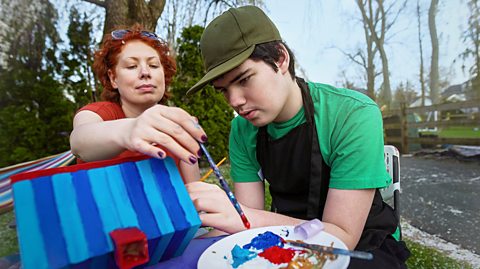
Art activities to do at home
Try some of the following with children aged 5-11:
Make collages using old magazines, newspapers, old bits of paper and card, feathers, buttons, material scraps, etc.
Create a printed picture using old sponges, potatoes, hand prints, wood and other natural objects.
Use online videos for learning how to draw, and different sketching and shading styles.
Draw a colour wheel and then create a landscape painting using, for example, only tertiary colours.
Grab a camera or mobile device with zoom settings, and take close-up pictures of things you find in the house like clothes fabrics, sponges, carpets, toothbrushes, insects and pets!
Create masks or other 3D art.
BBC Bitesize's art and design pages has lots more ideas for kids aged 5-7 and children aged 7-11.
Or visit the Regenerators and help your child to think like a designer.
For children aged around 11-16, you can go a little more into ‘project’ mode.
Give them a brief on something they’re interested in and help them learn how to find inspiration, create a design brief, research an artist or topic and put together a portfolio of work.
With some basic art supplies such as paper, pens and pencils, they can also experiment with things like tone, colour, line, shape and texture, as well as using the internet, or trips to art galleries, to find out more about artists they like.
See more on the BBC Bitesize pages for GCSE Art and Design, Higher Art and Design, and National 5 Art and Design.
How to teach basic music
If you’re nervous about teaching music at home, check out this discussion on how to teach music if you’re not a musician.
If your child is aged four to seven and has Special Educational Needs and Disabilities (SEND) try out these SEND music teaching guides.
According to the Department for Education, music plays a role in brain development “because it helps with the nurturing of language, motor skills, emotional intelligence and collaboration skills.”
Music is something you can incorporate into almost any kind of home learning, and is great for enhancing early literacy.
To get started, try these ten musical activities that can be taught at home.

Music home education resources
If you’re looking for some music home education resources, BBC Bitesize and BBC Teach have lots of ideas.
For younger children:
have a go at Play It!, where they can learn about, and experiment with, making sounds
try Gareth Malone’s tips for teaching singing
clap or tap out names of people you know or groups of nouns such as animals
talk about the music when you’re watching a movie or musical together
combine history and music with these songs about Guy Fawkes
try creating music with reused objects or have a go at making upcycled musical instruments.
For older children, try the following:
write a song or rap together
use free computer software and apps to record and edit music or sounds
listen to and discuss different genres of music, including British pop music.
You may decide to use a music teacher or service if your child wants to learn an instrument. Alternatively, your child could try online tutorials and apps to teach themselves.
Some local authority music services or trusts hire out instruments to home educators at the same rate as schools. It’s best to check services locally to see what’s available.
What is drama?
Drama is the production of plays, including acting skills, stagecraft and theatre techniques.
If you’re home educating, you can choose how and when you incorporate drama and dramatic techniques, but in theory drama can be used to learn about almost any subject…
How to teach drama
If your child is fascinated by history, get them to read about significant people like Elizabeth I and then act out a scene featuring the monarch.
Encourage your child to think about what they’ll say (the script), what space they’ll act in and how they’ll use it, and how they might use their body and their voice to appear like her. Using fancy dress might be the crowning glory!
Bryony, Head of Drama at Haggerston School in East London, suggests that tweens and teens can, “take a scene and write down how they want it to be performed,” and then see if mum / dad / carer / sibling / cousin / friend are able to follow the instructions and act it out.
This could include things like stage directions, eg ‘enter from stage left’, Bryony adds, or thinking of the script and performance, “from the performer, designer and director’s perspective."
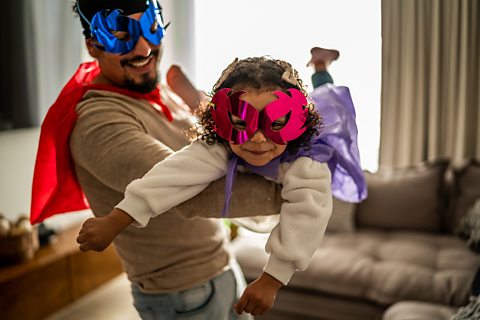
With her Key Stage 3 students, aged 11-14, Bryony discusses current affairs and issues which are important to young people. Together they might then devise a script that looks at the different viewpoints around an issue, so they can “challenge and facilitate conversations” without it being personal.
Bryony elaborates: “Drama is really important at giving people a space to explore stuff and to question and be curious and inquisitive. That’s super important, especially with the little ones, they’re so energetic and enthusiastic… It’s a great tool to understand what’s going on around you.”
Drama resources for children aged 7-11
Learn about history and other subjects like PSHE with these drama activities for children aged seven to 11.
Drama resources for children aged 11-16
Explore the different exam boards for GCSE drama ideas, topics and approaches.
Where can I find more support for home education and parenting?
The BBC Bitesize home education collection is designed to support you and your child’s learning at home with free resources for early years and foundation stage (EYFS), primary and secondary-age students.
Bitesize Parenting is the go-to place for the whole parenting community to find stories, expert advice and fun activities.
If your child has special educational needs and / or disabilities, be sure to check out the Parenting SEND collection. Bitesize also has a collection of Sensory Stories, an immersive video series that transports you on unique sensory adventures, for children with additional or complex needs.
For more information about home education, these BBC News articles cover the rise in families deciding to educate their children at home and, from 2021, the impact of Covid on home education.
