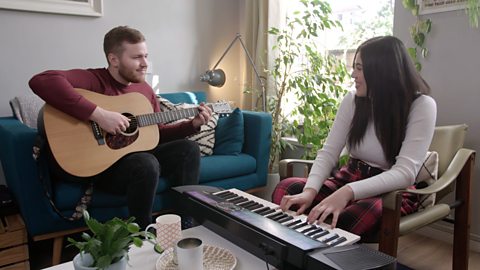
- Find out about rap and its history, including hip-hop, MCs, sound systems and grime.
- Explore rap by artists like C Cane, Stormzy, Kae Tempest and Slowthai.
- Get ideas for making your own rap.
Grime artist C Cane explains some simple steps for how you can get started with rap.
Ben: Thank you for taking the time to see us.
C Cane: Fine.
MUSIC
Ben: How did you get started in music, and more specifically, becoming a rapper?
C Cane: I always wanted to do music. I picked up some instruments, I taught myself through trial and error. I couldn’t really express myself through playing instruments so I started rapping. I was really bad, by the way, really bad. But I had very good friends with me who just kept on encouraging me and here I am.
Ben: Do you perform a particular style of rap?
C Cane: Yeah. I perform the style of rap called ‘grime’. Now, grime is from the UK. Everyone where I live, my friends, family, loved grime so I chose to go in that direction. When I’m rapping, I mix languages like French, Lingala and obviously English. Lingala is the native language in Congo, so I’ll mix all three of those languages at high speeds and that’s what I kind of got known for.
Ben: Can I hear a little bit?
C Cane: Sure. Here’s one that I wrote. It goes like this. RAPS IN MIX OF LINGALA, FRENCH AND ENGLISH.
Ben: Nice.
C Cane: Thank you.
Ben: How do you create the lyrics you use? Like what inspires you to write?
C Cane: So, it could be two things. One being I get instrumentals sent to me. That’s a beat from the producer, the beat maker. And the beat could be happy sounding or sad sounding. So if it’s happy, I talk about something positive, if it’s sad then I’ll talk about something that made me sad. Another one is the experiences that I go through, my friends go through and family go through. So that serves as inspiration for me to write some of my songs. Here’s an example, actually, of a song about two of my friends if… yeah?
Ben: Absolutely, yeah, please.
C Cane:You say it’s best that we just be friends.
It’s best that way so what we have don’t ever come to an end.
I guess I can understand and I should kinda respect your request.
‘Cos it’s for the best.
But that’s easier said than done when I’ve gotta deal with the what, ifs and buts and you see them things start to mess with my head.
I know you feel the same too.
We can’t even sit still, stay away from each other when left alone in the same room and that’s all mad.
This elephant just gets enormous.
Freestyling is improvising with a beat or without a beat. So I’m going to give you a quick demonstration.
Ben: Great.
__BEAT __
C Cane:Look, this is how I do it on the beat, freestyling for BBC.
And if you didn’t know, now you’re gonna know that my name is C CANE.
Now if you wanna start, make sure you practice every day to get far.
I mean it, practice every day and watch how all of you will find your way.
Ben: How do you develop a rap from an initial idea, and what techniques do you use to turn that idea into a whole performance?
C Cane: Well, once I hear the beat, what I do is I’ll hum without lyrics. So I’m just humming on top of the instrumental. I record it on my phone and then I listen back to it and fill in the blanks. So, I’ll give you an example of how I find the rhythm now.
Ben: Awesome.
BEAT
C Cane:Ya-uh, uh uh uh uh…
Uh uh uh uh uh uh uh…
What I would do next is have it on repeat and find words that could fit into that rhythm. After I find words that will fit into the rhythm, I would then draw into my inspiration and make it fit the theme.
You bet, from young I’ve been top set.
Anything I put my heart on, I get.
What I wanna do, I do, no stress.
Ben: Lastly, have you got any tips or advice for someone wanting to get started in rap?
C Cane: The more you practice, the better your lyrics will be and the better your flow would be and you’ll be able to find your unique style. My second piece of advice would be try to listen to as many artists as possible. So let it be rock, let it is jazz, spoken words, poetry; all of this will make your musical knowledge better.
Ben: Thank you so much. It was really great hearing you perform.
C Cane: Thank you.
Rap is a popular form of music.
It can fit over many different types of music.
It usually takes the form of couplets, which are pairs of rhymed words.
Hip-hop is the style most associated with rap. There are many different styles popular in different parts of the world, for example grime and drill in the UK and Afro Trap in France.
The history of rap
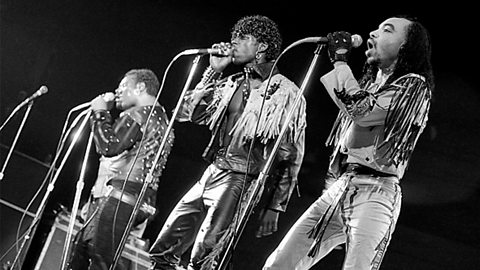
Rap, as it is known today, began in New York. When Jamaican sound system culture arrived there in the late 1970s, it had a history of MCs toasting - speaking over tracks played by the DJ - to entertain the crowd and keep them engaged. From this, a new style of music emerged, known as hip-hop.
Hip-hop gave the world some of the first popular rappers, along with beats made by DJs scratching and cutting together parts of records.
A whole culture was created around hip-hop, with graffiti art and B-boys dancing to the music.
Rappers combined rhymes with beats to make entertaining music for parties. These lyrics would often brag about being the best MC, and rap battles became a way for two MCs to decide who was the crowd’s favourite.
As rap progressed, rappers moved from simple rhymes to more complex lyrical patterns, including poetic techniques like internal rhyming or assonance. Rakim and Big Daddy Kane were some of the first artists to use this more lyrical style, which paved the way for global superstars like Tupac, Biggie Smalls, Nas and Jay-Z.
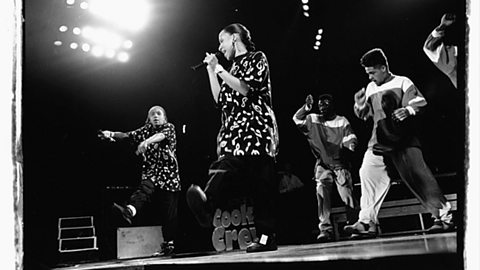
Rap broke through into the UK in the 1970s and 80s. The London Posse and the Cookie Crew were two successful early British rap groups.
Listen to these examples of rap music
Listen to Big for Your Boots by Stormzy. This is a Live Lounge version of his popular grime track.
Listen to Lionmouth Door Knocker by Kae Tempest. She paints a picture of London by describing a housing estate in great detail.
Listen to Doorman by Slowthai. In the UK, home grown styles like grime combine rap with higher tempos, new rhyme patterns and an energetic delivery.
Get started in rap
Choose a theme - it could be about anything, for example where you live, your family, school. Write down lots of words that you associate with your theme, they don't need to rhyme at first.
When you have the words, try to build some rhymes. Rap is often written with couplets that go at the very end of each line. Find some pairs of rhyming words that work well together as you're writing, and aim to keep the lines all the same length.
Project self-confidence – often rappers will write about being the best at what they do.
Work on performing and writing lyrics that get the crowd excited.
Listen to more
Try setting your rap to this remix of The Sound Of Us.
Listen to the electronic mix of The Sound of Us.
Listen to the bass drum track of The Sound of Us.
Keywords
| Keyword | Definition |
|---|---|
| rapping | Reciting words to a beat. |
| MCs | Masters of Ceremonies - another term for people who rap. |
| couplet | A pair of rhyming words. |
| internal rhyme / assonance | Matching the sounds of words within lines as well as at the ends of each line. |
| grime | A type of rap from the UK with high energy, electronic sounds, and new flows and rhyme patterns. |
| sound system | Large outdoor speaker systems which originated in Jamaica and were often run by a group of DJs and MCs. |
| B-boys | Breakdancers - this originated with people who danced to the DJs playing breaks in hip-hop music. (Breaks are the repeated drum breakdowns from existing tracks.) |
Careers advice and tips from BBC Bitesize
Future careers, further studies and the world of work - we're here to help with advice from experts and from young people who've found their path.

More on Composing music
Find out more by working through a topic
- count6 of 8
- count7 of 8
- count8 of 8
- count1 of 8