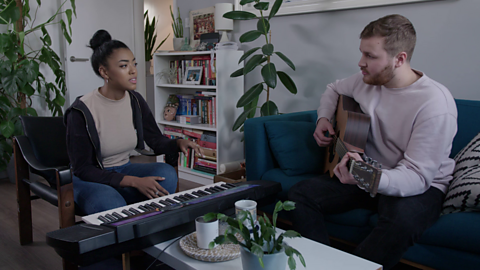
- Learn about different elements of video game music.
- Explore the music of games like Angry Birds, Final Fantasy and Tomb Raider.
- Start making your own video game music.
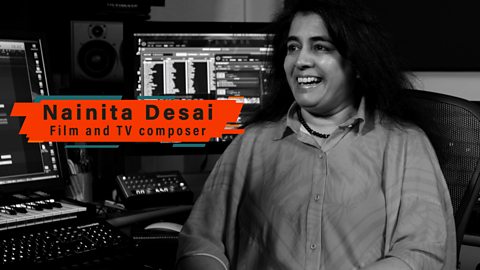
Listen to Ninichi describe how she creates music for video games.
Sarah: Hi, Nanichi.
Ninichi: Hi, Sarah.
Sarah: How is music used in video games?
Ninichi: One way is to use music to set the mood and to set the tone in a game. So, this is an example of a happy, uplifting track that I did for a empire building game where you essentially run a hospital.
UPBEAT HAPPY MUSIC
Ninichi: And so, the general idea is to just make people happy and feel comfortable in this environment. Another example would be this other game where the world has basically ended and so the track here is quite mysterious.
DARK MYSTERIOUS MUSIC
Ninichi: Another way that music is used in games is to help set the scene. So, different games tend to be set in different environments and in different locations, such as a beach…
RELAXED BEACHY MUSIC
Sarah: It’s tropical.
Ninichi: And then this. Actually, why don’t you see if you can figure out what this one is.
Sarah: Okay.
MUSIC WITH BUBBLES
Sarah: It’s definitely somewhere magical.
Ninichi: Yeah. So that one is set in a witches hut. Music is sometimes used to emphasise key moments in a game. Sometimes you may start off with slightly more chilled out music where you’re just exploring and you’re on a general level, trying to win points and so on. But then at another point, you may come across a big, bad boss. In which case, the music will intensify, it will change, it will feel more difficult. There are so many different types of games. For example, role playing games. The music is there usually to support the story, so it’s all about storytelling and character building. So each character may have a different theme. This is a warrior king, so it’s quite strong and fierce.
INTENSE MUSIC
Sarah: Yeah, sounds powerful. How do you get started on a project?
Ninichi: I’ll work with the game developer to try and understand what it is that they really want for their game. What sort of style they have in mind, what sort of mood they want to set. I will also play the game, if they do have any bits that I can play.
Sarah: So, what are some of the tools that you use when you’re composing your music?
Ninichi: Well, the brilliant thing about composing music today is that you can really do it anywhere. So, I use my laptop to create music and then on there, I basically have these different tools that let me score the music, so write it out and then also choose lots of different sounds to pull together to create the tracks with the video games.
Sarah: Have you got any tips or advice for someone who might want to get started in game composition?
Ninichi: I would say try and have fun with it. Grab as many games as you can, play them, enjoy them but also start noticing what the music is like. And then what you can do is play the game without any music and then have a go at creating your own version of the soundtrack.
The video game industry is huge. Many composers make a living as full-time film and video game composers.
There are countless genres of video games and, as a result, many different styles of music to accompany them.
A game can include classical music, pop and rock songs and original compositions and sound effects.
An effective score can often turn a good game into a great one.
Composing music for film and composing music for video games are closely related and share many features:
Themes and leitmotifs
Leitmotifs, or themes, can be used to describe or represent a character through music in a video game.
A theme will often be heard as soon as a game is loaded, and return at key points in the game's story.
Individual characters may have leitmotifs, just like characters in a film.
The characters in the game Undertale, as well as many characters in the Zelda series have very distinct leitmotifs.
Listen to the theme from Bitesize's game, Guardians: Defenders of Mathmatica. What sort of atmosphere do you think it creates?
Incidental music
Incidental music is used to create atmosphere. It can be used to create tension, or add excitement to what is going on on-screen.
Repetition
Imagine a player enters a cave or a spooky house. The composer might write some music especially for this location. It is difficult for the composer to know how long the player will stay in the area. The music will need to loop until the player moves on.
Adaptive music
Adaptive music is unique to video games, and involves creating multiple layers that fade in/out as players move around in a game.
Imagine a player is in a quiet location. The music might just be a simple, repeating melody. As a player moves towards danger, a layer of repeating drums could be added to create tension. When the player encounters enemies, loud brass and string patterns could be added. Technology allows composers to create music that adapts to what is happening in the game.
In this clip, composer Eimear Noone talks about how she creates music for video games.
Listen to these themes from well known video games
Listen to the theme from the game Angry Birds, played by the London Philharmonic Orchestra.
Listen to the theme from the game Tomb Raider. It uses gentle harps and strings to give a sense of exploration.
Write your own video game music
Imagine that you have been asked to write for a game in which a character explores a dark cave. As the character enters the cave, a repeated ostinato is heard.
As the character nears danger, the tension increases. Make a list of musical things that could reflect this increase in tension, such as adding drums or getting louder. Think about the effect that these additions would have.
Listen to this repeated ostinato played on A
Take it further
- Can you recreate this ostinato on an instrument or on music software?
- Can you add another part with some high notes? White notes (A, B, C, D, E, F, G) should work well.
- Can you build the drama by adding notes, playing chords instead of single notes?
Quiz
Revise for your exams with BBC Bitesize
Get ready for the GCSEs with quizzes, past papers, flashcards, podcasts and more resources!

More on Composing music
Find out more by working through a topic
- count8 of 8
- count1 of 8
- count2 of 8
- count3 of 8