- Learn about the building blocks of a song.
- Find out how songs by Elton John, Amy Winehouse and the Beach Boys are put together.
- Start to write your own song.
Watch how Tara and Ben start writing their new song.
Ben: So, where shall we start?
Tara: I have a few ideas for the lyrics but I think it would be good to work out the chords first and then we can add a melody to work over the top and I can fit the lyrics later.
Ben: Okay, let’s come up with our verse and chorus ideas.
Tara: Yeah? Shall we start with the chorus? Have you got any chord progressions you want to try?
Ben: I’ve got three chords.
PLAYS CHORDS
Ben: What do you think?
Tara: I like it. G, C, D. Classic. I think we could add something else though. Maybe another chord at the end.
PLAYS CHORDS
Ben: It’s not quite right. What if I went back to C after the D. That might work.
PLAYS GUITAR
Tara: Nice. Let’s try it together.
PIANO & GUITAR PLAYING
Ben: Sounds great. I think to liven it up, we should try speeding up the tempo a bit.
PIANO & GUITAR PLAY FASTER
Ben: I definitely like it faster.
Tara: Yeah. I have a few vocal melodies I want to try and improvise. Can we try again?
Ben: Sure.
GUITAR PLAYING & TARA HUMMING
Tara: This is the sound of us.
Ben: There’s the title to our song, ‘The Sound of Us.’
Tara: Yeah, it works, doesn’t it?
Ben: It’s going to sound great when we add the rhythm section in. Let’s go one more time from the top and then we can start working on our verse.
GUITAR PLAYING & TARA HUMMING
Songs have been written in many different forms over the course of music history.
Often a song can reflect the emotions of the writer or the character it was composed for.
Songs can also be about a particular time and place and have a historical or political context too.
These are a few of the key components of a song:
- Melody and lyrics which give the song a tune and story.
- Chords or accompanying notes that will play underneath.
- Bass line to drive the song forward.
- Drum beat to add rhythm.
Listen to these examples of lyrics
Listen to the second verse of Elton John's Your Song. The vocals are supported by chords, piano, a bass line and strings. This was one of his first big hits and has been covered by Ellie Goulding and Lady Gaga.
Listen to Tears Dry On Their Own by Amy Winehouse. Her lyrics are combined with chord progressions and melodies from Ain’t No Mountain High Enough. Recreating musical ideas from an existing song in this way is called interpolation.
Listen to Good Vibrations by the Beach Boys. The song has six different sections and features some unusual production for its time. The instruments range from a string quartet to a harp and an electronic instrument called a theremin.
Where do you start?
Here are some questions to get you started writing a song:
- What’s it about? - Will it be personal to you or something completely different?
- What are the lyrics? - Will you write your own or borrow someone else’s? Where will you find some that you can use?
- What’s the style? - What’s the genre? Pop, rap, folk, opera, rock?
- Who’s the singer? - If it’s for you, then make sure it’s not too high or too low for you to sing. If it’s for someone else, play to their strengths or have a go at writing with them.
- Do you need instruments? - Will you have instruments playing live or a backing track produced on a computer?
Structure
Most songs will have a chorus, which is repeated several times with the same lyrics.
In between there are verses – there are usually new lyrics in each verse and they have a different melody to the chorus.
Some songs have a bridge – a section which is a bit different to the rest. It often appears before the final chorus.
Some songs have an instrumental section or solo. The solo could be the same on each performance or it could be improvised.

Writing lyrics
Some musicians write lyrics first and use them to create the melody. Others come up with a tune first and then add words later.
If you're going to write your own lyrics, keep them simple and think about rhymes and syllables.
Improvising your lyrics over the top of a repeated chord progression can help you start to find a melody you like. If you haven’t got any words yet, just make sounds with your voice instead of words, like ‘oohs’ and ‘aahs’. These are called vocalisations and you can later try to make lyrics out of those sounds.
You might want to find a repeated chord progression to play over and over again to get your ideas flowing.
If you are stuck, try using the famous four-chords sequence, on which many popular songs are based.
Listen to this chord sequence of C major, G major, A minor and F major.
What makes a song successful?
One thing that makes a song successful is how memorable and catchy it is.
Catchy tunes tend to have short repeated melodies, such as riffs.
They can be played in the bass line or by other instruments in a group.
Explore the score
In the film above, Tara and Ben are writing a song.
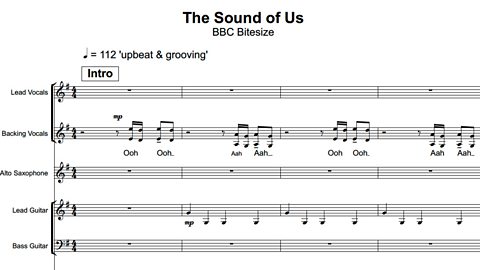
Download the sheet music to see how the final song looks as notation.
The Sound Of Us - Full score. document
Download the sheet music for the band's song The Sound Of Us.
Listen to more
Listen to the band perform their song The Sound Of Us.
This recording just has Tara's vocal part from The Sound Of Us. Listen and focus on the lyrics and melody.
The recording has just the bass line from The Sound Of Us. Hear how it drives the song along.
Keywords
| Keyword | Definition |
|---|---|
| lyrics | The words used in a song. |
| genre | A style or type of music. |
| structure | The overall number of different sections in a song or a piece of music. |
| melody | A sequence of notes that make a tune. |
| instrumental | A section in a song where an instrument or several instruments are featured, usually without singing. |
| outro | The end section of a song, often repeated and fading out. |
| bridge | A section of a song which is a bit different to the rest. It often appears before the final chorus. |
| riff | A short repeated and catchy musical idea. This can be a melody, bass line or a chord progression. |
Revise for your exams with BBC Bitesize
Get ready for the GCSEs with quizzes, past papers, flashcards, podcasts and more resources!

More on Composing music
Find out more by working through a topic
- count2 of 8
- count3 of 8
- count4 of 8
- count5 of 8

