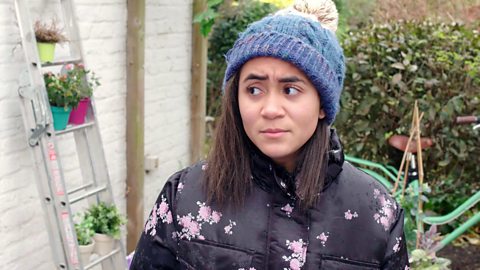
Ivy: Ah Posey, it's great to see you. I've been looking after all my flowers, they've all got light and air and water and nutrients andspace and love and room service and pocket money…
Posey: Aunt Ivy, you've got…
Ivy: …and the roots and the stems and the leaves and the flowers are all present and correct, and nobody has tried to hack them apart.
Posey: Aunt Ivy, your nose is orange.
Ivy: What? Oh how's that happened?
Posey: Have you been sniffing the flowers?
Ivy: Well, obviously, they smell beautiful.
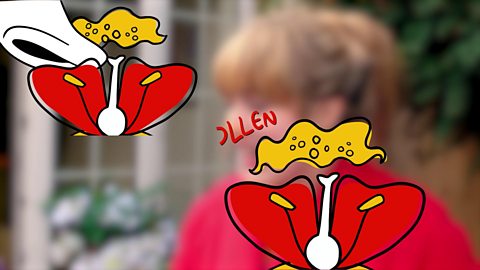
Posey: Well, you've rubbed all the pollen off from the stamen onto your nose.
Ivy: The petals don't rub off on me when I touch them.
Posey: Well, the petals are on the outside of the flower, and they make the plant look attractive to bees and insects, to them, it looks like a perfect runway for them to land on.
Ivy: But the petals are purple, why is my nose orange?
Posey: That's just the pollen on the stamen; there are lots of tiny bits inside the flower, they all have different jobs.
Ivy: Is one of their jobs to make my nose orange?
Posey: Not usually, but the pollen does need to rub off easily, so that insects can take it to other plants. The stamen is made of the anther and the filament. The pollen is on the anther, and the filament supports it.
Ivy: Why do insects want to look orange? You look silly.
Posey: Insects want to drink the nectar at the bottom of the flower, and they have to squeeze past the stamen and the pollen to get there. Nectar is produced and held in the nectaries.
Ivy: The nectarines?
Posey: No, but that is a good way to remember it; the nectar is sweet and juicy.
Ivy: So, what other parts are there in the flower?
Posey: Well, I've already told you about the petals, the stamen and the nectaries, but there's also the carpel, the sepals and the receptacle. The carpel is made of the style, the stigma, and the ovary. And the ovary produces eggs, and protects the baby plant. Aunt Ivy, are you even listening?
Ivy: Of course, I heard every word.
Posey: Well, if you've heard every word, why don't you tell me?
Ivy: So this is what I learned in less than an hour, the carpel's one important part of the flower. There's stigma style and ovary, the insect gets the nectar from the nectary. And what supports the flower while it's feeble? They look like leaves but we call them sepals. And what makes a flower so bright and special? All the pretty colours on all the pretty petals. Another little part is called the stamen, on the top is the anther on the bottom, filament. At the base, the ovary makes the whole spectacle of fruit, which then moves down to the receptacle. Hey Posey you got any questions? Guess not, movin' on, I'm done with this lesson.
Posey When did you learn how to rap?
Ivy: I spend a lot of time, just me and the plants. Someone has to provide the entertainment.
Video summary
This film introduces the anatomy of the flower, including the receptacle, sepals, nectaries, carpel, stigma, style, ovary, stamen and petals.
By describing the functions of each organ in a simple, scientific and entertaining manner, it allows the students to get a full overview of the flower.
This is from the series: Ivy's plant shop.
Teacher Notes
You could get students to draw diagrams of a flower and label each part, including a short description of their function.
This film will be relevant for teaching Science/Biology at Key Stage 1 and Key Stage 2 in England, Wales and Early and 1st and 2nd Level in Scotland.
Also at Foundation, KS1 and KS2 in Northern Ireland.
What do plants need to survive? video
A film looking at what plants need in order to survive.
Parts of a plant. video
A film looking at the various parts of a plant and their functions.
What is pollination and how does it work? video
A film looking at what pollination is and how it works.
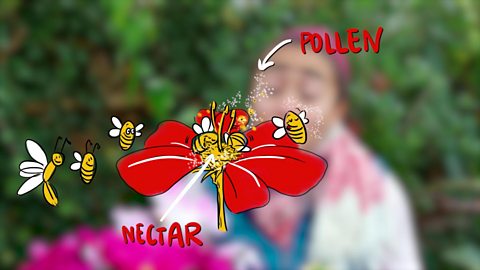
How does water get from the roots to the leaves of a plant? video
A film looking at how water travels through a plant from the roots to the leaves.
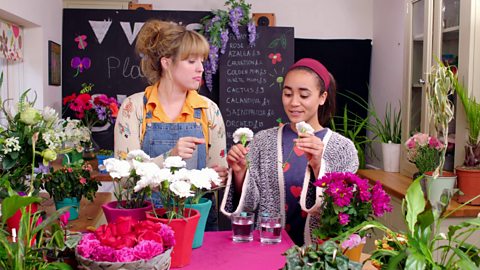
Classifying and grouping plants. video
A film looking at different ways of classifying and grouping plants.
Grouping living things. video
A film looking at different ways of classifying and grouping living things.
The anatomy of the flower. video
A film looking at the various parts and functions of flowers.
The impact deforestation has on plants and nature. video
A film looking at the impact deforestation has on plants and nature.
How can we protect plants and nature? video
A film looking at the ways we can all protect plants and nature.