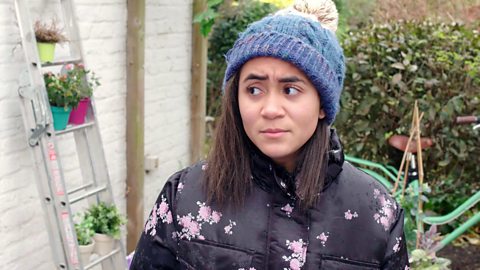
Ivy: Laughs I've got good at sorting my plants, but how do I sort animals? They just run away.
Ash: Well, you only have to look at an animal to know what type it is.
Ivy: What do you mean?
Ash: Imagine all the animals you can.
Ivy: Like a zoo.
Ash: All the animals. Everything in a zoo, and everything outside a zoo. There are millions of species of animal. So imagine a giant ball of everything living. There are three types of living thing, or organism. What are the smallest living things you can think of?
Ivy: Mice. No. Ants. No, baby ants.
Ash: Actually, sometimes you can't see the smallest organisms they're that tiny. The first type of living organism is bacteria. Bacteria are tiny little organisms that are everywhere around us. We can't see them without a microscope because they are so small, but they are in the air, on our skin, in our bodies, in the ground and all throughout nature. Some of them are so small that millions of them would fit on the head of a pin.
Ivy: Why would you want to sit there? Sounds spiky.
Ash: Now, as a florist what do you think the second type of living thing is?
Ivy: Ooh. Monkeys.
Ash: Plants. I expected you to say plants. Plants are organisms that can't move by themselves and produce their own food. Most plants have leaves, stems, roots and either flowers or cones.
Ivy: I realise that! I am a florist you know.
Ash: The third type of organism are animals.
Ivy: Like I said, monkeys.
Ash: There's a little bit more to it than that. Animals can be divided up into two groups. Vertebrates and invertebrates.
Ivy: Look, a slide… Well how can you tell the difference?
Ash: Vertebrates have a spine inside their body. Like you and me.
Ivy: Wahoo, I'm a vertebrate!
Ash: And invertebrates…
Ivy: Booooo
Ash: Invertebrates don't have a spine inside their bodies.
Ivy: What about vertebrates?
Ash: Well you can group vertebrates into five classes. The easiest way of doing this is looking at their features. Reptiles and most fish have scales. Birds have feathers. Amphibians have smooth or bumpy skin and mammals have fur or hair.
Ivy: The lizard's kind of scaly, is that a reptile?
Ash: Yes! They usually lay eggs and are cold blooded.
Ivy: So the eagle must be a bird because of the feathers.
Ash: Birds have two wings and two legs. They're warm blooded and they lay eggs too. And they all have beaks or bills.
Ivy: Well the shark and the frog both have smooth skin.
Ash: The frog is an amphibian. It lives on both land and in water. They're cold blooded, lay eggs and breathe using their lungs.
Ivy: What about sharks?
Ash Well the shark has gills, so technically it's a fish even though its skin is smooth.
Ivy: So the salmon must be a fish too. Because of their scales and the gills!
Ash: Yes! They lay eggs and are cold blooded.
Ivy: Ah, and the tiger must be a mammal because of the fur.
Ash: Mammals give birth to live young and feed them on milk. They're also warm blooded and breathe with their lungs.
Ivy: What's that weird little duck-faced beaver?
Ash: That is a platypus, one of the most confused and confusing animals on Earth. Technically it is a mammal, and has fur and produces milk, but it also has a beak like a bird and lays eggs like a reptile.
Ivy : It wants to be everything! Greedy.
Video summary
In this film students will learn about classification of all living organisms, including animals, bacteria and plants.
It highlights how to identify different classes of animal according to their attributes, using examples of vertebrates and invertebrates, mammals, reptiles, birds, amphibians and fish.
This is from the series: Ivy's plant shop.
Teacher Notes
You could get pupils to complete an activity on grouping other objects based on shared characteristics.
This film will be relevant for teaching Science/Biology at Key Stage 1 and Key Stage 2 in England, Wales and Early and 1st and 2nd Level in Scotland.
Also at Foundation, KS1 and KS2 in Northern Ireland.
What do plants need to survive? video
A film looking at what plants need in order to survive.
The anatomy of the flower. video
A film looking at the various parts and functions of flowers.
Parts of a plant. video
A film looking at the various parts of a plant and their functions.
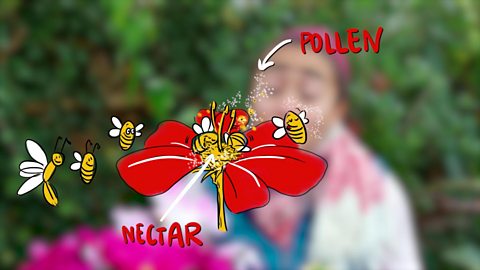
What is pollination and how does it work? video
A film looking at what pollination is and how it works.
Classifying and grouping plants. video
A film looking at different ways of classifying and grouping plants.
Grouping living things. video
A film looking at different ways of classifying and grouping living things.
Are plants the same all year round? video
A film looking at how plants adapt in order to deal with the different seasons of the year.
The impact deforestation has on plants and nature. video
A film looking at the impact deforestation has on plants and nature.
How can we protect plants and nature? video
A film looking at the ways we can all protect plants and nature.