Sign up to the BBC Bitesize newsletter! External Link
For home education news and stories plus updates on the latest Bitesize content, register for our newsletter today.

If you’re home educating your child you may want some ideas for science teaching, even if you’re not intentionally teaching by subject.
Science is a great topic for learning through play and experimentation, and being led by your child’s interests.
Science can be incorporated into home education in so many fun ways, especially when children are aged five to 11.
How to teach science
The best ideas for science teaching will come when you're led by your child’s natural curiosity and through the hands-on approach.
You can also explore jobs that use science with your child and help to find role models your child can relate to.
Here are five suggestions for how to teach science including some basic science experiments and easy science activities to do at home.
1. Talk! And learn together with your child
One of the simplest ideas for science teaching is just to talk to your child. Chat while you’re out and about, read a book or watch a programme together. You don’t need to be an expert!
Head of Education at British Science Association, Maria Rossini, says: “Be curious yourself, and ask your own questions along the way: learn together with your child."
On the National Curriculum in England, four to seven-year-olds learn about animals and humans. If you go to the pets corner in your park, or to your local pet shop, discuss with your child which animals might be mammals, reptiles or other types of animals.
You could follow this up with pictures online or in books, or by drawing a reptile and a mammal yourselves. You could also arrange some of your child’s soft toys and small world animals together by type. If they’re older, try and classify animals as vertebrates or invertebrates.
The story of the Three Little Pigs is a fun way to explore the use and effectiveness of different materials when building a house.
Talk to your child about what materials they think are good for different things, such as building a den, a nest or a house. Go for a walk in your neighbourhood and see how many materials you can spot.
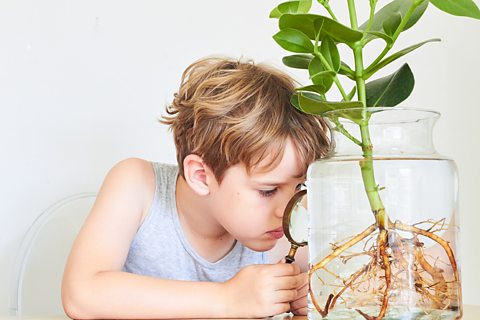
2. Get hands-on with science activities for kids
Maria Rossini says there are lots of easy science activities you can do at home:
Create a music-maker. “Children put different amounts of water in a variety of containers, and tap them to hear the sound they make. They can experiment with how the amounts of water and the types of containers make different sounds and invent their own instrument. They could even compose and perform a tune on their unique invention!”
Make a wormery in a clear jar or bottle. “Learn about how worms live and how they’re essential to the ecosystem.” This activity is especially suited to children aged 5-11 year olds. You could also make your own terrarium.
Be a desert island survivor, perfect for 7-11 year olds. “Harness children’s vivid imaginations and get them thinking about how to take contaminated water and turn it into clean water by creating their own filtering system and monitoring its progress.”
Reinforce these science activities for kids by watching this BBC Bitesize for Teachers video about how fallen leaves are broken down by worms, fungi and slime moulds and taking this BBC Bitesize ecosystems quiz.
3. Use what’s already in your house
You don’t need to go out and buy kit for science experiments if you don’t have the budget. Science education for children covers everyday materials and testing out their uses. With a younger child, play a game where they have to go round the house finding materials that can be squashed, twisted, stretched, etc.
With a slightly older child, grab some materials from the house made of paper, cloth, wood, metal, etc and run some tests on them. Are they magnetic? Do they absorb water? Are they flexible? Can you see through them, known as transparency? What is the volume?
If you’re learning about parts of the human body, sing the song ‘head, shoulders, knees and toes’ with younger children. Using song and rhyme can be fun and effective.
Then get out into the garden or a green space, and make a human skeleton together out of sticks. You can also talk to your child about their teeth while they’re brushing them, and what happens to food in their mouth… perhaps while you’re having dinner together!
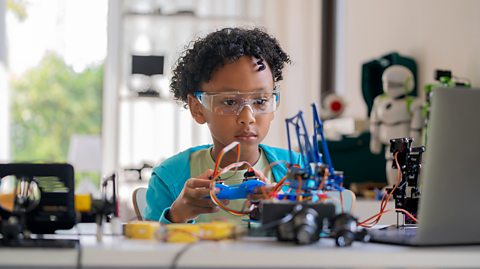
4. Do some basic science experiments together
Here are some fun and easy science experiments that you can do at home, including building your own bottle rocket and making your own rainbow.
BBC Bitesize for Teachers: Experiments in controlled environments
The Royal Institution features at-home science experiments on their website.
The Royal Society of Biology has a series of ‘experiments to try at home’.
Cancer Research UK has science quizzes and activities for kids on their website.
5. Follow your child’s and your own interests
Maria says: “Most children love to learn about how the world works by interacting with it, rather than by reading dry facts.” Remember, you don’t need to be an expert, you’re going on a journey of discovery with your child.
She adds that as long as it’s safe, let your child take the lead as much as possible. Connect it to your child’s interests as well as, “day-to-day life if possible: nature, sport, food, cooking, transport, etc. Even better, connect it to a joint interest that you both enjoy.”
For example, if you’re both into cars, talk about the different ways they are powered and their future sustainability.
If you’re into gaming and interactive quizzes, try these:
If you love being outdoors, try these activities:
Where can I find more support for home education and parenting?
The BBC Bitesize home education collection is designed to support you and your child’s learning at home with free resources for early years and foundation stage (EYFS), primary and secondary-age students.
Bitesize Parenting is the go-to place for the whole parenting community to find stories, expert advice and fun activities.
If your child has special educational needs and / or disabilities, be sure to check out the Parenting SEND collection. Bitesize also has a collection of Sensory Stories, an immersive video series that transports you on unique sensory adventures, for children with additional or complex needs.
For more information about home education, these BBC News articles cover the rise in families deciding to educate their children at home and, from 2021, the impact of Covid on home education.
