What are reptiles?
Most reptiles are covered in dry, scaly skin.
They can be found living in both water and on the land.
There are six species of reptile which live in the UK. They are rare and very shy so spotting them in the wild can be difficult.
Vertebrates
Reptiles are one of the five main groups of vertebrates – animals that have a backbone inside their body.
Watch: What are reptiles?
Find out all about reptiles with the help of Tyler from One Zoo Three and his friend Marion the tortoise in the film below.
Hi I’m Tyler and this is Marion, a Sulcata tortoise.
She has dry, scaly skin making her a reptile just like crocodiles, lizards, turtles and snakes.
The grass snake is the UK’s longest snake and having scaly skin protects it when moving across rough ground.
The adder has brown zigzags running along its skin. They’re also shy and hard to find.
Some reptiles like snakes haven’t got any legs whilst other reptiles like sand lizards have four.
The common lizard, smooth snake and slow worm can also be found living in the UK and reptiles are found living all over the world.
The Komodo dragon is the heaviest lizard on earth. It lives on land.
Reptiles can also live in the water like turtles.
And sometimes both like the green anaconda.
Nearly all reptiles lay eggs.
They also breathe air like we do, so those who live in water must come up for air.
As reptiles are cold-blooded they need to bask in the sun to warm themselves up and be ready for action.
And if you think reptiles look a bit like dinosaurs that’s because dinosaurs were reptiles!
So because Marion is a reptile, that means that she lays eggs, has dry scaly skin, is cold blooded and breathes air.
Oh and there she goes starting to walk off to have a sunbathe and keep warm.
Did you know?
Fossil evidence has been discovered which shows that reptiles have been on Earth for about 315 million years – the longest of any of the vertebrate groups.
It is hard to know exactly how many species of reptile there are today, as new ones are being discovered and named all the time. It is thought though that there are around 10,000 different types of reptile living on Earth today.
A dinosaur fossil
Different types of reptile
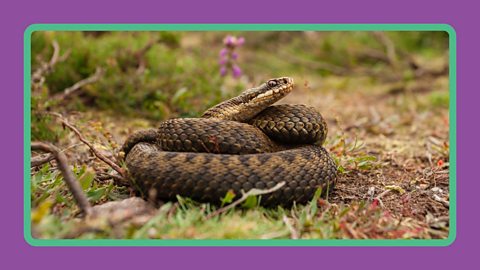
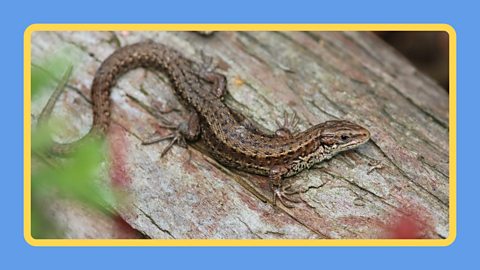
Image caption, Snakes
Snakes are reptiles which do not have limbs. Adders are snakes which can be found living in heathland and moors across Great Britain and Europe.
1 of 4
Did you know?
The shells of a turtle and a tortoise are part of their skeleton, it's just on the outside of its body rather than inside it.
This means that they can't crawl out of it.
When a part of a skeleton is on the outside of an animal's body it is called an exoskeleton.
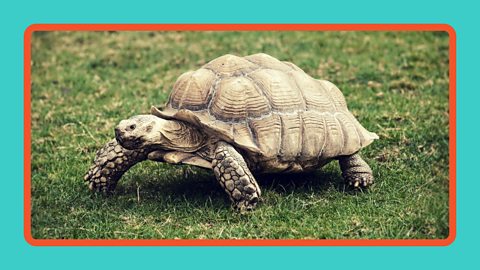
A tortoise
Watch: Reptiles around the world
Reptiles are found on all the continents of the world except Antarctica.
There are four main types of reptiles:
- Lizards and snakes
- Crocodiles and alligators
- Turtles and tortoises
- Tuatara, which are only found in New Zealand
Each reptile has its own distinct features – let's find out about them.
A veiled chameleon
Find out about the reptiles in the UK and others found around the world.
Did you know?
Some species of lizard have a clever trick that they use to stop predators catching them.
They drop their tails and run away!
The predator stops to eat the tail and the lizard can escape and later can grow a new tail to replace the old one.
A lizard
Fascinating facts about reptiles
- Some reptiles live on land, while others like crocodiles spend much of their time in the water.
- All reptiles have lungs and need air to breathe.
- Reptiles are vertebrates, which mean they have a backbone.
- Most reptiles have four legs, but some like snakes or slow worms have no legs at all.
- Most reptiles are covered in dry, scaly skin.
- Reptiles are cold-blooded (or ectothermic) which mean that they cannot control their body temperature.
- Most reptiles lay eggs, but some reptiles such as skinks give birth to live young.
- Most reptiles are carnivores and eat meat.
- Turtles and tortoises are mostly herbivores. Some species of iguana have also evolved to eat plants.
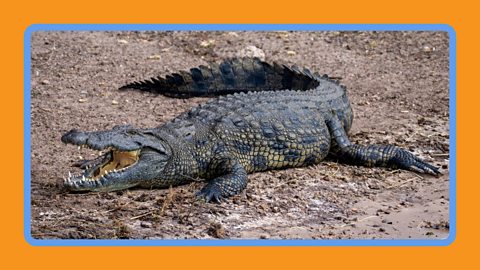
A crocodile
Important words
Carnivores – Animals which eat meat. Most reptiles are carnivores.
Cold-blooded (ectothermic) – Animals which are hotter or colder depending on the temperature around them. All reptiles are cold-blooded.
Exoskeleton – Part of the skeleton which is on the outside of an animal's body. The shell of a tortoise is an example of an exoskeleton.
Herbivores – Animals which only eat plants. Turtles and tortoises are herbivorous reptiles.
Predators – A wild animal that hunts other animals for food. Adders will hunt small mammals, birds, lizards, and amphibians.
Scales – Scales are hard overlapping plates which cover an animal's body. Most reptiles have scales.
Tuatara – A rare reptile, like a lizard, that is found only in New Zealand. Tuataras have existed for millions of years, since the time of the dinosaurs.
Vertebrate – An animal with a backbone. All reptiles are vertebrates.
A snake
Activities
Activity 1 – Find the reptiles
Activity 2 – Take the quiz
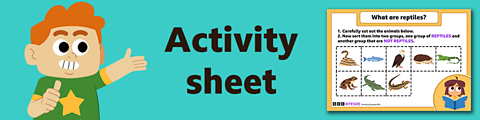
Activity 3 – Sort the reptiles
NEW Creative Lab game - spring update! game
Time to get creative! Creative Lab is an art and design game that lets you paint, draw, build and design. Now with 3D sculpt mode and immersive backgrounds. Use new materials like wood, marble, steel and gold. We've added more brush types: charcoal, felt tip, watercolour and print. Plus spring-themed stickers and templates!

More on Animals including humans
Find out more by working through a topic
- count5 of 12
- count6 of 12
- count7 of 12
- count8 of 12