This investigation shows how a current, when passed through a component, changes as the potential difference changes.
The resulting graph is called the I-V characteristic.
An ohmic conductor is a resistor at constant temperature. You can measure the I-V characteristic of an ohmic conductor by setting up a circuit like this one.
Use the power pack to change the potential difference and then measure the potential difference across the resistor and the current through the circuit. Ohm's Law states that, for an ohmic conductor, the potential difference across a component is proportional to the current through it.
Voltage equals current multiplied by resistance. Therefore, the graph for an ohmic conductor shows that resistance stays the same as current changes.
Other components do not behave in the same way. You can explore this by using the same circuit, but changing the component across which the voltage is measured. So instead of using an ohmic conductor you could use a filament lamp.
With a filament lamp you will see that resistance increases as the current increases. This is because the temperature of the filament increases. Therefore, less current flows per potential difference unit and the graph gets shallower. This sketch graph shows how this looks.
Or if you use a diode the current only flows in one direction. In the other direction, the resistance is very high.
The sketch graph for this investigation looks like this.
Repeat each reading three times to allow you to identify and discount anomalies, before calculating an average potential difference for each current. Use a milliammeter rather than standard ammeter to increase resolution. A milliammeter measures in milliamperes rather than amperes.
Video summary
A demonstration of the key points of the required practical to investigate the I-V characteristics of circuit elements such as a filament lamp, diode and resistor at constant temperature.
This short film reinforces several circuit symbols and also how to setup circuits to measure potential difference across and current through several circuit elements.
It then explores the IV characteristics, as sketch graphs, for three circuit elements.
Teacher Notes
The practical allows development of Apparatus & Techniques Physics 6 & 7 (DfE GCSE subject content guidance, Appendix 4).
This short film could be used before or after students’ own investigations and could be used to describe how to set up the graphs or as an opportunity to revisit.
Showing the IV characteristics as sketch graphs, rather than actual plotted graphs, should help students to recognise and explain the shape of each graph without being distracted by axes and values.
If using as revision, the film could be paused at the stage before each graph is displayed and students could be asked to sketch the graph, or to match the three graphs to the three different components.
Improvements are suggested, importantly, including the explanation of how that would improve the investigation.
Points for discussion:Students often find electricity concepts challenging generally and so familiarity with circuits and how diagrams relate to practice is important.
The graphs produced from students’ own results don’t always look like the theoretical graphs which in itself provides a challenge but it is important that as well as knowing how to investigate I-V characteristics, students can recognise and explain the expected graphs.
The film also focuses on specific improvements, which students often find challenging.
Language of science such as anomaly and resolution are highlighted as part of the discussion around improvements.
Suggested activities:Students should be encouraged to draw circuit diagrams whenever describing any of these investigations.
Familiarity with circuit symbols and the basics of setting up circuits will help students to recall this investigation but also then apply to unfamiliar contexts.
Suitable for teaching physics and combined science at Key Stage 4 and GCSE in England, Wales and Northern Ireland, and at National 4 and 5 in Scotland, and Cambridge IGCSE Physics.
Investigate osmosis in plant tissue. video
A demonstration of the key points of the required practical to investigate osmosis in plant tissue for GCSE biology and combined science.
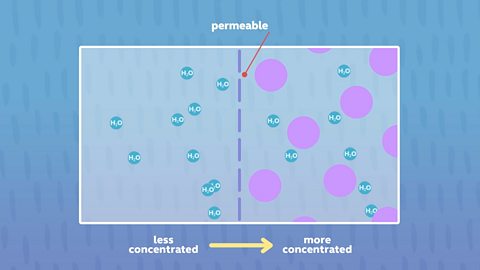
Investigate the effect of pH on enzyme activity. video
A demonstration of the key points of the required practical to investigate the effect of pH on enzyme activity for GCSE biology and combined science.
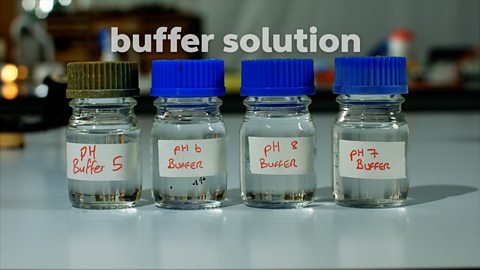
Investigate the effect of light intensity on the rate of photosynthesis. video
A demonstration of the key points of the required practical to investigate the effect of light intensity on the rate of photosynthesis for GCSE biology and combined science.
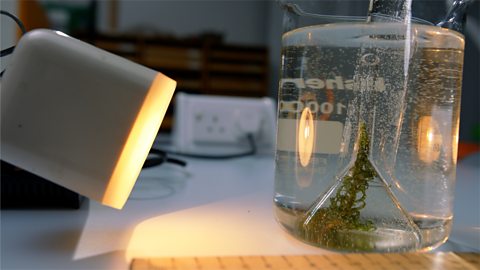
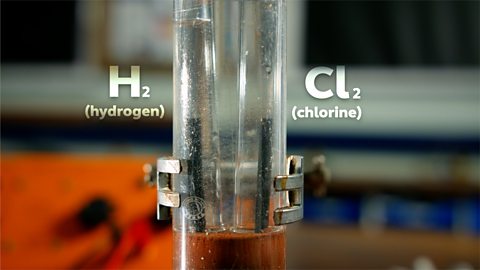
Investigate electrolysis of aqueous solutions using inert electrodes. video
A demonstration of the key points of the required practical to investigate electrolysis of aqueous solutions using inert electrodes for GCSE chemistry and combined science.
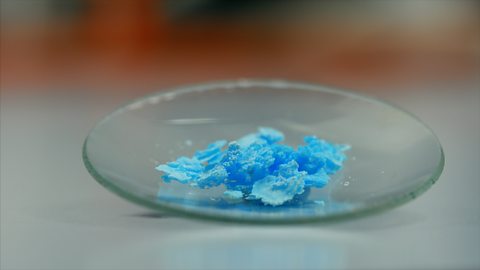
Prepare a pure, dry sample of a soluble salt from an insoluble oxide. video
A demonstration of the key points of the required practical to prepare a pure, dry sample of a soluble salt from an insoluble oxide for GCSE chemistry and combined science.
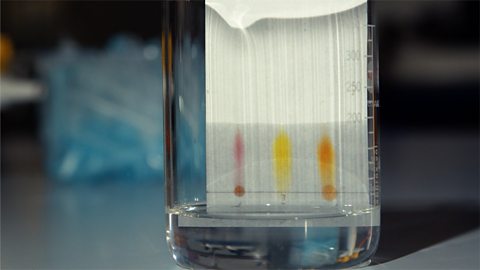
Investigate the separation of substances using paper chromatography video
A demonstration of the key points of the required practical to investigate the separation of substances using paper chromatography for GCSE chemistry and combined science.
Investigate the effect of varying force or mass on the acceleration of an object. video
A demonstration of key points of the required practical to investigate the effect of varying force or mass on the acceleration of an object for GCSE physics and combined science.
Measure the frequency, wavelength and speed of waves in a ripple tank video
A demonstration of the key points of the required practical to measure the frequency, wavelength and speed of waves in a ripple tank for GCSE physics and combined science.