There are three distinct steps when preparing a dry sample of a soluble salt from an insoluble oxide or carbonate and dilute acid: filtration, evaporation, crystallisation.
It's important to understand the purpose of each step. The salt formed depends on the acid used.
In this example we' re preparing copper sulfate crystals from copper oxide using dilute sulfuric acid.
You'll need to wear goggles to protect your eyes.
Start by warming dilute sulfuric acid to 50 degrees Celsius, either in a water bath or over a Bunsen burner. Then add the copper oxide slowly to prevent bubbling over.
Stop adding the copper oxide when it's in excess - in other words when the black powder doesn't disappear anymore. This means there is no remaining sulfuric acid to react.
The next step is filtration - filtering the mixture removes any excess copper oxide. This filtered solution now contains copper sulfate plus water.
We can see a reaction has taken place here because the filtered solution is blue, and not black like the copper oxide. The equation for this reaction is:copper oxide plus sulphuric acid gives copper sulfate plus water.
The starting oxide or carbonate must be insoluble, otherwise you wouldn't be able to filter it from the solution.
Now, you will need to remove some of the water by evaporation in an evaporating basin. This will make the solution more concentrate. Make sure you don't remove all the water this way. If you do, you won't get the crystals you're after. Instead you'll get a powder.
When about half of the water has evaporated, leave the solution to cool more slowly. This is when the crystals will form.
You could finish drying the crystals using a drying oven or paper towels, but to prevent burning you will need to leave the evaporating basin to cool before moving it.
Safety is important, and remember, if you're asked a question about safety precautions, you must give specific instructions and explain the reasons behind the precautions.
Like wearing goggles to protect eyes from spitting chemicals, or leaving the evaporating dish to cool to avoid burning your hands.
Video summary
A demonstration of the key points of the required practical to prepare a pure, dry sample of a soluble salt from an insoluble oxide for GCSE chemistry and combined science.
This short film uses the example of the extraction of copper sulfate crystals from copper oxide and dilute sulfuric acid. It highlights the three distinct steps in the method, explaining the purpose and specific safety precautions needed at each step.
Teacher Notes
The practical allows development of Apparatus & Techniques Chemistry 2, 4 and 6 (DfE GCSE subject content guidance, Appendix 4).
This short film could be used before or after students carry out their own practical to prepare a dry soluble salt from an insoluble oxide or carbonate.
If used beforehand, the film could reinforce some of the science theory behind separating mixtures.
If used after the practical has been carried out, it could be used to revisit and reinforce the three distinct steps and the purpose of each step.
The film also allows a focus on the specific safety precautions needed at each step, highlighting the need to explain the purpose of any safety precaution.
Points for discussion:Students sometimes struggle to recognise or recall the distinct steps used in preparing a dry, soluble salt from an insoluble oxide or carbonate using dilute acid.
This film separates, describes and explains each of three steps that are always required in the process.
If they can identify and explain each of these steps for their own practical, students should then be able to apply the learning to preparing other salts, using different reactant oxide or carbonate and different dilute acid.
Students also often find it challenging to identify specific safety precautions. This film highlights the safety precautions needed at each step and stresses the purpose of each precaution.
Suggested activities:
Students should practise writing equations to show how a variety of soluble salts can be prepared from different reactants (insoluble oxides or carbonates and dilute acids).
If possible, allow students to carry out the process to produce more than one salt to reinforce the fact that the same three steps are required each time.
Suitable for teaching chemistry and combined science at Key Stage 4 and GCSE in England, Wales and Northern Ireland, and at National 4 and 5 in Scotland.
Investigate osmosis in plant tissue. video
A demonstration of the key points of the required practical to investigate osmosis in plant tissue for GCSE biology and combined science.
Investigate the effect of pH on enzyme activity. video
A demonstration of the key points of the required practical to investigate the effect of pH on enzyme activity for GCSE biology and combined science.
Investigate the effect of light intensity on the rate of photosynthesis. video
A demonstration of the key points of the required practical to investigate the effect of light intensity on the rate of photosynthesis for GCSE biology and combined science.
Investigate electrolysis of aqueous solutions using inert electrodes. video
A demonstration of the key points of the required practical to investigate electrolysis of aqueous solutions using inert electrodes for GCSE chemistry and combined science.
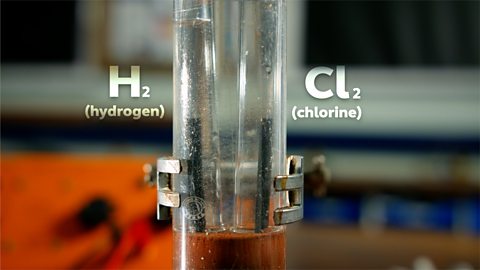
Investigate the separation of substances using paper chromatography video
A demonstration of the key points of the required practical to investigate the separation of substances using paper chromatography for GCSE chemistry and combined science.
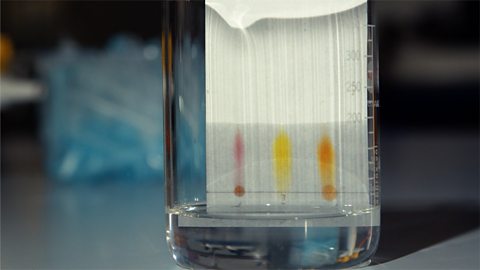
Investigate the I–V characteristics of circuit elements such as a filament lamp, diode and resistor at constant temperature. video
A demonstration of the key points of the required practical to investigate the I-V characteristics of circuit elements such as a filament lamp, diode and resistor at constant temperature.
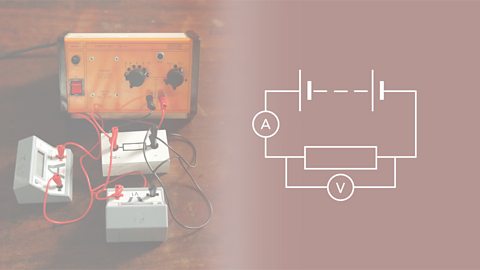
Investigate the effect of varying force or mass on the acceleration of an object. video
A demonstration of key points of the required practical to investigate the effect of varying force or mass on the acceleration of an object for GCSE physics and combined science.
Measure the frequency, wavelength and speed of waves in a ripple tank video
A demonstration of the key points of the required practical to measure the frequency, wavelength and speed of waves in a ripple tank for GCSE physics and combined science.